What is the College GPA Calculator?
This calculator computes your grade point average (GPA) on a standard 4.0 scale by combining the grade points you earned in each course with the number of credit hours that course was worth. Because higher-credit courses weigh more heavily, this is called a credit-weighted GPA — the same method most US colleges and universities use.
How to use it
For each course, enter the grade points (A = 4.0, A- = 3.7, B+ = 3.3, B = 3.0, and so on) and the number of credit hours. Leave a row's credits blank or 0 to skip it. The calculator multiplies grade points by credits for every course, sums those products, and divides by the total credits.
The formula explained
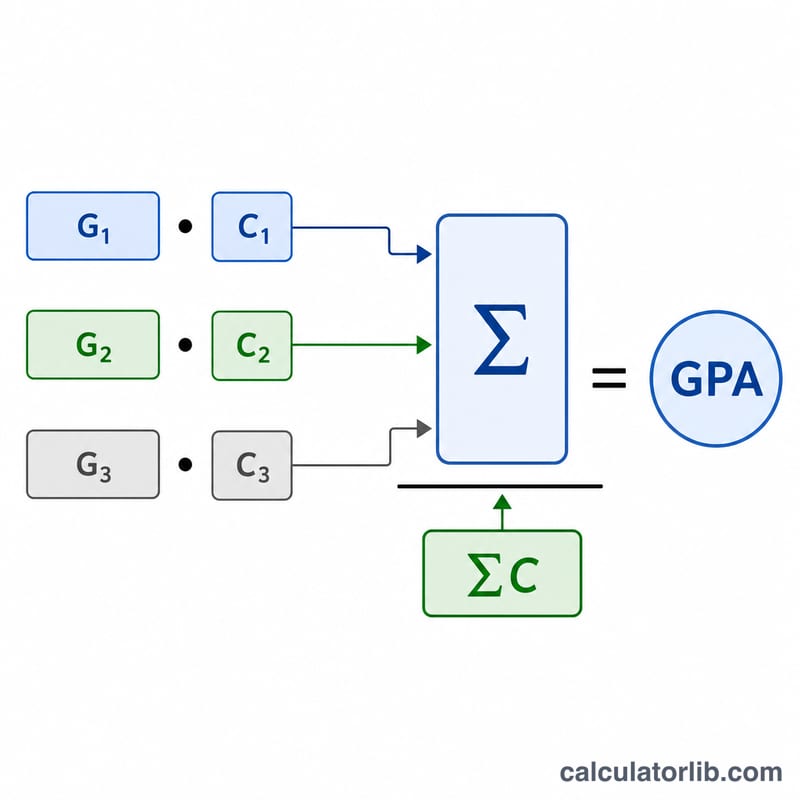
The GPA equation is:
$$\text{GPA} = \frac{\displaystyle\sum_{i=1}^{5} g_i \cdot c_i}{\displaystyle\sum_{i=1}^{5} c_i} = \frac{g_1\,c_1 + g_2\,c_2 + g_3\,c_3 + g_4\,c_4 + g_5\,c_5}{c_1 + c_2 + c_3 + c_4 + c_5}$$
The numerator is your total quality points; the denominator is the total credit hours attempted. The ratio is your weighted average grade.
Worked example
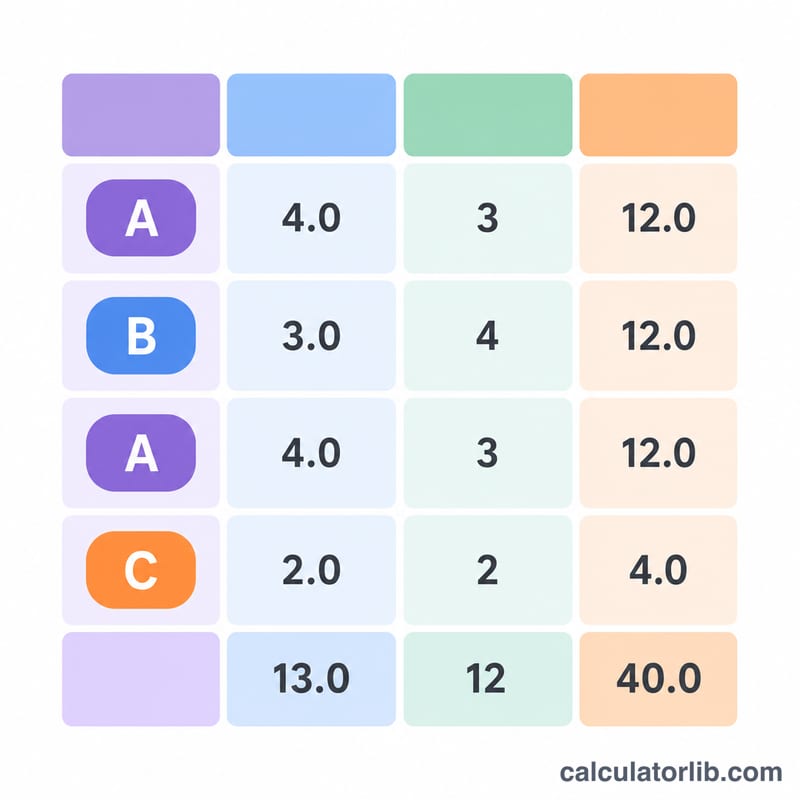
Suppose you took three courses: a 2-credit A (4.0), a 2-credit B (3.0), and a 2-credit A (4.0). Quality points = \((4.0\times2) + (3.0\times2) + (4.0\times2) = 8 + 6 + 8 = 22\)? No — for a true mixed example: $$4.0\times2 + 3.5\times2 + 3.0\times2 = 8 + 7 + 6 = 21$$ over 6 credits = 3.5 GPA.
Letter Grade to 4.0 Grade Point Conversion Table
This table shows the standard plus/minus 4.0 scale used by many colleges in the United States. The percentage ranges are typical examples only. Each school or instructor sets its own cutoffs, so check your syllabus or registrar's grading policy.
| Letter grade | Grade points | Typical percentage range |
|---|---|---|
| A | 4.0 | 93–100% |
| A- | 3.7 | 90–92% |
| B+ | 3.3 | 87–89% |
| B | 3.0 | 83–86% |
| B- | 2.7 | 80–82% |
| C+ | 2.3 | 77–79% |
| C | 2.0 | 73–76% |
| C- | 1.7 | 70–72% |
| D+ | 1.3 | 67–69% |
| D | 1.0 | 63–66% |
| D- | 0.7 | 60–62% |
| F | 0.0 | Below 60% |
Schools vary. Some institutions award A+ = 4.3, though many cap the scale at 4.0 so that A+ and A both count as 4.0. Other schools do not use plus/minus grades at all, so A, B, C, D and F are worth 4.0, 3.0, 2.0, 1.0 and 0.0. Enter the grade points your own school assigns in the calculator.
Interpreting Your GPA
These bands are approximate and follow the common US 4.0 scale. Your institution's policies take precedence.
| GPA band | Approximate average letter grade |
|---|---|
| 3.7–4.0 | A range (A- to A) |
| 3.0–3.69 | B range (roughly B to A-) |
| 2.0–2.99 | C range (roughly C to B-) |
| Below 2.0 | Below C average; usually under the common good-standing threshold |
Academic standing: A cumulative GPA of 2.0 is a common minimum for good academic standing at many US colleges. Falling below it can trigger academic warning or probation, depending on the school.
Latin honors: Many institutions award cum laude, magna cum laude and summa cum laude at graduation. These cutoffs differ by institution. Some schools set fixed GPA thresholds, while others use a percentage of the graduating class. Latin honors may also be set separately by college or department. Check your school's catalog for the exact requirements.
How Credit Hours Change the Same Grades
GPA is credit-weighted, so a grade in a course with more credit hours moves your GPA more. The two scenarios below use the same two grades, an A (4.0) and a C (2.0), but swap which course carries more credits. Quality points = grade points × credit hours.
| Scenario | Quality points | Total credits | GPA |
|---|---|---|---|
| A in 1 credit, C in 4 credits | 4.0 × 1 + 2.0 × 4 = 12 | 5 | 2.4 |
| A in 4 credits, C in 1 credit | 4.0 × 4 + 2.0 × 1 = 18 | 5 | 3.6 |
First scenario: \(\text{GPA} = \frac{12}{5} = 2.4\). Second scenario: \(\text{GPA} = \frac{18}{5} = 3.6\). The grades are identical, but the GPA differs by 1.2 points because of how the credit hours are distributed. A simple average of 4.0 and 2.0 would give 3.0 and ignore credit weighting.
FAQ
Does credit weighting matter? Yes. A poor grade in a high-credit course pulls your GPA down more than the same grade in a low-credit course.
What about A+ grades? Many schools cap A at 4.0; some allow 4.3. Enter whatever value your institution uses.
Can I include more than five courses? This tool supports five rows; for a full semester, group or add courses across multiple calculations using cumulative totals.