
What Is a Grade Curve?
A grade curve adjusts raw exam scores so that results better reflect overall class performance — useful when a test turns out harder than expected. This calculator supports the two most common classroom methods: a flat add (linear bump) and a proportional scaling approach.
How to Use It
Enter your raw score, the highest score earned in the class, and the maximum possible points on the assignment. Choose a method and the calculator returns your curved score, your new percentage, and how many points the curve added. The result is capped at the maximum possible points so no score exceeds 100% of the exam.
The Formulas Explained
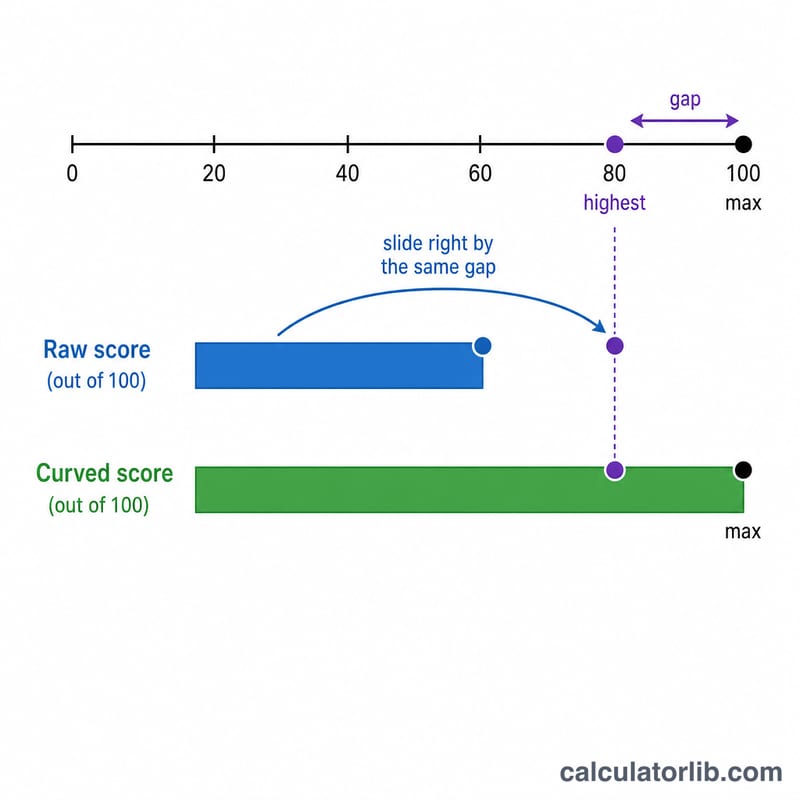
The flat add method finds the gap between the maximum points and the top student's score, then adds that same number to everyone: $$\text{Curved} = \text{Raw Score} + \left(\text{Max Points} - \text{Highest Score}\right)$$ The top scorer ends up at the maximum and everyone moves up by the same amount.
The scaling method stretches scores proportionally: $$\text{Curved} = \text{Raw Score} \times \dfrac{\text{Max Points}}{\text{Highest Score}}$$ Lower scores gain more points than in the flat method, and the curve grows with how far you are from the top.
Worked Example
Suppose you scored 78, the class high was 92, and the test was out of 100. Flat add: $$78 + (100 - 92) = 86$$ Scaling: $$78 \times (100 \div 92) \approx 84.78$$ Either way your raw 78% improves meaningfully.
FAQ
Which method is more generous to low scorers? The scaling method usually gives a larger boost to lower scores because the multiplier applies to the whole score.
Can the curved score exceed 100? No — this calculator caps the curved result at the maximum possible points.
What if no one scored near the max? Both methods will produce a large boost; the flat add adds a fixed amount, while scaling magnifies the gap proportionally.