
What Is Crop Factor?
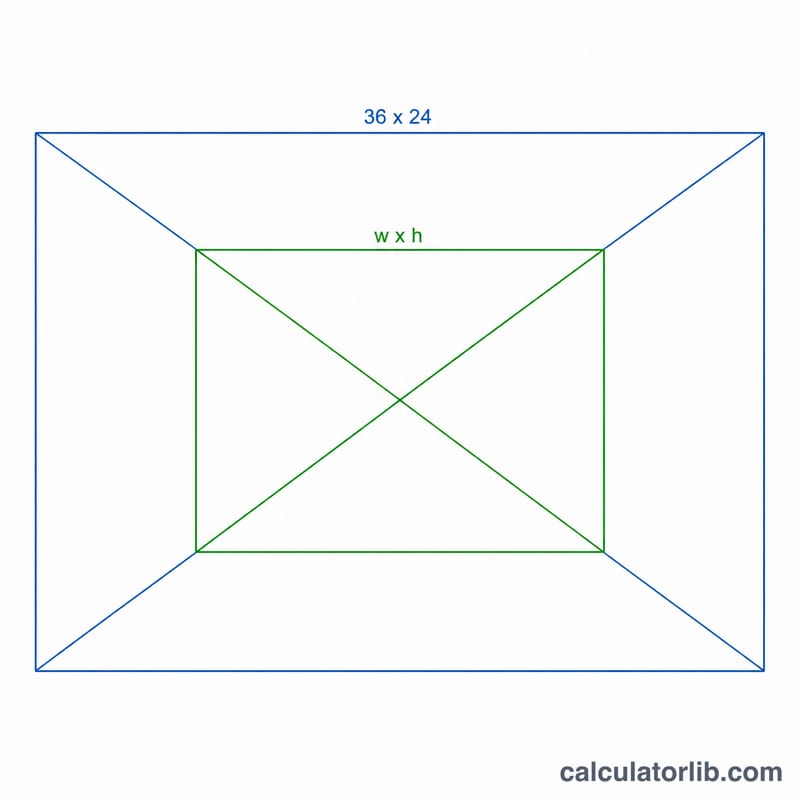
Crop factor describes how much smaller a camera's image sensor is compared to a 35mm full-frame sensor (36 × 24 mm). A smaller sensor "crops" the field of view of any lens, making the image appear more zoomed in. The crop factor is the ratio of the full-frame diagonal to the sensor's diagonal, and it lets you compare lenses across different camera systems on equal footing.
How to Use This Calculator
Enter your sensor's width and height in millimetres, plus the actual focal length printed on your lens. The calculator returns the crop factor and the 35mm-equivalent focal length — the focal length a full-frame camera would need to capture the same field of view.
The Formula Explained
The full-frame diagonal is \(\sqrt{36^2 + 24^2} \approx 43.267\) mm. The sensor diagonal is \(\sqrt{\text{width}^2 + \text{height}^2}\). Dividing the full-frame diagonal by the sensor diagonal gives the crop factor. Multiplying that by your lens focal length gives the equivalent focal length.
$$\text{Crop Factor} = \frac{\sqrt{36^2 + 24^2}}{\sqrt{\text{W}^2 + \text{H}^2}}, \qquad f_{eq} = \text{Focal (mm)} \times \text{Crop Factor}$$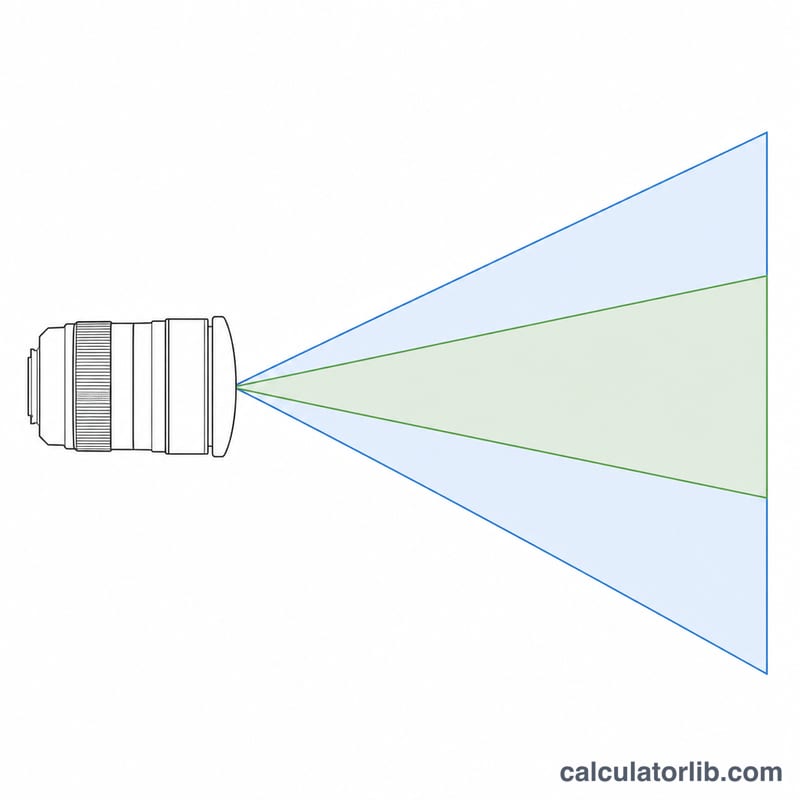
Worked Example
For a Sony APS-C sensor of 23.6 × 15.7 mm with a 50mm lens: the sensor diagonal is $$\sqrt{23.6^2 + 15.7^2} = \sqrt{556.96 + 246.49} = \sqrt{803.45} \approx 28.345 \text{ mm}.$$ Crop factor $$= 43.267 / 28.345 \approx 1.526.$$ Equivalent focal length $$= 50 \times 1.526 \approx 76.32 \text{ mm}.$$
FAQ
Does crop factor change my lens's actual focal length? No. A 50mm lens is always 50mm. Crop factor only describes the field of view relative to full frame.
What is the crop factor of a typical APS-C camera? Around 1.5× for Nikon/Sony and 1.6× for Canon APS-C, and 2× for Micro Four Thirds.
Does crop factor affect aperture or depth of field? The marked aperture (f-number) is unchanged, but for the same field of view and framing, a smaller sensor yields greater depth of field.