
What Is Hyperfocal Distance?
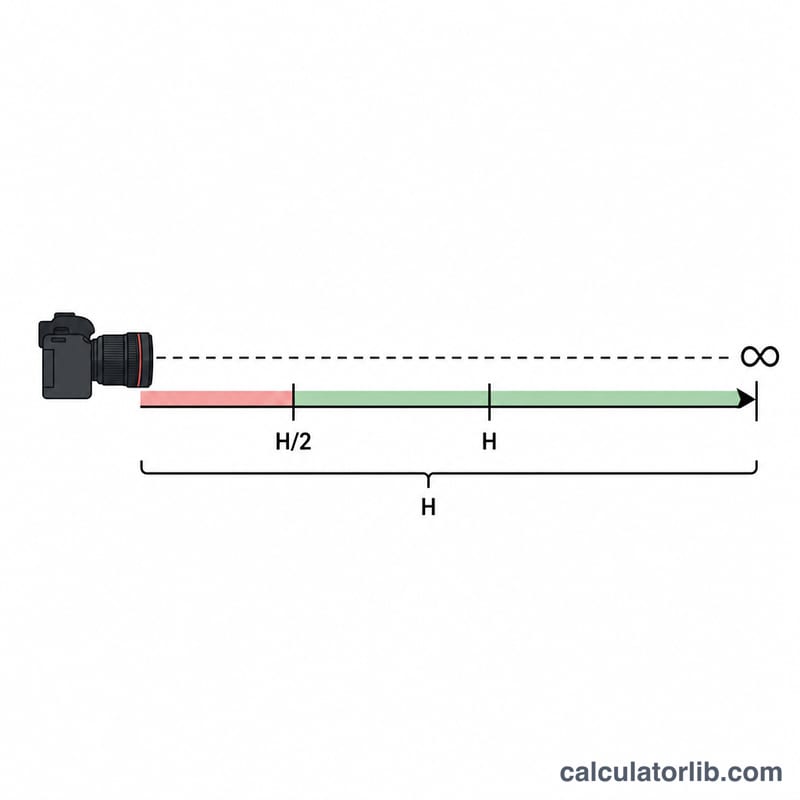
The hyperfocal distance is the closest focusing distance at which a lens keeps objects from that distance all the way to infinity acceptably sharp. Focusing at the hyperfocal distance gives you the maximum possible depth of field for a given focal length and aperture, which is why landscape and architecture photographers rely on it constantly.
How to Use This Calculator
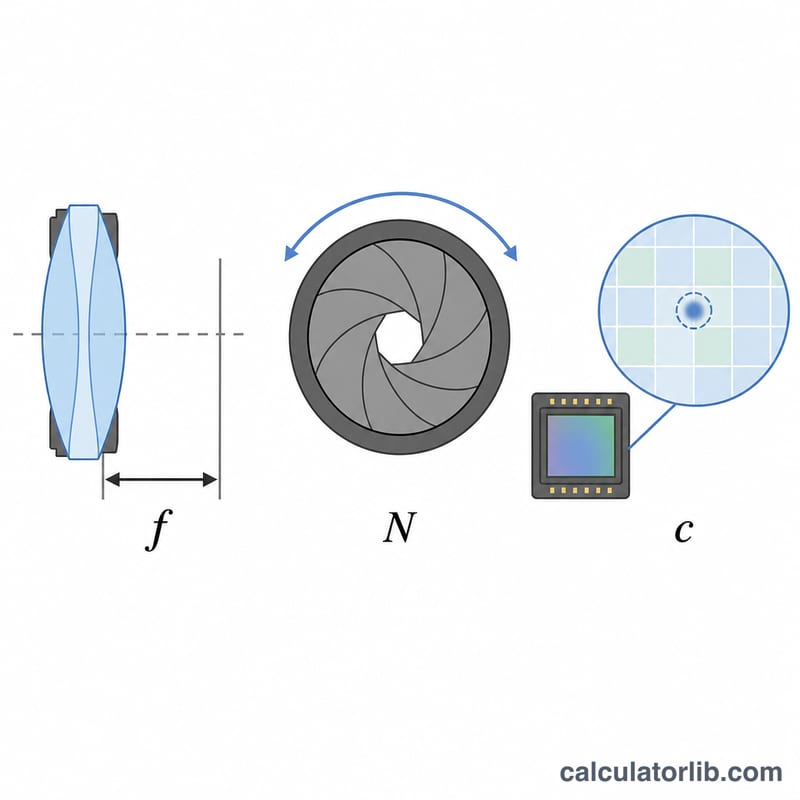
Enter three values: your lens focal length in millimeters, your aperture as an f-number (e.g. 8 for f/8), and the circle of confusion in millimeters. The circle of confusion depends on your sensor size — common values are 0.03 mm for full-frame, 0.02 mm for APS-C, and 0.015 mm for Micro Four Thirds. The calculator returns the hyperfocal distance in meters and millimeters, plus the near focus limit.
The Formula Explained
The hyperfocal distance is computed as:
$$H = \frac{\text{Focal Length}^{2}}{\text{Aperture} \times \text{CoC}} + \text{Focal Length}$$
where f is focal length, N is the aperture f-number, and c is the circle of confusion. Larger focal lengths and wider apertures (smaller f-numbers) push the hyperfocal distance farther away, while stopping down brings it closer.
Worked Example
For a 50 mm lens at f/8 on a full-frame camera (c = 0.03 mm):
$$H = \frac{50^{2}}{8 \times 0.03} + 50 = \frac{2500}{0.24} + 50 = 10416.67 + 50 = 10466.67 \text{ mm} \approx 10.47 \text{ m}$$ Focusing here keeps everything from about 5.23 m to infinity sharp.
FAQ
What circle of confusion should I use? Use 0.03 mm for full-frame, 0.02 mm for APS-C, and 0.015 mm for Micro Four Thirds as good defaults.
Where should I focus? Set focus exactly at the hyperfocal distance; everything from half that distance to infinity will appear sharp.
Does aperture matter most? Both aperture and focal length strongly affect the result. Stopping down (higher f-number) and using shorter focal lengths reduce the hyperfocal distance and increase usable depth of field.