
What this calculator does
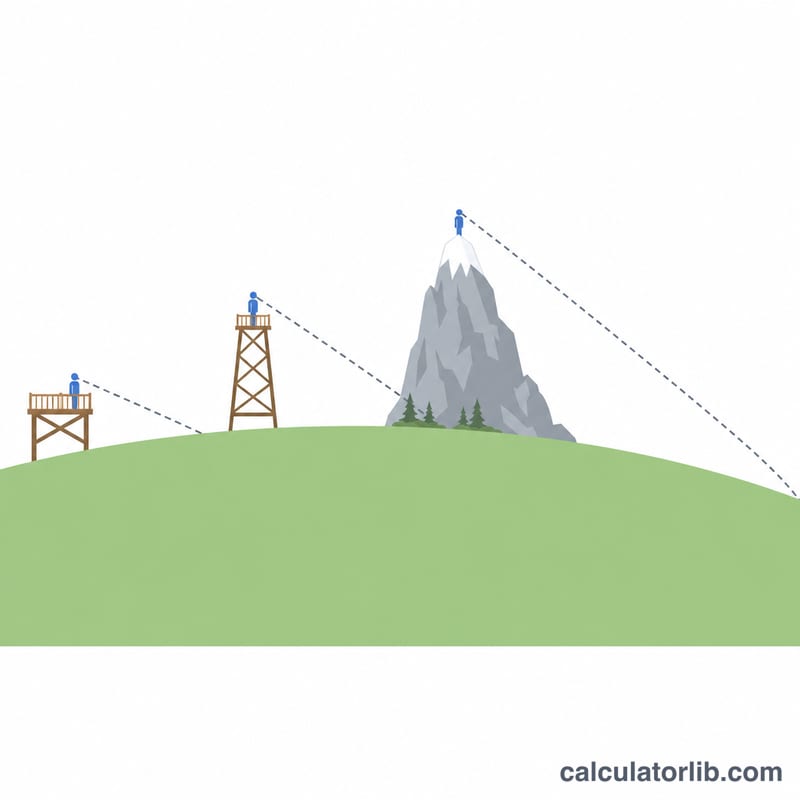
This tool tells you how far you can see to the horizon from an elevated viewpoint, such as an observation deck, a tower, or a mountain summit, and how large an area of ground that view covers. It assumes a smooth spherical Earth with no obstacles and applies a standard 6% atmospheric-refraction allowance so you see slightly farther than pure geometry would predict.
How to use it
Pick a famous viewpoint from the preset list to auto-fill its height, or simply type your own observation height in meters. The Earth radius defaults to 6378.137 km (the WGS84 equatorial radius) and rarely needs changing. The calculator returns the line-of-sight distance to the horizon in kilometers and the visible circular ground area in square kilometers.
The formula explained
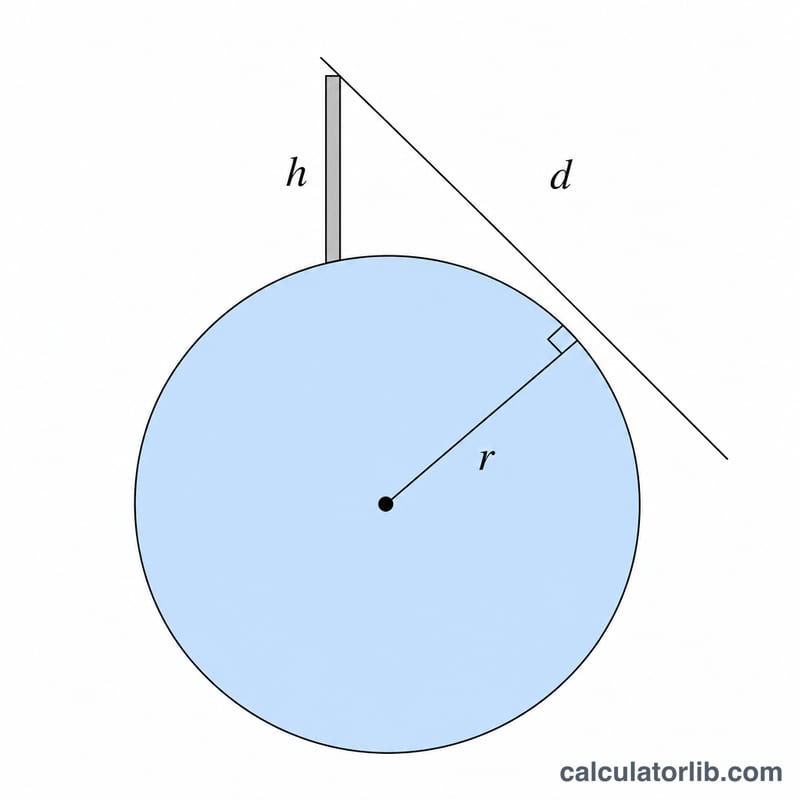
For an eye at height \(h\) above a sphere of radius \(r\), the straight tangent distance to the horizon is \(\sqrt{h^{2} + 2rh}\). Both \(h\) and \(r\) must be in the same unit, so height in meters is divided by 1000 to convert to km. Multiplying by 1.06 accounts for atmospheric refraction (you see about 6% farther). The visible region is a circle of radius \(d\), so its area is $$A = \pi d^{2}.$$
Worked example
From the Tokyo Skytree Tembo Galleria at \(h = 450\) m: \(h = 0.45\) km, so $$\sqrt{0.45^{2} + 2\times 6378.137\times 0.45} = \sqrt{5740.53} = 75.77 \text{ km}.$$ With refraction, $$d = 1.06 \times 75.77 = 80.31 \text{ km}.$$ The visible area is $$A = \pi \times 80.31^{2} \approx 20{,}260 \text{ km}^{2}.$$
FAQ
Why is the result an idealized maximum? It assumes flat, obstacle-free surroundings. Real buildings, hills and haze reduce the actual range.
Why include a 6% factor? Air bends light slightly downward, extending the visible range. 6% is a typical average-atmosphere value; actual refraction varies with temperature gradients.
Can I change the Earth radius? Yes, but 6378.137 km is a sound default. The result scales gently with \(r\).