
What Is the 2D Distance Calculator?
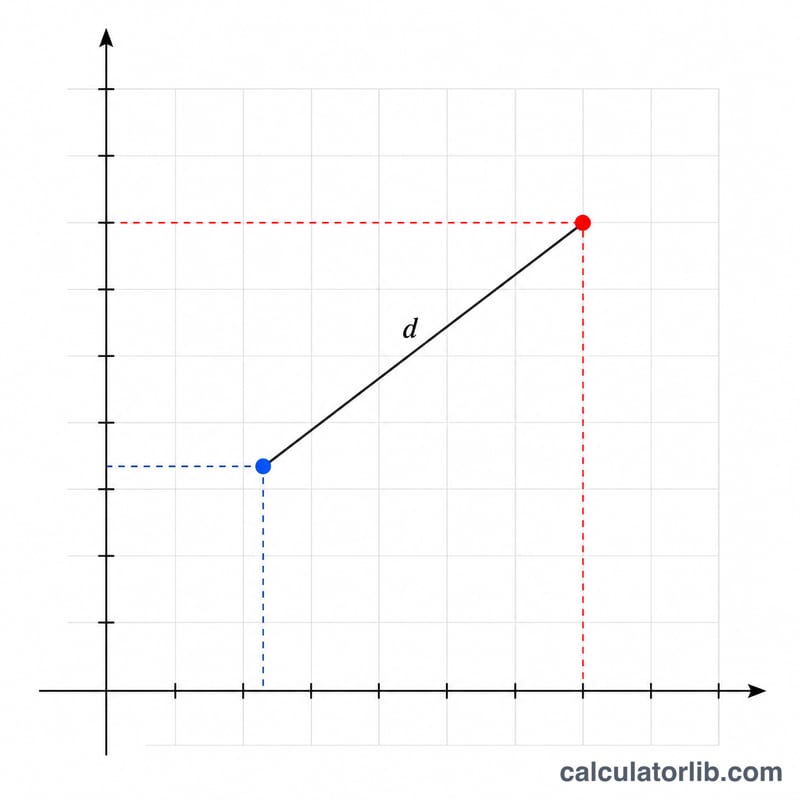
The 2D Distance Calculator finds the straight-line (Euclidean) distance between two points on a flat coordinate plane. Given the coordinates of point one (x₁, y₁) and point two (x₂, y₂), it returns the shortest distance between them — the length of the straight segment connecting the two points. This works for any units (pixels, meters, miles) as long as both points share the same scale.
How to Use It
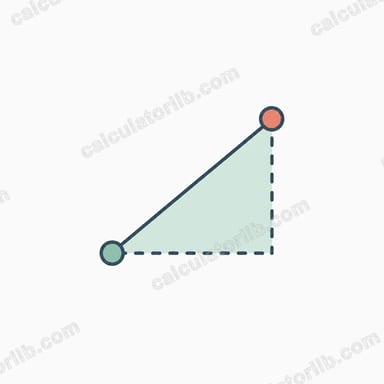
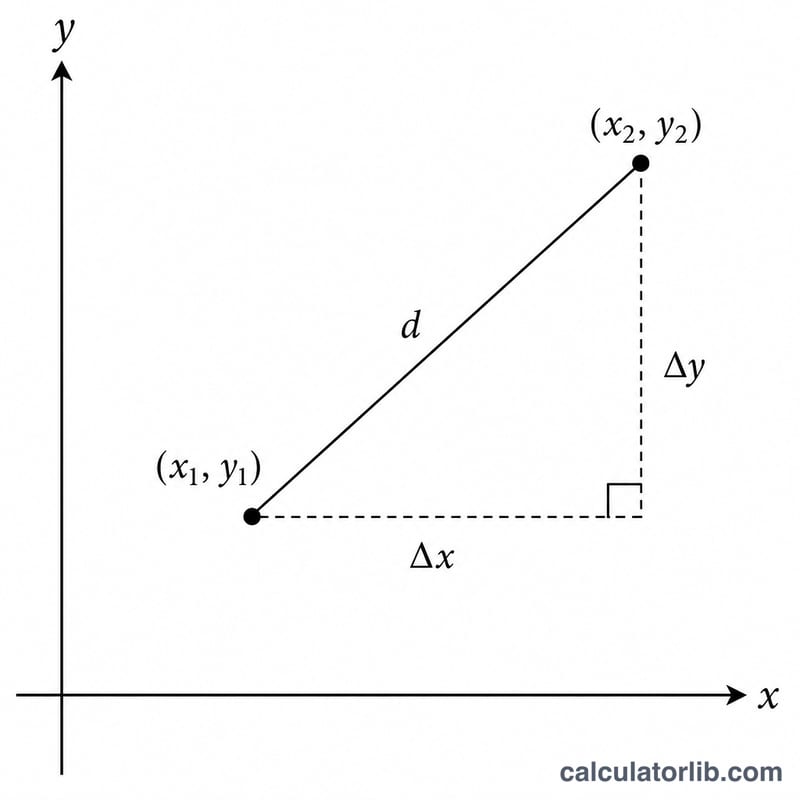
Enter the X and Y coordinates for each of the two points. Coordinates can be positive, negative, or decimal. Click calculate and the tool returns the distance plus the horizontal (Δx) and vertical (Δy) differences that make up the right triangle behind the result.
The Formula Explained
The distance formula is a direct application of the Pythagorean theorem. The horizontal leg of the triangle is \(\Delta x = x_2 - x_1\) and the vertical leg is \(\Delta y = y_2 - y_1\). The distance is the hypotenuse:
$$d = \sqrt{(x_2 - x_1)^2 + (y_2 - y_1)^2}$$
Squaring removes the sign of each difference, so the order in which you list the two points does not change the result.
Worked Example
Take point one at (0, 0) and point two at (3, 4). Then \(\Delta x = 3 - 0 = 3\) and \(\Delta y = 4 - 0 = 4\). The distance is $$d = \sqrt{3^2 + 4^2} = \sqrt{9 + 16} = \sqrt{25} = 5 \text{ units}$$ — the classic 3-4-5 right triangle.
More Worked Examples
Each example uses the 2D distance formula \(d = \sqrt{(x_2 - x_1)^2 + (y_2 - y_1)^2}\). Substitute the coordinates, simplify the differences, square them, add, and take the square root.
Example 1 — Negative coordinates: (−2, 3) to (4, −1)
- Find the differences: \(\Delta x = 4 - (-2) = 6\), \(\Delta y = -1 - 3 = -4\).
- Square them: \(6^2 = 36\), \((-4)^2 = 16\).
- Add: \(36 + 16 = 52\).
- Take the root: \(d = \sqrt{52} = 2\sqrt{13} \approx\) 7.2111.
Notice that subtracting a negative coordinate increases the gap — the squaring step removes the sign so the order of the points does not matter.
Example 2 — Decimal coordinates: (1.5, 2.0) to (4.5, 6.0)
- Differences: \(\Delta x = 4.5 - 1.5 = 3.0\), \(\Delta y = 6.0 - 2.0 = 4.0\).
- Squares: \(3.0^2 = 9\), \(4.0^2 = 16\).
- Sum and root: \(d = \sqrt{9 + 16} = \sqrt{25} =\) 5.
This is a scaled 3-4-5 right triangle, so the distance is exactly 5 even with decimal inputs.
Example 3 — Points sharing an axis (vertical line): (3, 1) to (3, 8)
- Differences: \(\Delta x = 3 - 3 = 0\), \(\Delta y = 8 - 1 = 7\).
- Since \(\Delta x = 0\), the formula reduces to \(d = \sqrt{0 + 7^2} = |\Delta y|\).
- Result: \(d =\) 7.
When two points share an x-coordinate the segment is vertical and the distance is simply the absolute difference of the y-values; likewise, shared y-coordinates give a horizontal distance equal to \(|\Delta x|\).
Definitions & Glossary
- Euclidean distance
- The ordinary straight-line distance between two points, measured "as the crow flies." On a 2D plane it is computed with \(d = \sqrt{(x_2 - x_1)^2 + (y_2 - y_1)^2}\) and is always a non-negative value.
- Coordinate (x, y)
- An ordered pair locating a point on the plane: \(x\) is the horizontal position (measured along the x-axis) and \(y\) is the vertical position (measured along the y-axis), both relative to the origin (0, 0).
- Δx (delta x)
- The horizontal change between the two points, \(\Delta x = x_2 - x_1\). It can be positive, negative, or zero; only its square is used in the distance formula.
- Δy (delta y)
- The vertical change between the two points, \(\Delta y = y_2 - y_1\). Like \(\Delta x\), its sign is irrelevant once squared.
- Hypotenuse
- The longest side of a right triangle, opposite the right angle. The distance \(d\) is the hypotenuse of a right triangle whose two legs are \(|\Delta x|\) and \(|\Delta y|\).
- Pythagorean theorem
- The relationship \(a^2 + b^2 = c^2\) for a right triangle with legs \(a, b\) and hypotenuse \(c\). The 2D distance formula is a direct application, with \(a = \Delta x\), \(b = \Delta y\), and \(c = d\).
Distance Across Sample Point Pairs
Each row shows the two points, the horizontal and vertical changes, and the resulting straight-line distance. Several rows are classic right-triangle ratios that yield whole-number distances.
| (x₁, y₁) | (x₂, y₂) | Δx | Δy | Distance d | Note |
|---|---|---|---|---|---|
| (0, 0) | (3, 4) | 3 | 4 | 5 | 3-4-5 triangle |
| (0, 0) | (5, 12) | 5 | 12 | 13 | 5-12-13 triangle |
| (1, 1) | (9, 1) | 8 | 0 | 8 | Horizontal (shared y) |
| (2, 2) | (2, 9) | 0 | 7 | 7 | Vertical (shared x) |
| (−2, 3) | (4, −1) | 6 | −4 | ≈ 7.2111 | Negative coordinates |
| (1.5, 2) | (4.5, 6) | 3 | 4 | 5 | Decimal, scaled 3-4-5 |
| (0, 0) | (1, 1) | 1 | 1 | ≈ 1.4142 | Unit diagonal (\(\sqrt{2}\)) |
| (0, 0) | (8, 15) | 8 | 15 | 17 | 8-15-17 triangle |
FAQ
Does the order of the points matter? No. Because the differences are squared, swapping the points gives the same distance.
Can I use negative coordinates? Yes. Negative values are fully supported; the formula handles them correctly.
What units does the result use? Whatever units your coordinates use. If your points are in meters, the distance is in meters.