
What Is an Obtuse Triangle?
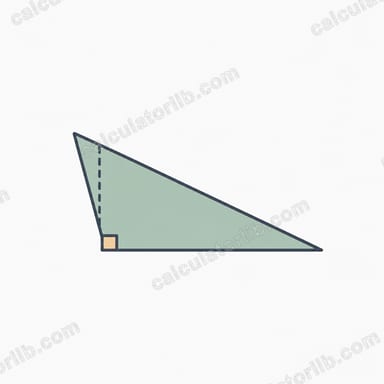
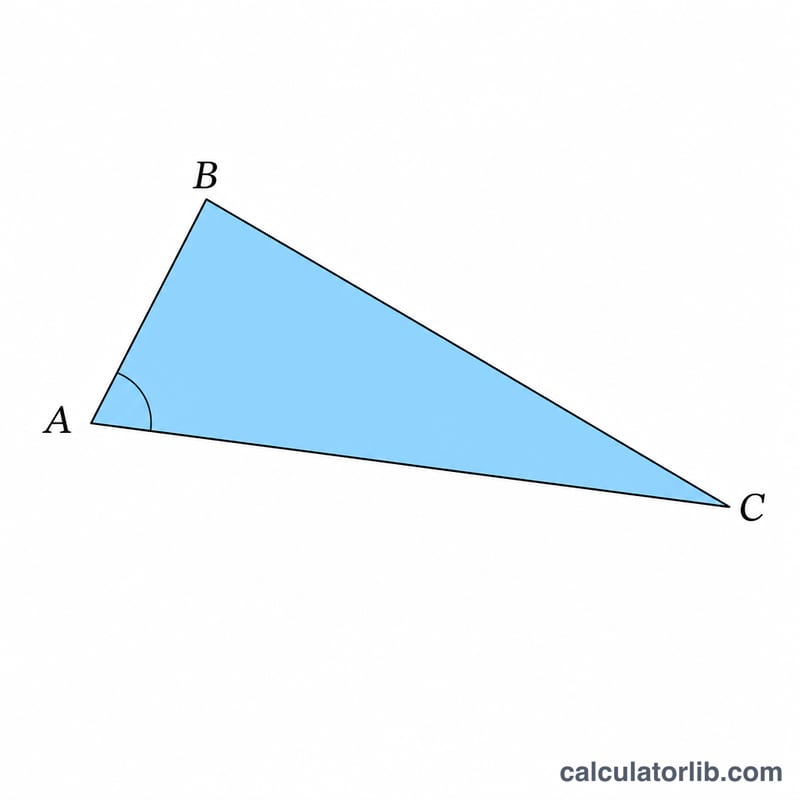
An obtuse triangle is a triangle that has one interior angle greater than 90°. Despite this distinctive shape, its area is found the same way as any other triangle. This calculator lets you compute the area using either the classic base × height method or Heron's formula when you only know the three side lengths.
How to Use This Calculator
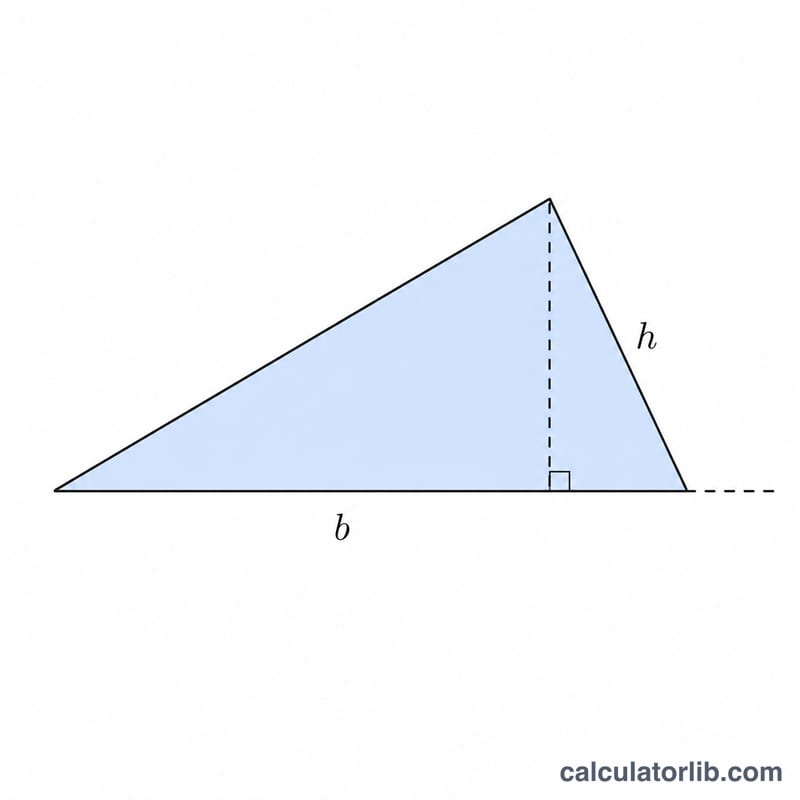
First choose a method. If you know the base and the perpendicular height that drops to that base, select Base & Height and enter both values. If you only know the three side lengths, select Three Sides (Heron) and enter sides a, b, and c. The area is returned instantly in square units, along with the perimeter and semi-perimeter when using Heron's method.
The Formulas Explained
The base-height formula is $$A = \frac{1}{2} \times b \times h$$ where \(h\) is the height measured at a right angle to the chosen base. In an obtuse triangle the height to certain sides falls outside the triangle, so be sure to use the true perpendicular distance.
Heron's formula uses only the sides: first compute the semi-perimeter $$s = \frac{a + b + c}{2}$$ then $$A = \sqrt{s\,(s-a)\,(s-b)\,(s-c)}$$ This avoids needing any angle or height.
Worked Example
Suppose an obtuse triangle has sides \(a = 7\), \(b = 12\), \(c = 9\). The semi-perimeter is $$s = \frac{7 + 12 + 9}{2} = 14$$ Then $$A = \sqrt{14 \times (14-7) \times (14-12) \times (14-9)} = \sqrt{14 \times 7 \times 2 \times 5} = \sqrt{980} \approx 31.30$$ square units.
FAQ
Does the obtuse angle change the area formula? No. The area formulas work for acute, right, and obtuse triangles identically.
What if Heron's formula gives no real result? If the three sides cannot form a valid triangle (the largest side exceeds the sum of the other two), the area is reported as 0.
Which units does it use? Any consistent units — the area is simply expressed in those units squared.