
What is Bretschneider's Formula?
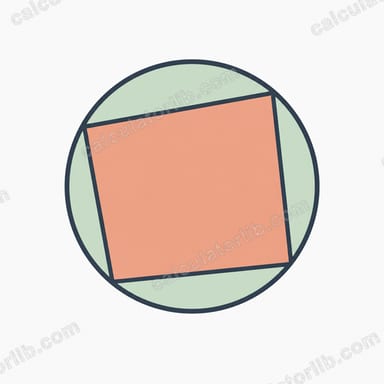
Bretschneider's formula gives the area of any simple quadrilateral — convex or not, cyclic or not — from its four side lengths and the sum of one pair of opposite interior angles. It generalizes Brahmagupta's formula (for cyclic quadrilaterals) and Heron's formula (for triangles). This calculator returns both the area S and the perimeter L using an arbitrary linear unit you choose (m, cm, in, etc.); the area is reported in that unit squared.
How to Use It
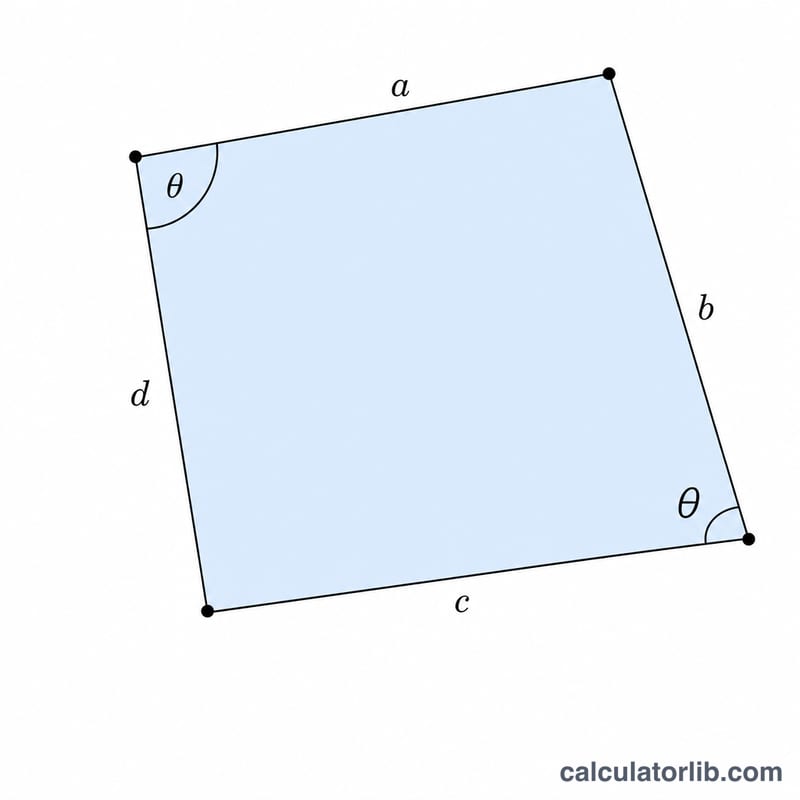
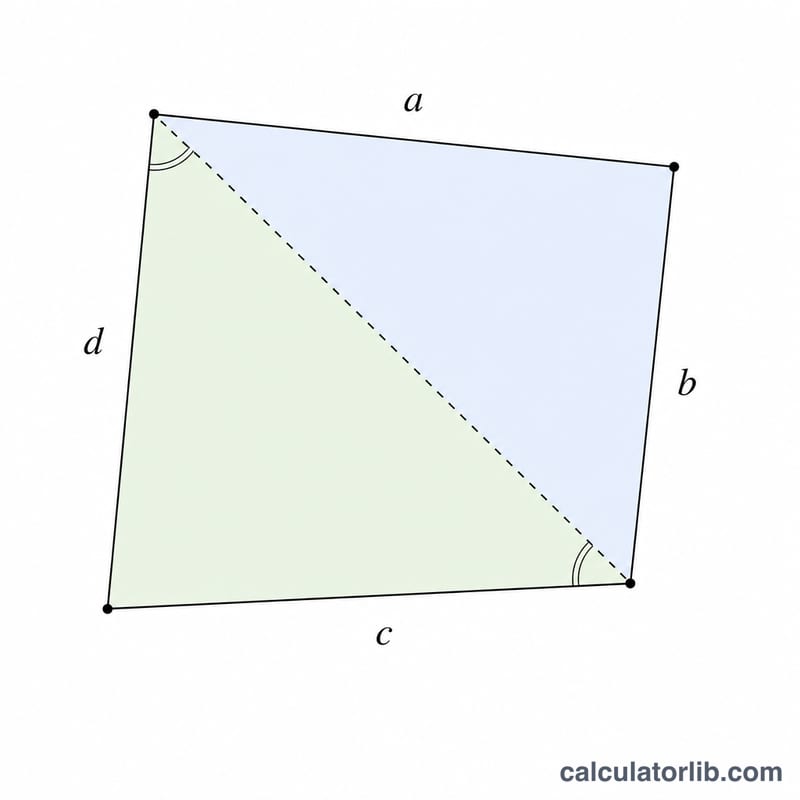
Enter the four side lengths \(a\), \(b\), \(c\), \(d\) in order around the quadrilateral. Then enter the sum of one pair of opposite interior angles, in degrees — these are the two vertex angles that are not adjacent to each other (the angle between sides \(a\) and \(b\), plus the angle between sides \(c\) and \(d\)). If the quadrilateral is cyclic, opposite angles are supplementary, so the sum is 180 degrees and the formula collapses to Brahmagupta's.
The Formula Explained
Let \(s = (a + b + c + d) / 2\) be the semiperimeter and \(\theta\) the sum of the opposite angle pair. Then the area is $$A = \sqrt{(s-a)(s-b)(s-c)(s-d) - abcd\,\cos^{2}\!\left(\tfrac{\theta}{2}\right)}$$ The angle is converted to radians (\(\times \pi/180\)) before the cosine, and the half-angle \(\theta/2\) is used inside the squared cosine. When \(\theta = 180\) degrees, \(\cos(90^\circ) = 0\) and the correction term vanishes.
Worked Example
Take \(a = 13\), \(b = 14\), \(c = 3\), \(d = 13\), \(\theta = 180\) degrees. The semiperimeter is \(s = 43/2 = 21.5\), giving \(s-a = 8.5\), \(s-b = 7.5\), \(s-c = 18.5\), \(s-d = 8.5\). Their product is \(10024.6875\). Because \(\cos(90^\circ) = 0\), the correction term is zero, so $$S = \sqrt{10024.6875} \approx 100.123 \text{ square units}$$ and the perimeter \(L = 13 + 14 + 3 + 13 = 43\) units.
FAQ
Why do I get an "invalid quadrilateral" message? Each side must be positive and shorter than the sum of the other three; otherwise the shape cannot close. The message also appears when the radicand turns negative, which means the side lengths and angle are inconsistent.
Do the sides need a specific unit? No. Use any single linear unit consistently; the area comes out in that unit squared and the perimeter in that unit.
What if I only know the diagonals? This calculator needs sides and the opposite-angle sum. For a cyclic quadrilateral you can simply use \(\theta = 180\) to apply Brahmagupta's formula.