
What Is Heron's Formula?
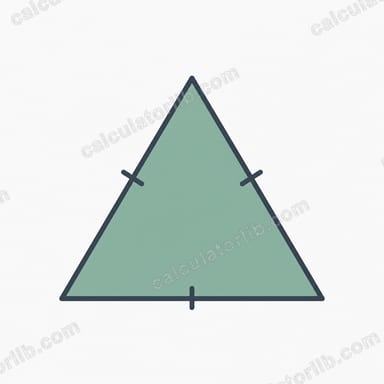
Heron's formula lets you compute the area of a triangle when you know only the lengths of its three sides — no angles or height required. Named after Hero of Alexandria, it is one of the most practical tools in geometry, surveying, and construction where measuring the three edges of a plot or shape is far easier than measuring its height.
How to Use This Calculator
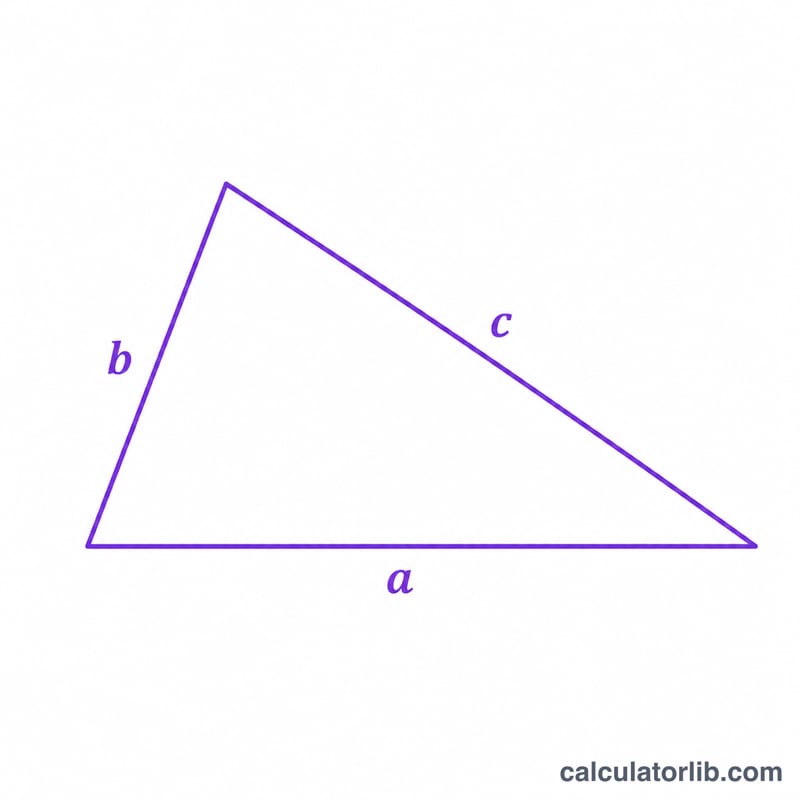
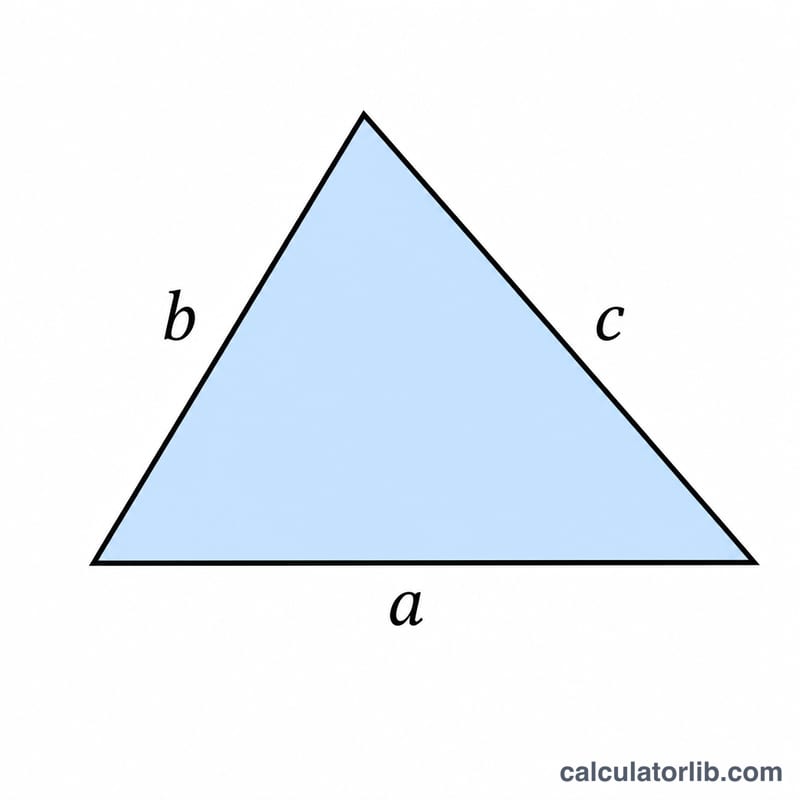
Enter the three side lengths a, b, and c in the same unit (centimeters, meters, inches, etc.). The calculator computes the semi-perimeter, then returns the area in square units. The three sides must satisfy the triangle inequality — each side must be shorter than the sum of the other two — otherwise no real triangle exists and the area is reported as zero.
The Formula Explained
First find the semi-perimeter \(s = (a + b + c) / 2\). Then the area is \(A = \sqrt{s(s - a)(s - b)(s - c)}\). Each factor \((s - a)\), \((s - b)\), and \((s - c)\) is positive only for a valid triangle, which guarantees the value under the square root is non-negative.
$$A = \sqrt{s\,(s-a)\,(s-b)\,(s-c)}$$Worked Example
For a triangle with sides \(a = 3\), \(b = 4\), \(c = 5\): the semi-perimeter is \(s = (3 + 4 + 5) / 2 = 6\). Then
$$A = \sqrt{6 \times (6-3) \times (6-4) \times (6-5)} = \sqrt{6 \times 3 \times 2 \times 1} = \sqrt{36} = 6 \text{ square units}$$This is the classic 3-4-5 right triangle, whose area also equals \(\tfrac{1}{2} \times 3 \times 4 = 6\), confirming the result.
FAQ
Can I use any units? Yes — just keep all three sides in the same unit; the area comes out in that unit squared.
Why does it show zero? If the longest side is equal to or longer than the sum of the other two, the three lengths cannot form a triangle, so the area is zero.
Does it work for any triangle? Yes — scalene, isosceles, equilateral, acute, right, or obtuse. Heron's formula needs only the three side lengths.