Heptagon Area Calculator
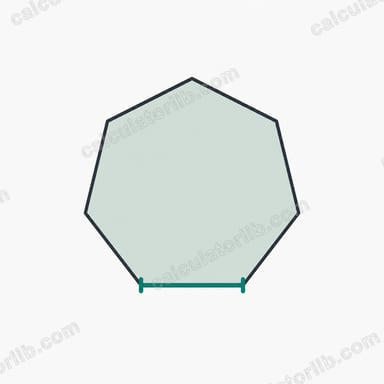
A heptagon is a seven-sided polygon with seven angles. A regular heptagon has all sides of equal length and all interior angles are equal. This calculator helps you compute the area and other important properties of a regular heptagon when you know the side length.
When to Use a Heptagon Area Calculator
This calculator is useful in various scenarios:
- Architectural design when working with heptagonal structures or design elements
- Construction projects that involve heptagonal shapes
- Educational purposes when studying geometry and regular polygons
How to Calculate Heptagon Properties
For a regular heptagon with side length s:
Area: A = (7/4) × s² × cot(π/7)
Perimeter: P = 7 × s
Inradius: r = (s/2) × cot(π/7)
Circumradius: R = (s/2) × csc(π/7)
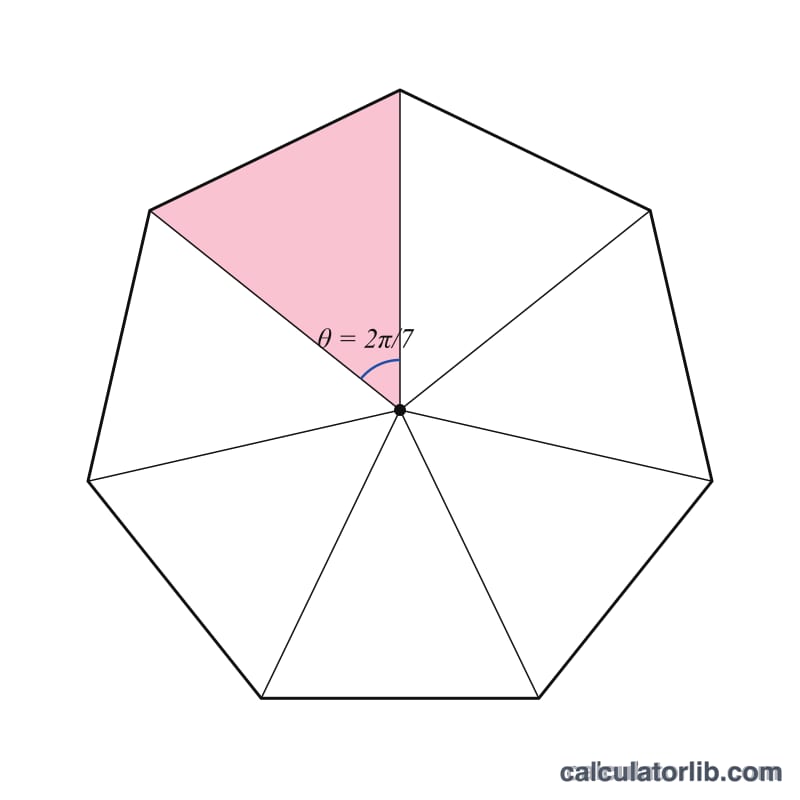
Central Angle: 360° ÷ 7 = 51.428°
Interior Angle: (7-2) × 180° ÷ 7 = 128.571°
The inradius is the radius of the largest circle that can be inscribed within the heptagon, while the circumradius is the radius of the smallest circle that can contain the entire heptagon.
Examples
Example 1: Calculating Area and Perimeter
Find the area and perimeter of a regular heptagon with side length 10 cm.
| Property | Formula | Calculation | Result |
|---|---|---|---|
| Side Length | Given | - | 10 cm |
| Area | (7/4) × s² × cot(π/7) | (7/4) × 10² × cot(π/7) | 273.64 cm² |
| Perimeter | 7 × s | 7 × 10 | 70 cm |
Example 2: Finding Inradius and Circumradius
Calculate the inradius and circumradius of a regular heptagon with side length 5 meters.
| Property | Formula | Calculation | Result |
|---|---|---|---|
| Side Length | Given | - | 5 m |
| Inradius | (s/2) × cot(π/7) | (5/2) × cot(π/7) | 5.24 m |
| Circumradius | (s/2) × csc(π/7) | (5/2) × csc(π/7) | 5.77 m |
Example 3: Calculating Angles
Determine the central and interior angles of a regular heptagon.
| Property | Formula | Calculation | Result |
|---|---|---|---|
| Central Angle | 360° ÷ 7 | 360 ÷ 7 | 51.43° |
| Interior Angle | (7-2) × 180° ÷ 7 | 5 × 180 ÷ 7 | 128.57° |
Important Formulas for Regular Heptagons
| Property | Formula | Description |
|---|---|---|
| Area | A = (7/4) × s² × cot(π/7) | Area based on side length |
| Perimeter | P = 7s | Sum of all sides |
| Inradius | r = (s/2) × cot(π/7) | Radius of inscribed circle |
| Circumradius | R = (s/2) × csc(π/7) | Radius of circumscribed circle |
| Area from inradius | A = 7 × r² × tan(π/7) | Alternative area formula |
| Area from circumradius | A = (7/2) × R² × sin(2π/7) | Alternative area formula |
For additional geometric calculations, you might also find these calculators useful: Triangle Area Calculator, Square Area Calculator, Regular Polygon Area Calculator, or Rectangle Area Calculator.
Heptagon Constants and Area Multipliers
These values apply to a regular heptagon (7 equal sides and 7 equal angles). All are dimensionless factors, rounded to 4 decimal places, and they multiply the side length \(s\).
| Quantity | Expression | Rounded value |
|---|---|---|
| Cotangent of π/7 | \(\cot(\pi/7)\) | ≈ 2.0765 |
| Cosecant of π/7 | \(\csc(\pi/7)\) | ≈ 2.3048 |
| Area coefficient | \(\tfrac{7}{4}\cot(\pi/7)\) | ≈ 3.6339 (so A ≈ 3.6339·s²) |
| Inradius factor (apothem) | \(\tfrac{1}{2}\cot(\pi/7)\) | ≈ 1.0383 (r ≈ 1.0383·s) |
| Circumradius factor | \(\tfrac{1}{2}\csc(\pi/7)\) | ≈ 1.1524 (R ≈ 1.1524·s) |
| Central angle | \(360^\circ / 7\) | ≈ 51.43° (≈ 0.8976 rad) |
| Interior angle | \(900^\circ / 7\) | ≈ 128.57° (≈ 2.2440 rad) |
The area formula is:
$$A = \frac{7}{4}\, s^{2}\cot\!\left(\frac{\pi}{7}\right) \approx 3.6339\, s^{2}$$
Because area scales with the square of the side, doubling the side length multiplies the area by 4. The result is in square units matching the unit you choose (for example, a side in cm gives an area in cm²). Rounded factors give slightly different results from the unrounded calculation in the last digits.

Frequently Asked Questions
What is the formula for the area of a regular heptagon?
The area of a regular heptagon with side length a is A = (7/4) × a² × cot(π/7), which equals approximately 3.6339 × a². The cotangent term comes from the seven equal triangles that make up the shape. Just square the side length and multiply by 3.6339 for a quick estimate.
How many sides and interior angles does a heptagon have?
A heptagon has seven sides and seven interior angles. In a regular heptagon, every interior angle measures about 128.571 degrees, and the seven angles sum to 900 degrees. Each exterior angle measures roughly 51.43 degrees, since the exterior angles of any polygon always add up to 360 degrees.
What units does the heptagon area calculator use?
You can enter the side length in millimeters, centimeters, meters, kilometers, inches, feet, yards, or miles. The area is returned in the corresponding square unit. For example, a side in centimeters gives area in square centimeters. Switching units recalculates instantly without re-entering the side length.
How do you find the inradius and circumradius of a heptagon?
For a regular heptagon with side a, the inradius (apothem) is r = a / (2·tan(π/7)) ≈ 1.0383 × a, and the circumradius is R = a / (2·sin(π/7)) ≈ 1.1524 × a. The inradius reaches the midpoint of a side; the circumradius reaches a vertex.
Can this calculator find the area of an irregular heptagon?
No. This calculator assumes a regular heptagon, where all seven sides and angles are equal. For an irregular heptagon, you would need to split the shape into triangles or use coordinate geometry, such as the shoelace formula with the vertex coordinates, since a single side length is not enough.
What is an example of calculating heptagon area from a side length?
Take a regular heptagon with a side of 10 cm. Multiply the area constant 3.6339 by the side squared: 3.6339 × 10² = 363.39 square centimeters. The perimeter is simply 7 × 10 = 70 cm. Doubling the side to 20 cm quadruples the area to about 1453.6 square centimeters.