What the Square Area Calculator Does
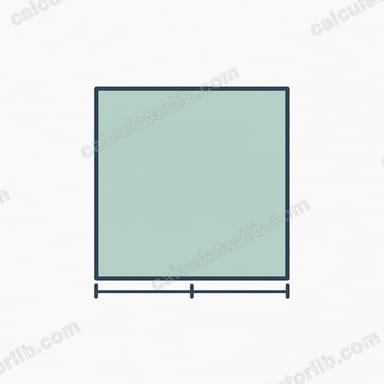
This calculator finds the area of a square from a single measurement: the length of one side. Because all four sides of a square are equal, that one number is all you need. Enter it in the Square Side Length field and the tool instantly returns the area using the formula A = a². As a bonus, it also computes the square's perimeter and diagonal from the same input, so you get a complete picture of the shape in one go.
How to Use It
- Square Side Length: type the length of one side (for example 5). Use whatever unit you like — centimetres, metres, inches or feet — just keep it consistent.
- The calculator squares that value to give the area, multiplies it by 4 for the perimeter, and multiplies by √2 for the diagonal.
The area comes out in square units (cm², m², etc.), the perimeter in the same linear unit you entered, and the diagonal also in that linear unit.
The Formula Explained
The core formula is:
A = a²
Here a is the side length and A is the area. Squaring the side works because area measures the space inside the square — a grid of a rows by a columns of unit squares. The calculator also applies:
- Perimeter = 4 × a (the total distance around all four sides)
- Diagonal = a × √2 (the straight line corner-to-corner, from the Pythagorean theorem)

Worked Example
Suppose you enter a side length of 5 metres:
- Area = 5 × 5 = 25 m²
- Perimeter = 4 × 5 = 20 m
- Diagonal = 5 × √2 ≈ 5 × 1.4142 = 7.07 m
So a square room with 5-metre walls covers 25 square metres of floor.

Square Unit Conversion Table
Use this table to convert a square's area between common units. These are standard, internationally defined relationships (metric and international yard/pound units).
| Unit | Equivalent values |
|---|---|
| 1 m² | 10,000 cm² = 1,550.0031 in² = 10.7639 ft² = 1.19599 yd² |
| 1 ft² | 144 in² = 0.092903 m² |
| 1 in² | 6.4516 cm² |
| 1 yd² | 9 ft² = 0.836127 m² |
| 1 km² | 1,000,000 m² |
| 1 hectare | 10,000 m² |
| 1 acre | 4,046.86 m² |
Note: Area conversion factors are the square of the linear factors. For example, 1 ft = 12 in, so 1 ft² = 12² = 144 in²; and 1 m = 100 cm, so 1 m² = 100² = 10,000 cm². Never apply a linear factor directly to an area.
Frequently Asked Questions
What unit does the area use? It uses the square of whatever unit you entered. Enter the side in metres and the area is in square metres; enter centimetres and you get square centimetres.
Can I find the side length if I only know the area? Yes — take the square root of the area. For an area of 25, the side is √25 = 5. This calculator works the other way (side to area), so you'd reverse the formula manually.
Why does it also show the perimeter and diagonal? Because they all derive from the same single side length, the tool computes them together to save you extra steps for homework, DIY projects, or quick design checks.