
What This Calculator Does
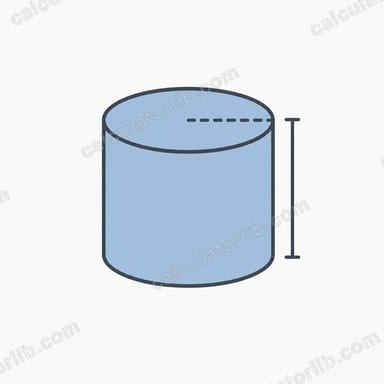
The Cylinder Volume Calculator works out how much space a cylinder occupies. You enter just two measurements — the radius and the height — and the tool returns the volume in cubic centimetres (cm³). It works for any cylinder shape, from a thin straw to a wide water tank, as long as you provide both values in centimetres.
The Inputs You Provide
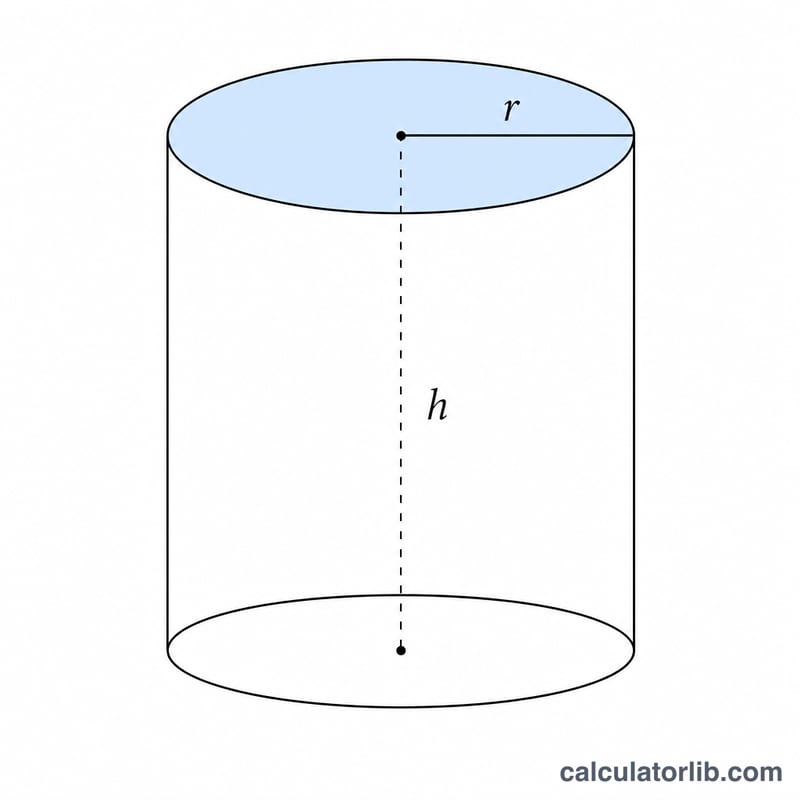
- Radius (cm) — the distance from the centre of the circular base to its edge. If you only know the diameter, divide it by 2 to get the radius.
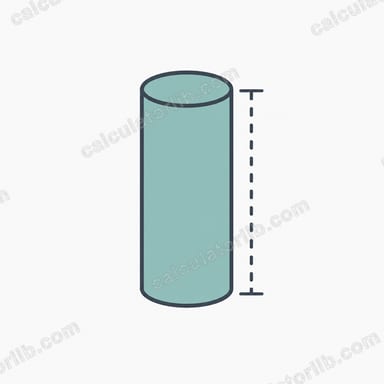
- Height (cm) — the straight-line distance between the two circular ends of the cylinder.
Both fields must use the same unit (centimetres) so the result comes out cleanly in cubic centimetres.
The Formula
The calculator uses the standard geometric formula for the volume of a cylinder:
$$V = \pi \times r^{2} \times h$$
Here \(\pi\) (pi) is approximately 3.14159, r is the radius and h is the height. Behind the scenes the tool squares the radius, multiplies it by pi to get the area of the circular base, then multiplies by the height. The calculation is run with high-precision decimal arithmetic, so even large or fractional inputs return accurate results.
Worked Example
Suppose you have a cylinder with a radius of 5 cm and a height of 10 cm:
- Square the radius: \(5 \times 5 = 25\)
- Multiply by pi: \(25 \times 3.14159 = 78.54\)
- Multiply by the height: \(78.54 \times 10 = 785.4\)
The volume is approximately 785.4 cm³. Change either value and the result scales accordingly — doubling the height doubles the volume, while doubling the radius quadruples it.
Frequently Asked Questions
What if I only know the diameter? Divide the diameter by 2 to get the radius before entering it. A 12 cm diameter means a radius of 6 cm.
How do I convert cm³ to litres? Divide the cm³ result by 1,000. So 785.4 cm³ equals about 0.785 litres — handy for working out container capacity.
Can I use other units like inches or metres? The calculator outputs cubic centimetres, so enter both measurements in centimetres for a correct answer. Convert your inches or metres to centimetres first (1 inch = 2.54 cm, 1 metre = 100 cm).