
What Is the Ellipse Circumference Calculator?
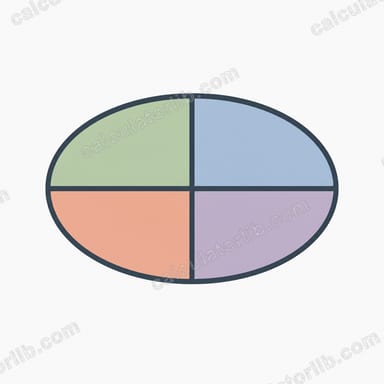
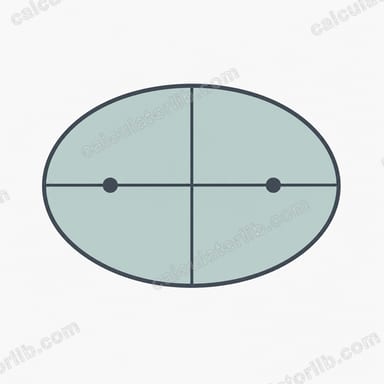
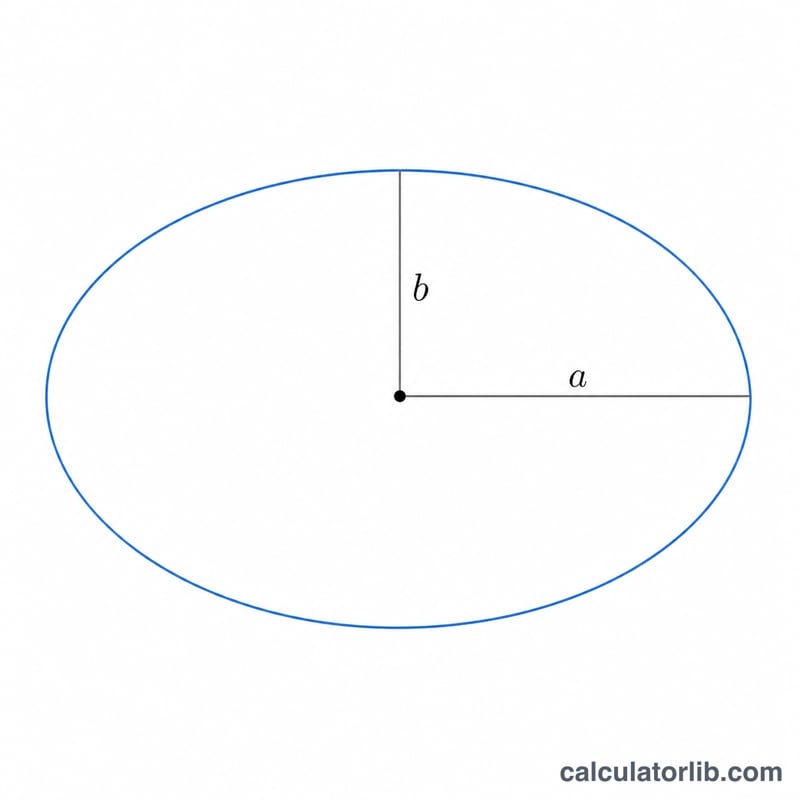
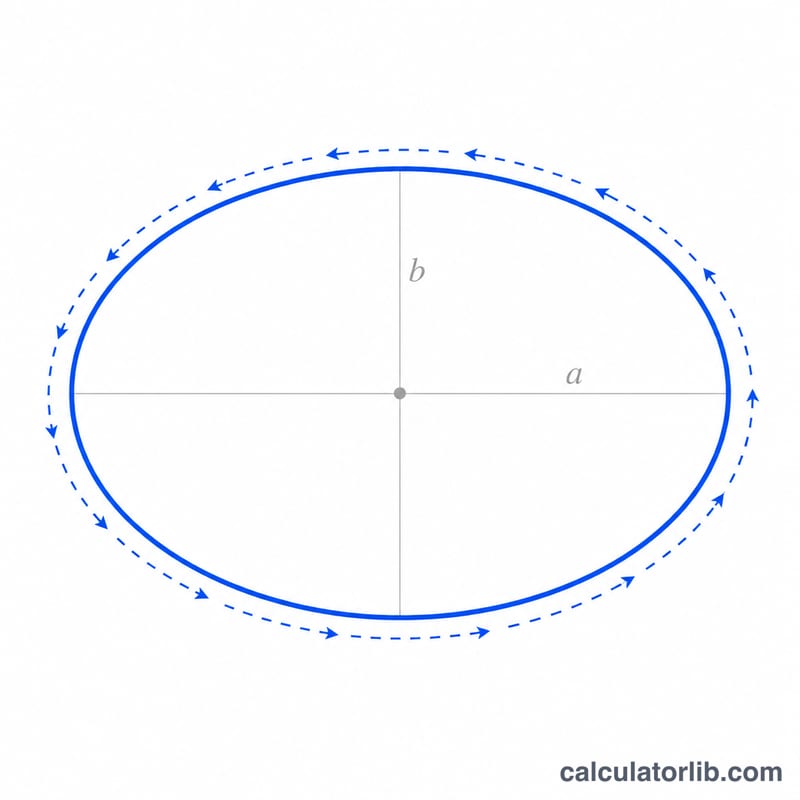
An ellipse is an oval-shaped curve defined by two radii: the semi-major axis (\(a\)), which is the longest distance from the center to the edge, and the semi-minor axis (\(b\)), the shortest. While the area of an ellipse is easy to compute, its circumference (perimeter) has no simple exact formula—it requires an infinite series. This Ellipse Circumference Calculator uses a highly accurate approximation to give you the perimeter, plus the area and eccentricity, in one step.
How to Use It
Using the calculator takes just a few seconds:
- Enter the length of the semi-major axis (\(a\))—the larger radius.
- Enter the length of the semi-minor axis (\(b\))—the smaller radius.
- Read the instant results for circumference, area, and eccentricity.
Make sure both values use the same unit (cm, m, inches, etc.). When \(a\) equals \(b\), the ellipse becomes a perfect circle and the circumference equals \(2\pi r\).
The Formula Explained
The most popular approximation is Ramanujan's second formula, which is accurate to within a tiny fraction of a percent for most ellipses:
- Circumference $$C \approx \pi\,(a+b)\left(1 + \frac{3h}{10 + \sqrt{4 - 3h}}\right), \quad \text{where } h = \frac{(a-b)^2}{(a+b)^2}$$
- Area $$A = \pi \times a \times b$$
- Eccentricity $$e = \sqrt{1 - \frac{b^2}{a^2}}$$
Eccentricity ranges from 0 (a circle) to nearly 1 (a very flattened, elongated ellipse).
Worked Example
Suppose an ellipse has \(a = 5\) cm and \(b = 3\) cm.
- $$h = \frac{(5 - 3)^2}{(5 + 3)^2} = \frac{4}{64} = 0.0625$$
- $$C \approx \pi \times 8 \times \left(1 + \frac{3 \times 0.0625}{10 + \sqrt{4 - 0.1875}}\right) \approx 25.53 \text{ cm}$$
- $$A = \pi \times 5 \times 3 \approx 47.12 \text{ cm}^2$$
- $$e = \sqrt{1 - \frac{9}{25}} = \sqrt{0.64} = 0.8$$
Frequently Asked Questions
Why is there no exact circumference formula? The perimeter involves an elliptic integral that cannot be expressed in elementary functions, so approximations like Ramanujan's are used instead.
How accurate is the result? Ramanujan's approximation is accurate to several decimal places for typical ellipses, with errors usually well under 0.01%.
Can I calculate a circle with this tool? Yes. Simply set \(a\) equal to \(b\), and the calculator returns the circle's circumference (\(2\pi r\)) and area (\(\pi r^2\)).