
What the Ellipse Area Calculator Does
This calculator works out the key geometric properties of an ellipse from just two measurements: the semi-major axis and the semi-minor axis. Enter both values and it instantly returns the ellipse's area, its perimeter (circumference), and its eccentricity. It also draws a scaled diagram of your ellipse so you can visually confirm the shape matches your numbers.
The Two Inputs Explained
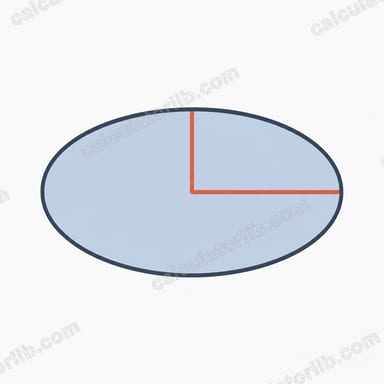
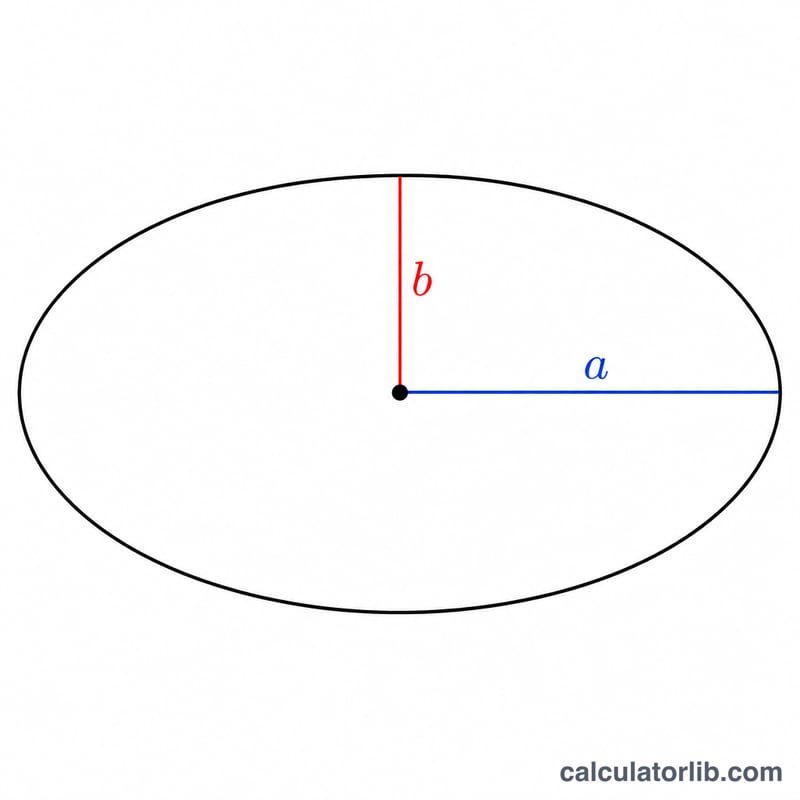
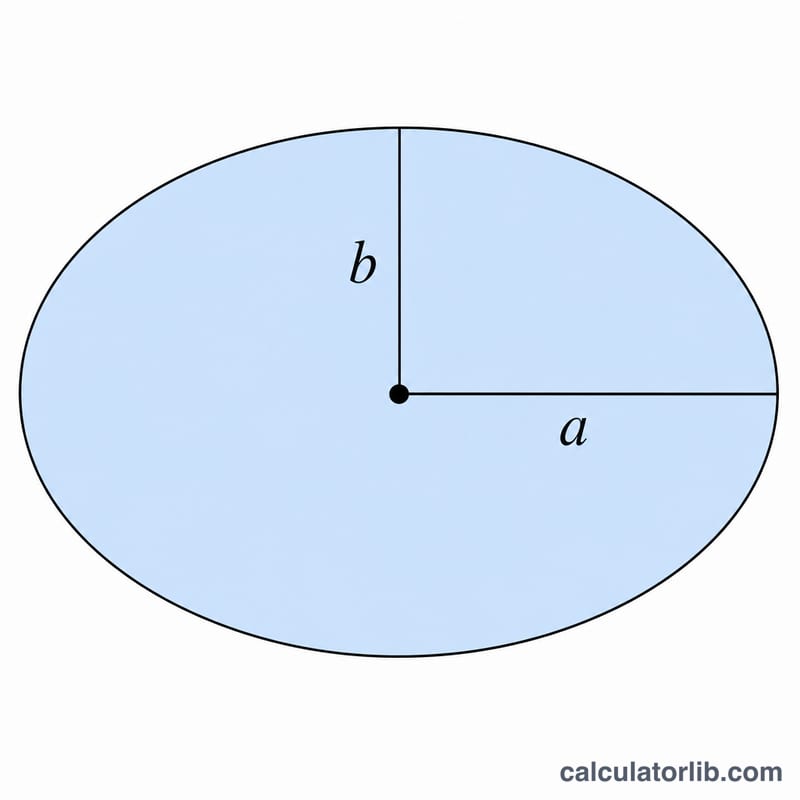
- Semi-Major Axis (a): half the length of the longest diameter of the ellipse, measured from the centre to the farthest edge.
- Semi-Minor Axis (b): half the length of the shortest diameter, measured from the centre to the nearest edge.
Use the same unit for both (cm, m, inches, etc.). If both values are equal, the ellipse becomes a circle.
The Formulas Used
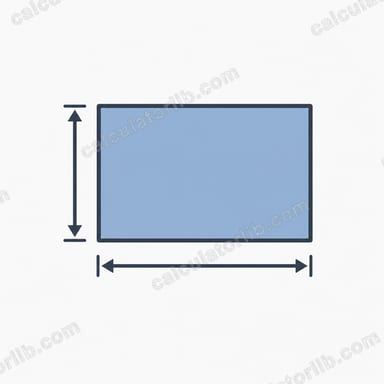
The area is the headline result and uses the standard formula:
$$\text{Area} = \pi \times \text{Semi-Major Axis }(a) \times \text{Semi-Minor Axis }(b)$$
The calculator also computes two extras directly from your inputs:
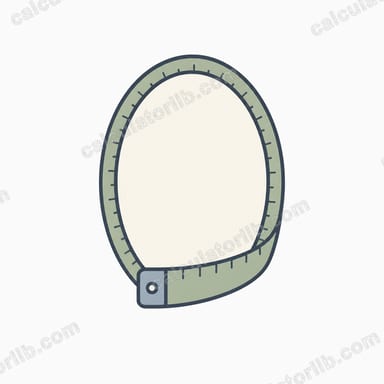
- Perimeter using the root-mean-square approximation: \(\text{Perimeter} = 2\pi \times \sqrt{(a^2 + b^2) / 2}\). This is a quick, close estimate, since an ellipse's true perimeter has no simple closed form.
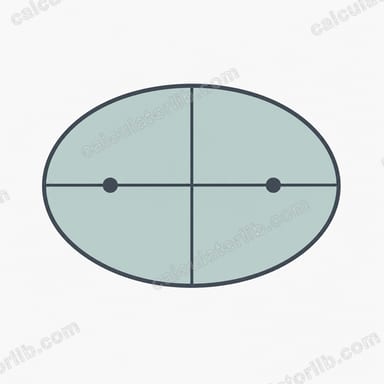
- Eccentricity \(= \sqrt{1 - b^2/a^2}\), a number between 0 and 1 that describes how "stretched" the ellipse is. A value near 0 is nearly circular; near 1 is highly elongated.
Worked Example
Suppose \(a = 5\) and \(b = 3\).
- Area = \(\pi \times 5 \times 3 = 15\pi \approx\) 47.12 square units.
- Perimeter \(\approx 2\pi \times \sqrt{(25 + 9) / 2} = 2\pi \times \sqrt{17} \approx\) 25.91 units.
- Eccentricity \(= \sqrt{1 - 9/25} = \sqrt{0.64} =\) 0.80, indicating a noticeably elongated ellipse.
Frequently Asked Questions
Should the larger value go in "a"? By convention the semi-major axis (a) is the larger of the two. The eccentricity formula assumes \(a \geq b\); if you enter a smaller "a" than "b", the eccentricity result will not be valid, so put the longer half-axis in the "a" field.
Why is the perimeter only an approximation? The exact perimeter of an ellipse requires an elliptic integral that cannot be expressed with elementary functions. This calculator uses the fast root-mean-square method, which is accurate for ellipses that are not extremely elongated.
What if a equals b? The shape is a circle. The area becomes \(\pi r^2\), the perimeter becomes \(2\pi r\), and the eccentricity is 0.