
What the Age Calculator does
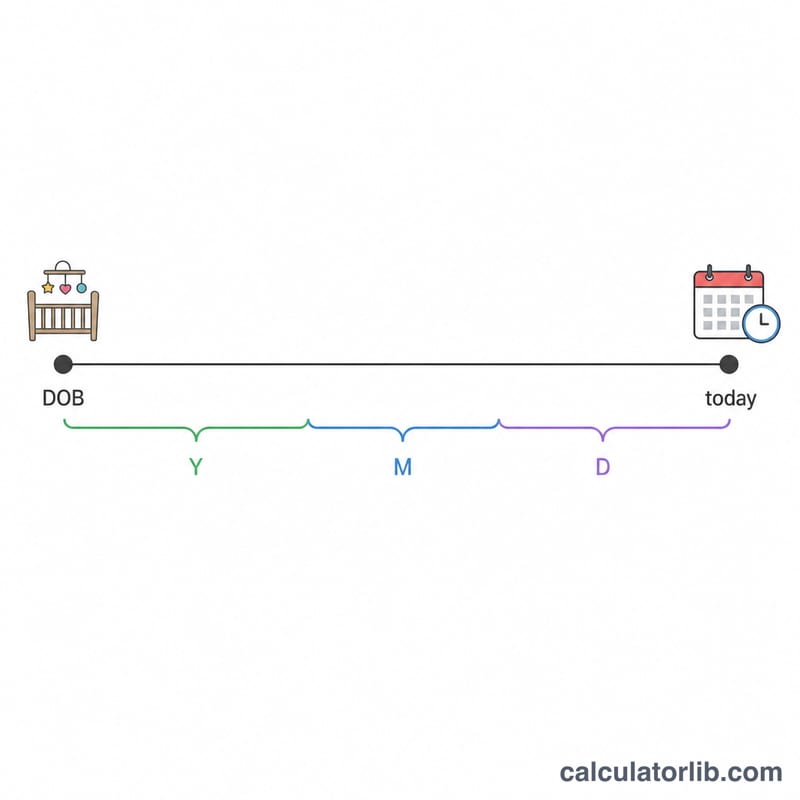
This Age Calculator turns a single piece of information — your Date of Birth — into a complete picture of how old you are. It tells you your exact age broken down into years, months and days, shows the full date span from the day you were born to today, and counts down the days until your next birthday. Because age is calculated against the current date, the result updates every day automatically.
How to use it
- Enter your Date of Birth in the date field. The tool accepts many common formats (e.g. 1990-05-14, 05/14/1990 or 14/05/1990).
- Submit, and the calculator compares your birth date to today's date.
- Read your age in years, months and days, plus the days remaining until your next birthday.
The formula explained
The calculator does not simply divide total days by 365. Instead it uses a calendar-accurate period calculation between two dates:
$$\text{Age} = \left\lfloor \frac{\text{Today} - \text{Date of Birth}}{1 \text{ year}} \right\rfloor$$Starting from your date of birth, it counts whole years up to today, then the remaining whole months, then the leftover days:
$$\text{Age} = \text{Today} - \text{Date of Birth} \;\Rightarrow\; (\text{Years},\ \text{Months},\ \text{Days})$$This respects the real number of days in each month and accounts for leap years, so the breakdown always reconciles back to today's date.
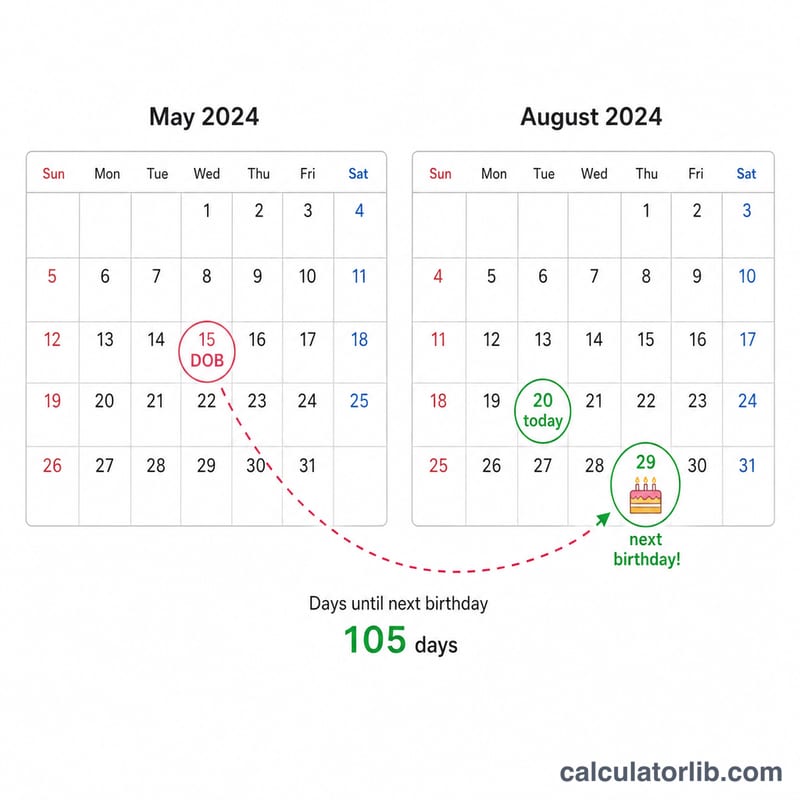
For the next-birthday countdown, it takes the month and day of your birth, finds the next time that month-and-day occurs on or after today, and counts the days between today and that date.
Worked example
Suppose your Date of Birth is 14 May 1990 and today is 20 March 2024:
- Years: from 14 May 1990 to 14 May 2023 = \(33\) full years.
- Months: from 14 May 2023, count whole months to 14 March 2024 = \(10\) months.
- Days: from 14 March 2024 to 20 March 2024 = \(6\) days.
So your age is 33 years, 10 months and 6 days. Your next birthday (14 May 2024) is 55 days away.
Age Results Across Different Birth Dates
All rows below use one fixed reference date — 20 March 2024 — so they can be checked against each other by hand. The calculator itself always uses the current date, so running the same birth dates today will give larger numbers; the point of the table is to show how each case is broken down, not to give values you can copy. Ages are chronological ages on the proleptic Gregorian calendar, expressed as completed years, then completed months, then leftover days.
| Date of Birth | Reference date | Age (years / months / days) | Total days lived | Days until next birthday |
|---|---|---|---|---|
| 14 May 1990 (normal mid-year birthday) | 20 Mar 2024 | 33 y, 10 m, 6 d | 12,364 | 55 |
| 29 Feb 2000 (leap-day birthday) | 20 Mar 2024 | 24 y, 0 m, 20 d | 8,786 | 1,441 (to 29 Feb 2028) |
| 5 Mar 1985 (birthday earlier this month) | 20 Mar 2024 | 39 y, 0 m, 15 d | 14,260 | 350 |
| 20 Mar 1975 (birthday is today) | 20 Mar 2024 | 49 y, 0 m, 0 d | 17,898 | 365 (366 if the coming year contains a 29 Feb) |
| 31 Jan 1995 (end-of-month birthday) | 20 Mar 2024 | 29 y, 1 m, 20 d | 10,641 | 317 |
How each row reconciles
- 14 May 1990. The 2024 birthday has not happened yet, so the age is 33, not 34. From the last birthday (14 May 2023) to 14 March 2024 is 10 whole months, plus 6 days to 20 March: \(33\ \text{y} + 10\ \text{m} + 6\ \text{d}\). Forward to 14 May 2024 is \(11 + 30 + 14 = 55\) days.
- 29 Feb 2000. 2024 is a leap year, so the birthday fell on 29 Feb 2024 and the person turned 24. From 29 Feb to 20 Mar is 20 days, so 0 months and 20 days. The next literal 29 February is in 2028, which is 1,441 days away. In non-leap years a calculator must choose a substitute date: treating the birthday as 28 February gives 345 days (to 28 Feb 2025), and treating it as 1 March gives 346 days (to 1 Mar 2025). None of these is "wrong" — they are different conventions, and legal rules for leap-day birthdays vary by country, so check local law if the date matters legally.
- 5 Mar 1985. The birthday has already passed this month, so the age is a clean 39 years plus the 15 days from 5 March to 20 March. The next birthday, 5 Mar 2025, is \(365 - 15 = 350\) days away, because the 12 months from 20 Mar 2024 to 20 Mar 2025 contain no leap day.
- 20 Mar 1975. Birth date and reference date are the same calendar day, so the remainder is exactly zero: 49 years, 0 months, 0 days. Total days \(= 49 \times 365 + 13 = 17{,}898\), where 13 is the number of 29 Februaries from 1976 through 2024. The next birthday is 365 days away here; it would be 366 if a 29 February fell inside that span.
- 31 Jan 1995 (month-end clamping). The last birthday was 31 Jan 2024. Adding one month to 31 January lands on a date that does not exist (31 February), so it is clamped to the last day of February — 29 Feb 2024 in this leap year — and the remaining 20 days reach 20 March: 29 years, 1 month, 20 days. A calculator that instead borrows days from the preceding month reports 29 y, 1 m, 18 d for the same instant. The unambiguous figures are the years (29) and the total days: from 31 Jan 2024 to 20 Mar 2024 is \(29 + 20 = 49\) days, and \(10{,}592 + 49 = 10{,}641\).
Note that "total days lived" counts elapsed days between two calendar dates at the same time of day; it ignores time zones and any hour-of-birth offset. Because months differ in length (28–31 days), the months-and-days part of an age is convention-dependent, while the year count and the total day count are not.
Key Terms and Definitions
- Date of Birth (DOB)
- The calendar date on which a person was born, the single input this calculator needs. It is interpreted on the Gregorian calendar; dates before a country's adoption of that calendar may not match historical records.
- Chronological age
- The amount of time elapsed since the date of birth, measured in completed years, months and days. This is the ordinary "how old are you" age used in most of the world; some traditions (for example the East Asian age reckoning still used informally in parts of the region) count differently and will not match this result.
- Completed (whole) year vs. fractional year
- A completed year is a full 12-month interval that has already elapsed, so someone 33 years and 10 months old is reported as 33, not 34. A fractional year expresses the leftover part as a decimal (about 33.85 years here) and is used mainly in statistics and medicine, not in everyday age reporting.
- Calendar month vs. 30-day month
- A calendar month runs from a day number in one month to the same day number in the next and therefore lasts 28, 29, 30 or 31 days. A 30-day month is a fixed accounting convention; using it would change the months-and-days breakdown of an age, which is why age results are computed with calendar months.
- Leap year
- A Gregorian year of 366 days instead of 365. The rule: a year divisible by 4 is a leap year, except century years, which must also be divisible by 400 — so 1900 and 2100 are not leap years, but 2000 and 2400 are. Roughly 97 leap years occur every 400 years.
- Leap day (29 February)
- The extra day inserted at the end of February in a leap year. It exists only in leap years, so leap-day birthdays are celebrated on 28 February or 1 March in the other three years out of four.
- Month-end clamping
- The rule applied when adding months produces a date that does not exist: the result is pulled back to the last valid day of the target month. For example, 31 January + 1 month gives 28 February in a common year and 29 February in a leap year, and 31 March + 1 month gives 30 April.
- Total days lived
- The count of whole days between the date of birth and the reference date, in days. Unlike the years/months/days breakdown, it is convention-free: two calculators should always agree on it, ignoring time-of-day and time-zone effects.
- Next birthday
- The next occurrence of the birth month and day on or after the reference date, and the number of days remaining until it. That gap is at most 366 days for an ordinary birthday, but can reach roughly 1,461 days for a 29 February birthday if only literal leap days are counted.
- Date span
- The elapsed interval between two dates expressed in mixed units — years, months and days — rather than a single unit. The age shown by this calculator is the date span from the date of birth to today.
Life expectancy in United States
How long people in United States live on average from birth, compared with the world, from the World Bank.
- Life expectancy 2024
- 78.9 years
- World 2024
- 73.5 years
- Change since 1960
- +9.1 years
Latest change Up +0.5 years 2024: 78.9 years, against 78.4 years in 2023.
A child born in United States in 2024 can expect to live 78.9 years on average (world: 73.5 years).
| Year | United States | World |
|---|---|---|
| 2024 | 78.9 | 73.5 |
| 2020 | 77.0 | 72.2 |
| 2010 | 78.5 | 70.7 |
| 2000 | 76.6 | 67.7 |
| 1990 | 75.2 | 65.1 |
| 1980 | 73.6 | 62.2 |
| 1970 | 70.8 | 57.9 |
| 1960 | 69.8 | 50.9 |
Life expectancy at birth is an average for the whole population, not a personal prediction.
United States and other countries
Life expectancy at birth, in years — each country’s latest published year.
- Japan 84.0 years (2024)
- South Korea 83.6 years (2024)
- France 83.0 years (2024)
- Saudi Arabia 79.0 years (2024)
- United States 78.9 years (2024)
- China 78.0 years (2024)
- Türkiye 77.4 years (2024)
- Mexico 75.3 years (2024)
- Vietnam 74.7 years (2024)
- World 73.5 years (2024)
- Russia 73.4 years (2024)
- India 72.2 years (2024)
No published figure yet for Taiwan.
Years can differ between rows: each figure is shown with its own year. The same World Bank indicator for every country.
Latest figure: 2024 Data last updated 2026-10-18 · older figure
Source: The World Bank Group CC BY 4.0
Differences and changes are computed by CalculatorLib from these data.
Source details and methodology
- The World Bank Group — World Development Indicators (SP.DYN.LE00.IN)
Frequently asked questions
Does it account for leap years? Yes. The calculation uses actual calendar dates, so 29 February and the varying lengths of months are handled correctly.
What if my birthday is today? The day counts as a completed year, and the days-until-next-birthday will show a full year ahead (your next birthday next year).
Which date format should I use? The calculator recognises several formats including ISO (yyyy-MM-dd), US (MM/dd/yyyy) and European (dd/MM/yyyy), so you can enter the one you're most comfortable with.