
What the IRA Calculator Does
This free IRA Calculator helps you project the future value of an Individual Retirement Account (IRA) — a tax-advantaged retirement savings vehicle used in the United States. By entering a few simple details about how much you save and how long you invest, the tool estimates your final balance, the total amount you contributed, and how much of your nest egg comes from investment earnings. It also produces a year-by-year breakdown so you can see your IRA grow over time.
The Inputs You Provide
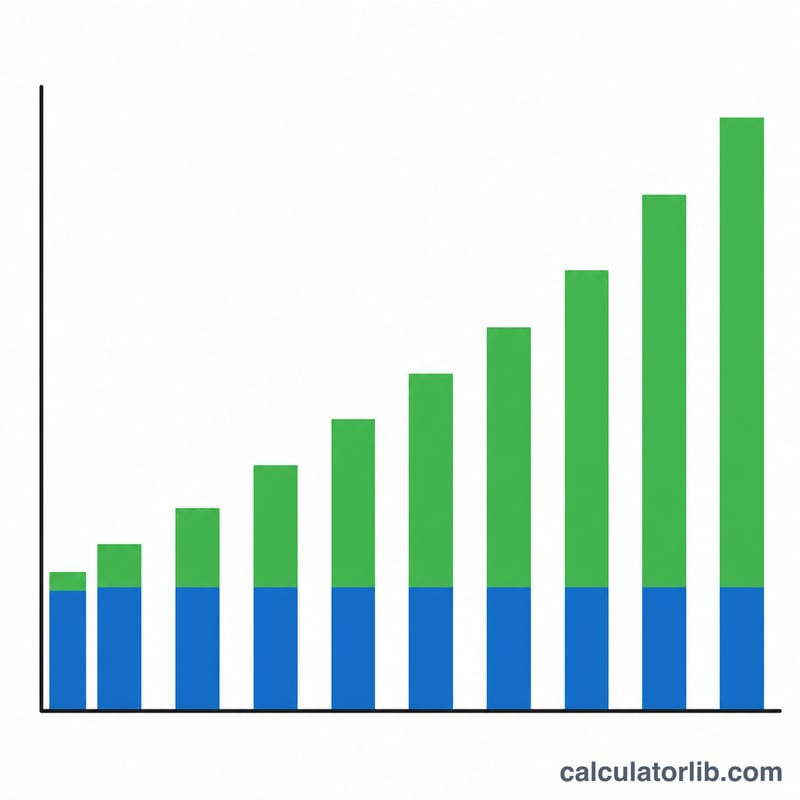
- Initial Investment ($): The lump sum you start your IRA with today.
- Monthly Contribution ($): The amount you add to the account each month.
- Annual Return Rate (%): Your expected average yearly investment return.
- Years to Grow: How many years you plan to keep investing before retirement.
How the Calculation Works
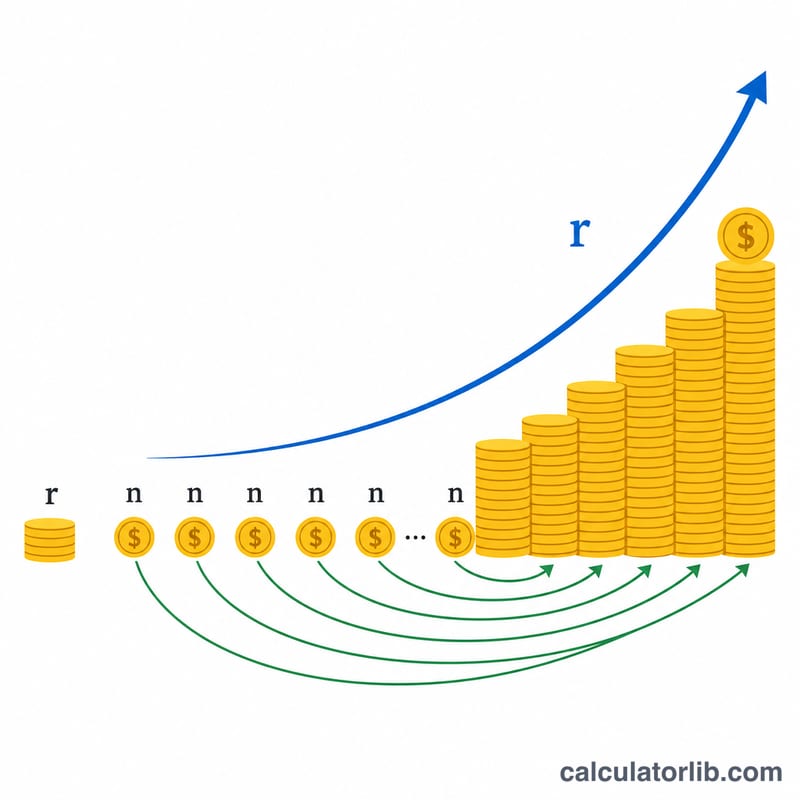
The calculator uses monthly compounding. It converts your annual return into a monthly rate (annual rate ÷ 12 ÷ 100) and runs the math for every month in your time horizon (years × 12). The overall balance follows:
$$B = P\,(1+r)^{n} + C \cdot \frac{(1+r)\left[(1+r)^{n}-1\right]}{r}$$where
$$\left\{ \begin{aligned} P &= \text{Initial Investment} \\ C &= \text{Monthly Contribution} \\ r &= \dfrac{\text{Annual Return (\%)}}{1200} \\ n &= 12 \times \text{Years} \end{aligned} \right.$$Each month it follows this order:
- Adds your monthly contribution to the balance.
- Applies one month of growth: \(\text{balance} \times (1 + \text{monthly rate})\).
It tracks total contributions (initial investment plus all monthly deposits) separately, so your total earnings are simply the final balance minus everything you put in.
Worked Example
Suppose you start with a $5,000 initial investment, add $500 per month, expect a 7% annual return, and invest for 30 years. The monthly rate is about \(0.5833\%\). After 360 months of contributions and compounding, your balance grows to roughly $649,000. Your total contributions would be \(\$5{,}000 + (\$500 \times 360) = \$185{,}000\), meaning around $464,000 comes from compound earnings alone — a powerful illustration of starting early.
Frequently Asked Questions
Does this account for IRA contribution limits? No. The IRS sets annual limits (for example, $7,000 in 2024, plus a catch-up amount if you're 50 or older). The calculator does not enforce these, so make sure your monthly contributions stay within current limits.
Is the result guaranteed? No. It assumes a constant annual return, but real markets fluctuate. Treat the figures as an estimate, not a promise.
Does it factor in taxes or inflation? No. Results are pre-inflation nominal dollars and don't model the tax differences between Traditional and Roth IRAs. Consult a financial advisor for personalized planning.