
What the CAC Calculator Does
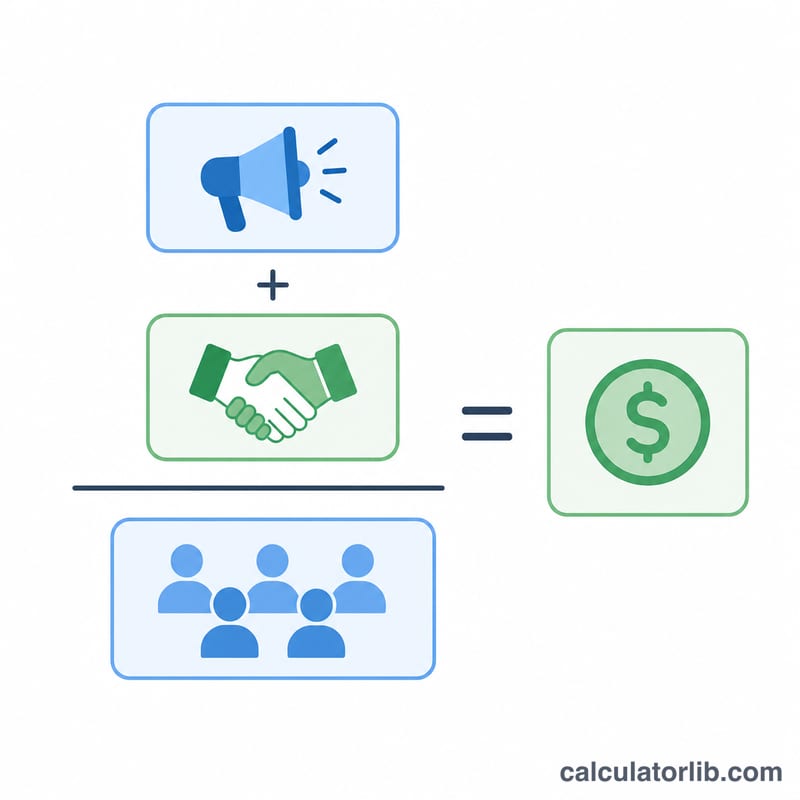
Customer Acquisition Cost (CAC) tells you how much you spend, on average, to win a single new customer. This calculator adds your total marketing spend and total sales spend over a period, then divides that combined cost by the number of new customers you acquired in the same period. Alongside the CAC figure, it also reports your total acquisition spend and the share of that spend coming from marketing versus sales—so you can see where your budget actually goes.
The Inputs You Enter
- Total Marketing Costs ($) — ad spend, content, tools, agency fees, and marketing salaries for the period.
- Total Sales Costs ($) — sales team salaries, commissions, software, and related overhead.
- Number of New Customers Acquired — the count of genuinely new customers gained in the same period.
Keep the time frame consistent across all three inputs (for example, one quarter) so the result reflects real efficiency.
The Formula
The core calculation is straightforward:
$$\text{CAC} = \frac{\text{Marketing Costs} + \text{Sales Costs}}{\text{New Customers}}$$
The calculator also derives:
- Total Costs = \(\text{Marketing Costs} + \text{Sales Costs}\)
- Marketing share % = \(\left(\dfrac{\text{Marketing Costs}}{\text{Total Costs}}\right) \times 100\)
- Sales share % = \(\left(\dfrac{\text{Sales Costs}}{\text{Total Costs}}\right) \times 100\)
If you enter zero new customers, CAC is returned as 0 to avoid dividing by zero.
Worked Example
Suppose last quarter you spent $30,000 on marketing and $20,000 on sales, and acquired 250 new customers.
- Total Costs = \(\$30{,}000 + \$20{,}000 = \$50{,}000\)
- CAC = \(\$50{,}000 \div 250 = \) $200 per customer
- Marketing share = \(\left(\dfrac{30{,}000}{50{,}000}\right) \times 100 = \) 60%
- Sales share = \(\left(\dfrac{20{,}000}{50{,}000}\right) \times 100 = \) 40%
So each new customer costs you $200 to acquire, and most of that spend is marketing-driven.
Interpreting Your CAC Result
Customer Acquisition Cost (CAC) tells you, on average, how much you spent on marketing and sales to win one new customer. By itself the number is neither "good" nor "bad" — its meaning depends on how much each customer is worth and how quickly that value is recovered.
Compare CAC to lifetime value. The most common health check is the LTV:CAC ratio, where LTV is the gross-margin value a customer generates over their lifetime. A widely cited benchmark is roughly 3:1: a customer worth $3 in lifetime value for every $1 of acquisition cost. For example, an LTV of $3,600 against a CAC of $1,200 gives an LTV:CAC ratio of 3:1. A ratio far below 3:1 (e.g. 1:1) suggests you may be spending nearly as much as a customer is worth, while a very high ratio (e.g. 5:1 or more) can indicate under-investment in growth.
Relate CAC to revenue and payback. Comparing CAC to average revenue per customer or average contract value shows how many months of revenue (or gross margin) it takes to recoup the acquisition cost — the CAC payback period. If your CAC is $1,200 and each customer contributes $200 of gross margin per month, payback is roughly six months. Shorter paybacks free up cash to reinvest in growth.
Rising vs falling CAC. A falling CAC over time generally signals improving acquisition efficiency — better targeting, stronger conversion, or word-of-mouth. A rising CAC can signal market saturation, increased competition for ad inventory, or declining channel performance, and warrants reviewing which channels and campaigns drive the increase. Always read CAC alongside LTV and payback rather than in isolation.
This is general educational information, not personalized financial advice.
Key Terms & Definitions
- Customer Acquisition Cost (CAC): The total marketing and sales spend over a period divided by the number of new customers acquired in that period — the average cost to win one customer.
- Customer Lifetime Value (LTV): The total revenue or gross-margin value a customer is expected to generate over the entire relationship with the business.
- LTV:CAC ratio: Lifetime value divided by acquisition cost, expressing how many dollars of value each acquisition dollar returns. A ratio around 3:1 is a common benchmark for sustainable unit economics.
- CAC payback period: The time — usually in months — required for the gross margin from a customer to recover the cost of acquiring them.
- Blended CAC: CAC calculated using all acquisition spend and all new customers, including those gained organically or for free.
- Paid CAC: CAC calculated using only paid acquisition spend and the customers attributable to it, isolating the efficiency of paid channels.
- New customer: A customer acquired during the measurement period, not previously a paying customer; the denominator in the CAC formula.
- Marketing share: The portion of total acquisition spend attributed to marketing activities (advertising, content, campaigns, tools).
- Sales share: The portion of total acquisition spend attributed to sales activities (salaries, commissions, sales tools, travel).
Frequently Asked Questions
What is a good CAC? There is no universal number—it depends on your industry and price point. A common benchmark is comparing CAC to customer lifetime value (LTV); an LTV:CAC ratio of roughly 3:1 is often considered healthy.
What costs should I include? Include everything tied to acquiring customers: ad spend, salaries, commissions, software, and agency or contractor fees for both marketing and sales.
Why show marketing and sales as percentages? The split highlights which function drives your acquisition spend, helping you decide where to trim or invest for better efficiency.