
What This NPV Calculator Does
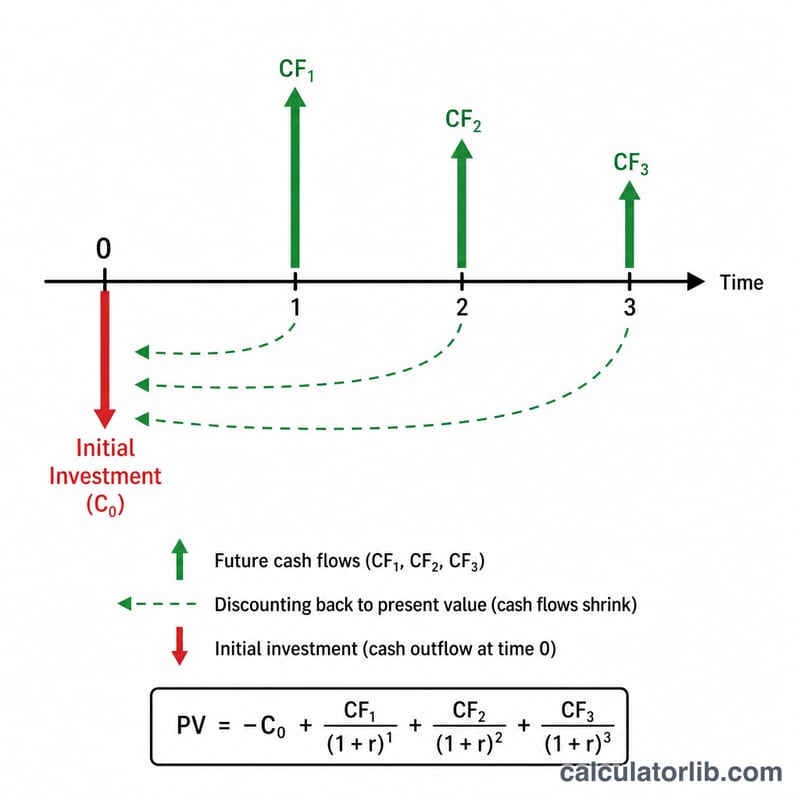
Net Present Value (NPV) tells you whether a project or investment is worth pursuing by converting all of its future cash flows into today's money and comparing them against the upfront cost. This calculator takes three inputs — an initial investment, a series of expected cash flows, and a discount rate — and returns the project's NPV along with the discounted value of each individual cash flow and a running cumulative total.
The Inputs Explained
- Initial Investment: The cash you spend up front (at time 0). The tool treats this as a negative value automatically — you just enter the positive amount.
- Cash Flows (comma-separated): Your expected returns for each future period, separated by commas (e.g.
3000,4000,5000). The first number is period 1, the second is period 2, and so on. Negative values are allowed if a period has a net outflow. - Discount Rate (%): Your required rate of return or cost of capital per period, entered as a percentage. The calculator divides it by 100 internally.
The Formula
The calculator applies the standard NPV equation:
$$\text{NPV} = -\,\text{Initial Investment} + \sum_{t=1}^{n} \frac{CF_t}{(1+r)^{t}}$$
Each cash flow is divided by a discount factor of \((1 + r)\) raised to the power of its period number \(t\). Earlier cash flows are discounted less heavily than later ones, reflecting the time value of money. The discounted amounts are summed and the initial investment is subtracted.
Worked Example
Suppose you invest $10,000, expect cash flows of 3,000, 4,000 and 5,000 over three years, and use a 10% discount rate:
- Year 1: \(3{,}000 \div 1.10 = 2{,}727.27\)
- Year 2: \(4{,}000 \div 1.10^{2} = 3{,}305.79\)
- Year 3: \(5{,}000 \div 1.10^{3} = 3{,}756.57\)
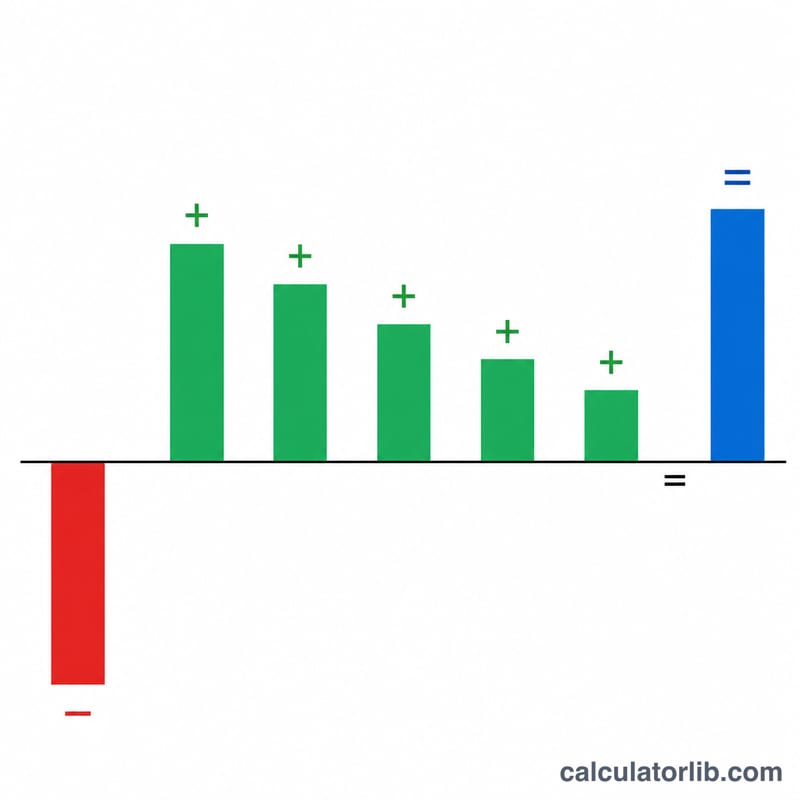
Sum of discounted flows = 9,789.63. NPV = \(-10{,}000 + 9{,}789.63 =\) −$210.37. A negative NPV means this project would fall slightly short of your 10% return target.
Frequently Asked Questions
What does a positive vs negative NPV mean? A positive NPV means the project earns more than your discount rate and adds value — generally accept it. A negative NPV means it underperforms your required return, so it's usually rejected.
What discount rate should I use? Use your cost of capital, required rate of return, or the yield on a comparable alternative investment. Higher rates shrink the value of distant cash flows.
Why is the initial investment subtracted? Because it happens today (time 0), it isn't discounted — it's already in present-value terms. The calculator simply negates it before adding the discounted future flows.