What this calculator does
It prices an OpenAI API workload at OpenAI's current list prices for the GPT model family: choose a model, enter tokens per request and requests per month, and see the monthly bill with an input, cached-input and output breakdown, plus the same workload on every other GPT model in the price list.
How OpenAI pricing works
- Input, cached input and output are priced per 1M tokens. Cached input — a repeated prompt prefix — costs a fraction of the normal input price.
- Batch: asynchronous jobs are billed at half the Standard price.
- Context length: the prices used here apply to prompts up to 272K input tokens; longer prompts are billed at higher rates, and the calculator warns when your input is above that size.
- Other tiers: Flex, Fast and regional-processing endpoints have their own prices (regional endpoints carry a 10% uplift for newer models). The calculator uses the Standard tier unless you tick Batch.
The formula
Providers bill input tokens (what you send) and output tokens (what the model writes) at separate rates, quoted per million tokens. Cached input — a prompt prefix the provider has already stored — is billed at a much lower rate. For one request:
$$\text{Cost} = \frac{(1-c)\,T_{in}\,P_{in} + c\,T_{in}\,P_{cache} + T_{out}\,P_{out} }{1\,000\,000}$$where \(T_{in}\) and \(T_{out}\) are input and output tokens per request, \(c\) is the share of input served from the cache, and \(P\) are the prices per 1M tokens. The monthly cost is the cost of one request times the number of requests per month. The Batch API option replaces \(P_{in}\) and \(P_{out}\) with the provider's batch prices.
Worked example
A support bot sends 2,000 input tokens and receives 500 output tokens per request, 10,000 times a month, on a model priced at 2 USD per 1M input tokens and 10 USD per 1M output tokens:
- Input: 2,000 × 2 ÷ 1,000,000 = 0.004 USD
- Output: 500 × 10 ÷ 1,000,000 = 0.005 USD
- Per request: 0.009 USD; per month: 0.009 × 10,000 = 90 USD
Output is only 20% of the tokens but 56% of the bill — trimming long answers usually saves more than trimming prompts. If half of the input were a cached system prompt billed at 0.10 USD per 1M, the input part would fall from 40 USD to 21 USD a month.
Where the prices come from
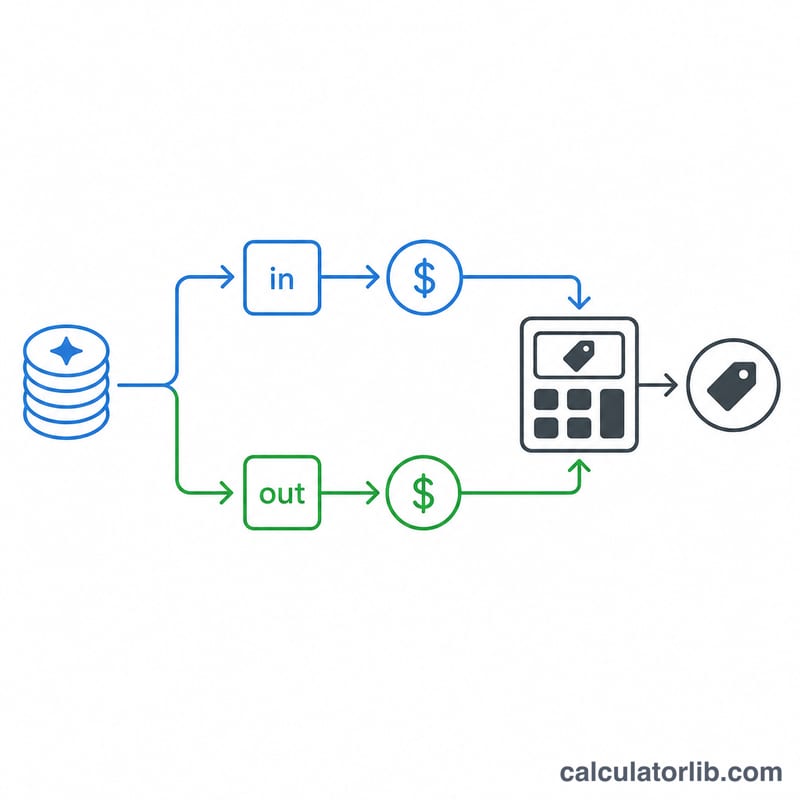
Prices come from LiteLLM's open model price list (model_prices_and_context_window.json, MIT licence), pinned to a dated commit, and every model is cross-checked by hand against the provider's own pricing page; the check date and links to both are printed under the result. Where the two disagree, the calculator uses the provider's page. Prices LiteLLM does not carry — announced future changes such as Google's new Gemini prices from 1 December 2026, and DeepSeek's off-peak rates — come from the provider's page and switch over automatically on their date. The list is refreshed weekly, and a large price change is held for a human check before it goes live. Prices are list prices for the standard (pay-as-you-go) tier in US dollars, before tax; enterprise discounts, regional-endpoint surcharges and priority tiers are not included. If a price looks different from the provider's page today, use the custom price fields and tell us.
FAQ
- Is the cheapest model the best choice?
- No. Price per token is one factor; quality, speed, context length and how many tokens a model needs for the same task all change the real cost per finished task. Use the comparison to shortlist, then test.
- Why does my invoice differ from the estimate?
- Invoices count every token actually processed: retries, tool definitions, system prompts, reasoning tokens and cache writes. Taxes and regional surcharges also apply. Start from token counts reported in your API responses for the most accurate estimate.
- How do I convert a price per 1K tokens?
- Multiply by 1,000: 0.002 USD per 1K tokens is 2 USD per 1M tokens.
- Where are GPT-3.5 and GPT-4?
- They are not in OpenAI's current flagship price table. An old link that names one of them opens with the current default model instead, and the page says so.
- Is Azure OpenAI priced the same?
- Azure publishes its own prices and regions; this calculator uses OpenAI's own API list prices.