
What Is the Percentage of Year Calculator?
The Percentage of Year Calculator tells you how far through the calendar year a particular date is, expressed as a simple percentage. For example, the end of June lands at roughly 50%, meaning half the year has elapsed. This tool works for any country and any date, since it relies only on the standard Gregorian calendar that most of the world uses. It automatically accounts for leap years, so calculations stay accurate whether the year has 365 or 366 days.
How to Use It
Using the calculator takes just a few seconds:
- Enter the month (1–12) for your chosen date.
- Enter the day of the month (1–31).
- Enter the year so leap years are handled correctly.
- Read the result as a percentage of the full calendar year that has passed.
The output is ideal for visualising progress toward annual goals, tracking budgets, monitoring savings targets, or simply satisfying curiosity about how much of the year remains.
The Formula Explained
The calculation counts the number of days from January 1 up to and including your chosen date, then divides by the total number of days in that year:
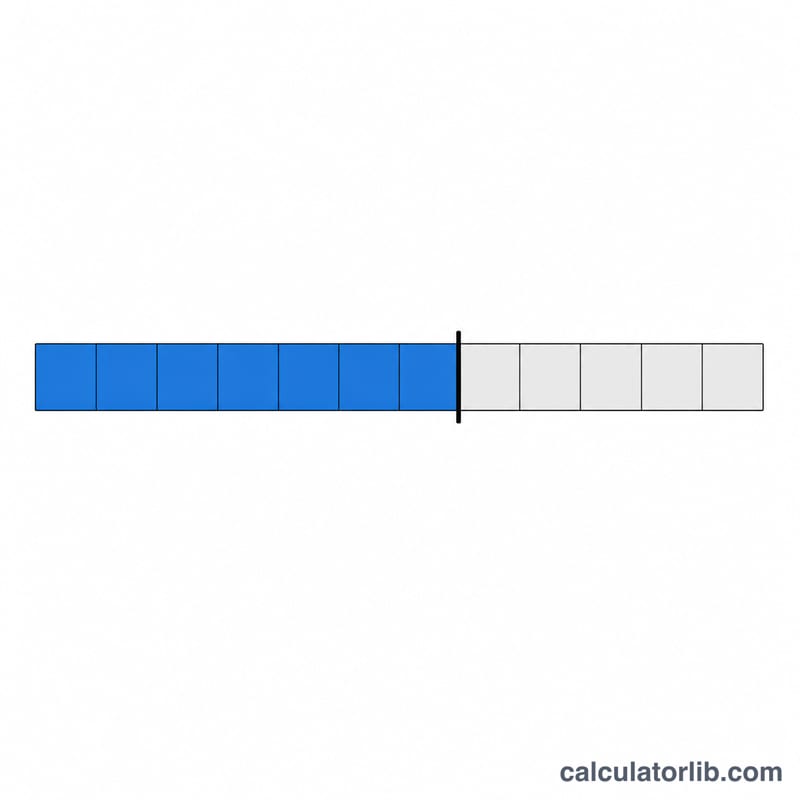
$$\text{Percentage} = \left(\frac{\text{Day of year}}{\text{Total days in year}}\right) \times 100$$The "day of year" is the position of your date within the year. January 1 is day 1, December 31 is day 365 (or 366 in a leap year). A year is a leap year if it is divisible by 4, except for century years, which must be divisible by 400.
Worked Example
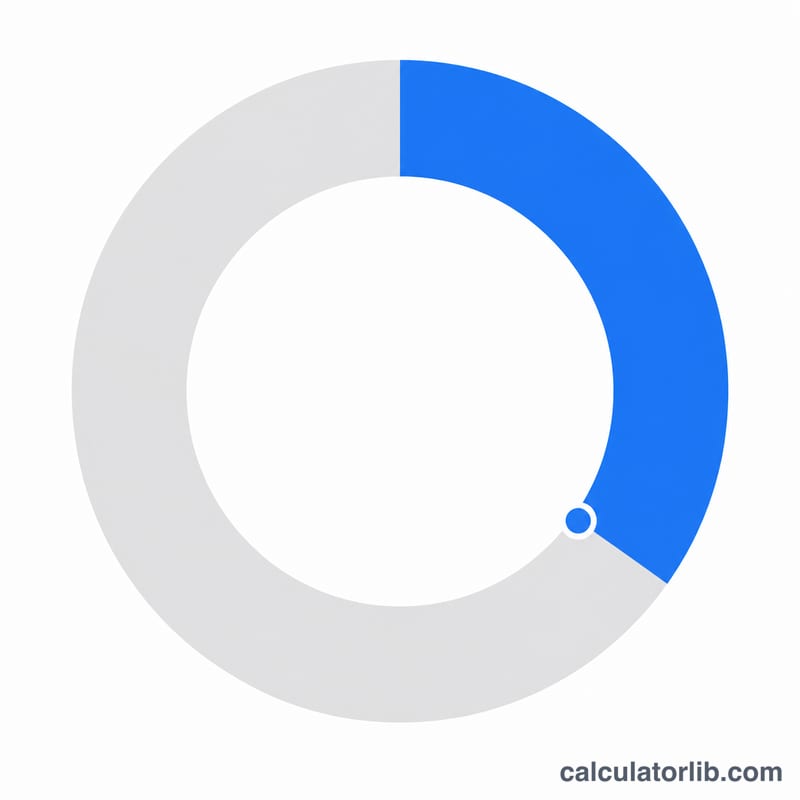
Suppose you choose July 1, 2025. Since 2025 is not a leap year, the total is 365 days. The number of days from January 1 to July 1 inclusive is 182. The calculation is:
$$\left(\frac{182}{365}\right) \times 100 = 49.86\%$$So by July 1, 2025, just under half of the year has passed.
Year Progress Across Different Dates
The clearest way to see leap-year impact is to compare the same calendar dates in a leap year (2024, \(T = 366\)) against a non-leap year (2025, \(T = 365\)). Because February gains a 29th day, every date from March onward sits one ordinal higher in 2024, while the larger divisor nudges each percentage slightly downward.
| Date | Day of Year (D) | Total Days (T) | Percentage of Year |
|---|---|---|---|
| Feb 28, 2024 | 59 | 366 | 15.85% |
| Feb 29, 2024 (leap day) | 60 | 366 | 16.12% |
| Mar 1, 2024 (leap year) | 61 | 366 | 16.39% |
| Mar 1, 2025 (non-leap) | 60 | 365 | 16.16% |
| Jun 30, 2024 | 182 | 366 | 49.45% |
| Jun 30, 2025 | 181 | 365 | 49.32% |
| Sep 30, 2024 | 274 | 366 | 74.59% |
| Sep 30, 2025 | 273 | 365 | 74.52% |
| Dec 31, 2024 | 366 | 366 | 99.73% |
| Dec 31, 2025 | 365 | 365 | 99.73% |
Notice that Mar 1 lands on day 61 in 2024 but day 60 in 2025 — a one-day shift caused entirely by the extra leap day. Despite this, Dec 31 reads 99.73% in both years because the final day is always \(\frac{T-1}{T}\) of the way through. To check how many days separate any two of these dates, use the Days Between Dates Calculator, and to verify whether a given year is a leap year, see the Leap Year Calculator.
Frequently Asked Questions
Does the calculator handle leap years? Yes. It checks whether the year is a leap year and uses 366 days when appropriate, keeping every result precise.
Is the chosen date counted as part of the elapsed days? Yes, the selected date is included, so January 1 returns a small positive percentage rather than zero.
Can I use this for any country? Absolutely. The calendar year is the same worldwide, so results apply equally regardless of where you live.
Related calculators
- Days Until Calculator — days until a date.
- ISO Week Number Calculator — ISO week number of a date.