
What the converter does
Pick the scale you know (a US size, a UK letter, a Japanese or Hong Kong number, an Indian size, or a measured circumference or diameter in mm) and type it: the same ring appears at once in every other scale. Everything goes through the inner circumference in millimetres, which is the ISO 8653 size used in most of Europe.
Example: 17.32 mm × π = 54.4 mm → ISO 54, which is US 7, UK N½ and Japan 14.
How the sizes relate
A US or Canadian size is an inner diameter: d = 11.6332 + 0.8128 × size, in mm, which matches the diameters Tiffany prints for sizes 4 to 13. The Japanese JCS scale starts at 13 mm for size 1 and adds 1/3 mm per size. ISO 8653 sizes are the circumference in whole millimetres. UK and Australian letters, Hong Kong, mainland China and India have no simple formula, so they come from published jewellers' charts, and brands differ by up to half a size.
| US / Canada | Diameter | Circumference | ISO / EU | UK / Australia | Japan | Hong Kong | India |
|---|---|---|---|---|---|---|---|
| 5 | 15.7 | 49.3 | 49 | J | 9 | 11 | 9 |
| 5.5 | 16.1 | 50.6 | 51 | K½ | 10 | 12 | 10 |
| 6 | 16.51 | 51.9 | 52 | L½ | 12 | 13 | 12 |
| 6.5 | 16.92 | 53.1 | 53 | M½ | 13 | 14 | 13 |
| 7 | 17.32 | 54.4 | 54 | N½ | 14 | 15 | 14 |
| 7.5 | 17.73 | 55.7 | 56 | P | 15 | 16 | 15 |
| 8 | 18.14 | 57 | 57 | Q | 16 | 17 | 17 |
| 8.5 | 18.54 | 58.3 | 58 | R | 18 | 19 | 18 |
| 9 | 18.95 | 59.5 | 60 | S | 19 | 20 | 19 |
How to measure at home
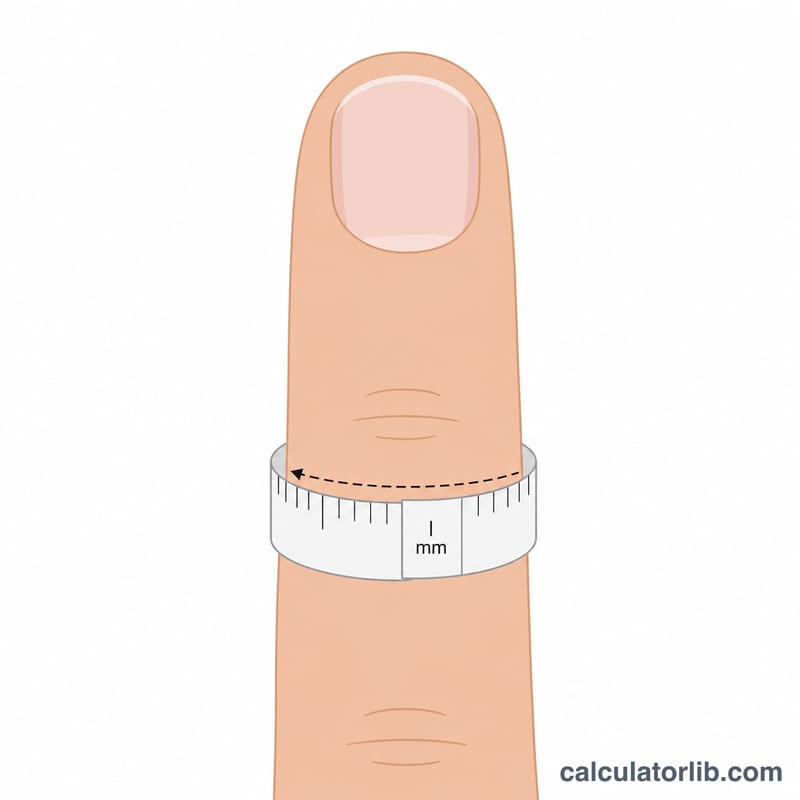
Wrap a strip of paper round the base of the finger, mark where it overlaps and measure the length in millimetres: that is the circumference. Or measure the inside of a ring that fits across the middle. Measure at the end of the day, when fingers are largest, and make sure the ring passes over the knuckle. The numbers you type stay in your browser.
Ring Size Conversion Chart: Circumference, Diameter, US, UK and EU
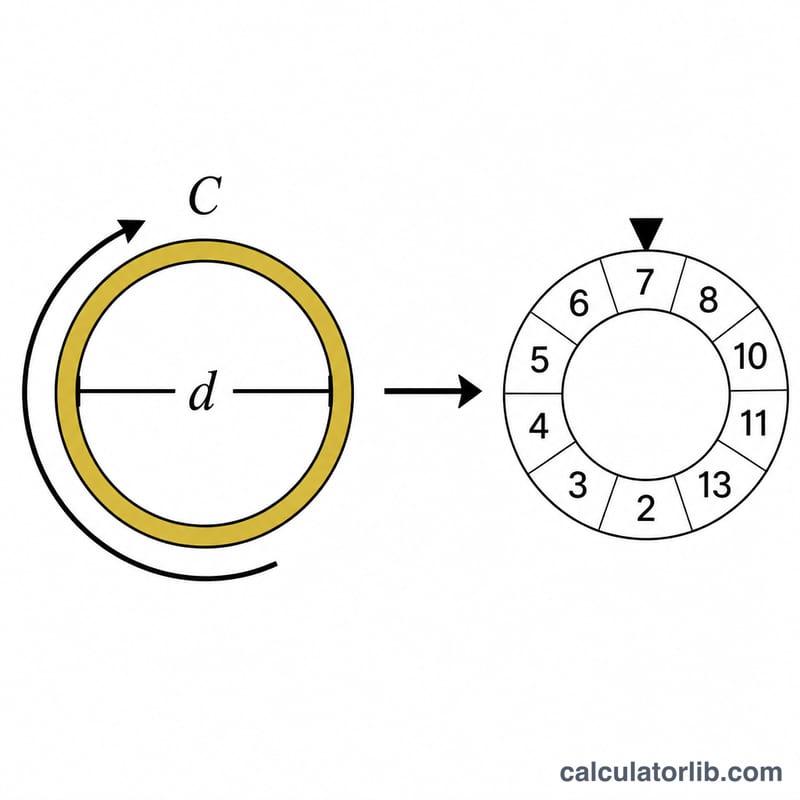
Ring sizes are really a measure of the inside of the ring. Inner diameter and inner circumference are linked by \(C = \pi \times d\). The chart below uses the commonly published North American (US/Canada) scale, where inner diameter in mm is about \(11.63 + 0.8128 \times \text{size}\), together with the usual UK (letter) and EU (ISO 8653-style, where the size is roughly the inner circumference in mm) equivalents.
| Finger circumference (mm) | Inner diameter (mm) | US size | UK size | EU size |
|---|---|---|---|---|
| 44.2 | 14.1 | 3 | F½ | 44 |
| 46.7 | 14.9 | 4 | H½ | 47 |
| 49.3 | 15.7 | 5 | J½ | 49 |
| 51.9 | 16.5 | 6 | L½ | 52 |
| 54.4 | 17.3 | 7 | N½ | 54 |
| 57.0 | 18.1 | 8 | P½ | 57 |
| 59.5 | 18.9 | 9 | R½ | 59–60 |
| 62.1 | 19.8 | 10 | T½ | 62 |
| 64.6 | 20.6 | 11 | V½ | 65 |
| 67.2 | 21.4 | 12 | X½ | 67 |
How to use it: measure the circumference of your finger with a strip of paper or a flexible tape, find the nearest row, and read across. If you fall between two rows, see the tips below on choosing the larger size.
Practical Tips for Choosing and Ordering Your Ring Size
- Size up for wide bands. Bands around 6 mm or wider fit more tightly than thin ones because more of the finger is covered. Many people go up about a quarter to a half size for wide bands, and more for very wide ones.
- Measure several times. Fingers swell with heat, salt intake, exercise and time of day, and shrink in the cold. Measure on at least two or three different days, at different times, with your hands at normal room temperature, and use the average.
- Consider your knuckle. If your knuckle is noticeably larger than the base of your finger, the ring must pass over the knuckle but still stay in place at the base. Measure both. A size between the two is often the practical compromise, and some people choose a ring with a slightly snug fit at the base plus a sizing bead or guard.
- When between sizes, choose the larger. A slightly loose ring can be padded or adjusted, while a tight ring is uncomfortable and hard to remove.
- Check the retailer's resizing policy. Before ordering, find out whether resizing is free, how many times it is allowed, and the time limit, as well as the return window for the item.
- Know the limits of resizing. Eternity bands or rings with stones set all the way around, rings with intricate engraving or patterns, tension settings, and some metals such as tungsten, titanium or ceramic generally cannot be resized, or only by a few sizes. For these, getting the size right the first time matters most.
- Know your size system. Confirm whether a seller uses US, UK or EU sizing, and compare your measurement against their own chart, since small differences exist between brands.
This is general information, not professional advice. For a very precise fit, especially for an important purchase, a jeweller can measure you with a ring sizer.