What the Chinese Zodiac Calculator Does
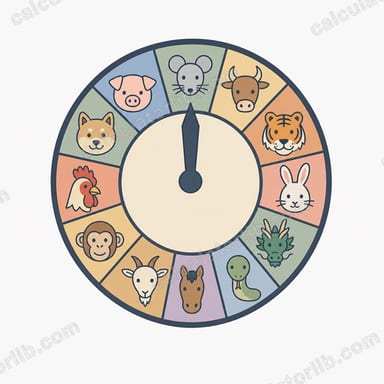
This calculator takes a single input — your birth year — and returns your Chinese zodiac animal, along with the associated element and yin/yang polarity. The Chinese zodiac (sheng xiao) is a repeating 12-year cycle, with each year named after one of twelve animals. The system originates in China and is widely used across East and Southeast Asia. Note that the traditional Chinese calendar begins at Chinese New Year (late January or February), so people born in January or early February may technically belong to the previous year's sign — this tool uses the calendar year you enter.

How to Use It
- Enter your four-digit Birth Year (for example, 1990 or 2000).
- The calculator instantly displays your animal sign, fixed element, and yin/yang.
- If no year is entered, it defaults to 2000.
The Formula Explained
The animal is found by taking the year, subtracting 4 (since the cycle is anchored so that year 4 = Rat), and finding the remainder when divided by 12:
- Animal = $$\text{Animal} = \text{Animals}\left[\left(\text{Year} - 4\right) \bmod 12\right]$$ where the list runs Rat, Ox, Tiger, Rabbit, Dragon, Snake, Horse, Goat, Monkey, Rooster, Dog, Pig.
- Element = $$\text{Element} = \text{Elements}\left[\left\lfloor \frac{\left(\text{Year} - 4\right) \bmod 10}{2} \right\rfloor\right]$$ cycling through Wood, Fire, Earth, Metal, Water over a 10-year pattern.
- Yin/Yang = Yang if the year is even, Yin if the year is odd.

Worked Example
Suppose you were born in 1990:
- Animal: $$\left(1990 - 4\right) \bmod 12 = 1986 \bmod 12 = 6 \rightarrow \text{index } 6$$ is Horse.
- Element: $$\left(1990 - 4\right) \bmod 10 = 6, \text{ then } 6 / 2 = 3 \rightarrow \text{index } 3$$ is Metal.
- Yin/Yang: 1990 is even → Yang.
So a person born in 1990 is a Yang Metal Horse.
Key Terms Explained
The Chinese zodiac is a calendar-based naming system, not a calculation about personality. These are the terms you will meet when you read a result from this calculator.
- Sheng xiao (生肖) / Chinese zodiac — the cycle of twelve animals (Rat, Ox, Tiger, Rabbit, Dragon, Snake, Horse, Goat, Monkey, Rooster, Dog, Pig) assigned to years in a fixed repeating order. The same system is used, with a few local animal substitutions, in Vietnam, Korea, Japan and Mongolia; in Vietnam, for example, the Rabbit year is traditionally a Cat year and the Ox is a Water Buffalo.
- Earthly Branches (地支) — the 12-year cycle — the twelve branches (子 zǐ, 丑 chǒu, 寅 yín, 卯 mǎo, 辰 chén, 巳 sì, 午 wǔ, 未 wèi, 申 shēn, 酉 yǒu, 戌 xū, 亥 hài) are the real underlying sequence; the twelve animals are popular labels attached to them. This calculator finds the branch with \((\text{year}-4)\bmod 12\), where the offset 4 makes 4 CE a Rat year.
- Heavenly Stems (天干) — the 10-year cycle — ten signs (甲 jiǎ, 乙 yǐ, 丙 bǐng, 丁 dīng, 戊 wù, 己 jǐ, 庚 gēng, 辛 xīn, 壬 rén, 癸 guǐ) that advance alongside the branches. The stem of a year is \((\text{year}-4)\bmod 10\).
- Sexagenary cycle (干支, 60 years) — stems and branches advance together, one step each per year, so only half of the 120 possible pairings ever occur (even stems meet even branches, odd meet odd). The number of distinct combinations is $$\frac{12 \times 10}{2} = 60$$ which is why a full stem-branch name such as 甲辰 (Wood Dragon) returns once every 60 years. A 60th birthday completing this cycle is traditionally a milestone.
- Five Elements / Wu Xing (五行) — Wood, Fire, Earth, Metal, Water. Each pair of stems shares one element: stems 1–2 are Wood, 3–4 Fire, 5–6 Earth, 7–8 Metal, 9–10 Water. The year element shown by a year-based tool is therefore fully determined by the year and repeats every 10 years.
- Year element vs. 'inner' or natal element — the element derived from the birth year stem is the only one a year-only calculator can give. Traditional Chinese astrology also uses a fuller chart (八字 bāzì, the "four pillars" of year, month, day and hour), from which practitioners read a person's day-master or "inner" element. That value cannot be obtained from the year alone and will often differ from the year element.
- Yin and yang (陰陽) — the polarity of the stem: odd-numbered stems (甲, 丙, 戊, 庚, 壬) are yang, even-numbered (乙, 丁, 己, 辛, 癸) are yin. In practice, an even Gregorian year such as 2024 is yang and an odd year such as 1985 is yin, so a full sign reads "Yang Wood Dragon" or "Yin Wood Ox".
- Chinese New Year vs. lichun (立春) — the two competing boundaries for where a zodiac year begins. The popular boundary is Chinese New Year, a lunisolar date that falls between roughly 21 January and 20 February. Many astrological schools instead start the year at lichun, the solar term "start of spring", around 3–5 February. A year-only calculator assumes 1 January, so anyone born in January or early February should check their actual birth date against that year's Chinese New Year (or lichun) and may belong to the previous animal year.
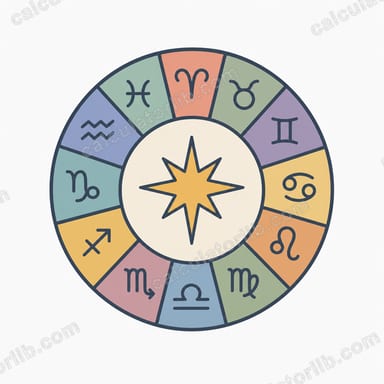
- Animal sign vs. Western zodiac sign — the Chinese animal sign is assigned by year and repeats every 12 years; a Western zodiac sign (Aries, Taurus, …) is assigned by the date within the year and repeats every 12 months. They are unrelated systems and a person has one of each.
Zodiac signs are cultural and traditional, not scientific. Treat results as heritage and entertainment rather than as information about health, character or compatibility.
Frequently Asked Questions
What if I was born in January or February? The Chinese zodiac year starts on Chinese New Year, not January 1. If you were born in the first few weeks of the year, check whether your birthday falls before or after that year's New Year — you may belong to the previous animal sign.
Why is the element only fixed to my year? The simple cycle here pairs each two consecutive years with one of the five elements. Traditional Chinese astrology also assigns elements to month, day and hour, but this tool reports only the year-based element.
How often does my exact sign repeat? The animal repeats every 12 years, but the full animal-and-element combination repeats every 60 years — the famous sexagenary cycle.