What the Hijri Date Converter Does
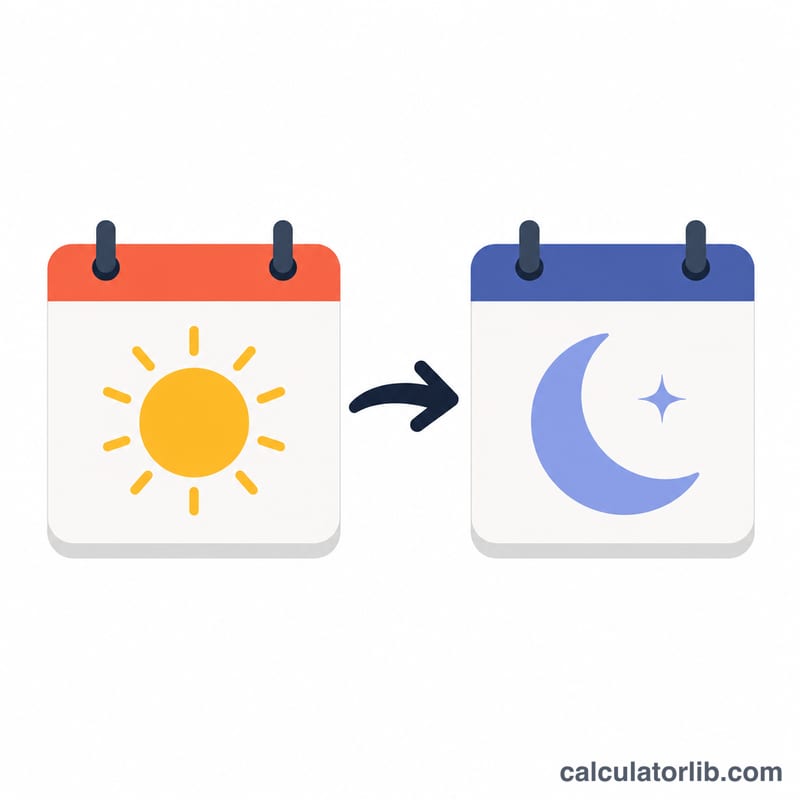
This tool converts a date from the Gregorian calendar (the standard civil calendar used worldwide) into the Islamic, or Hijri, calendar used across the Muslim world for religious observances, festivals, and historical dating. You enter a single Gregorian date and the converter instantly returns the matching Hijri year, month number, day of the month, and the full Hijri month name — for example, 1446, month 9, day 1, "Ramadan".
How to Use It
There is just one input field:
- Gregorian Date — pick or type the calendar date you want to convert (in standard year-month-day format, e.g. 2024-03-11).
Submit the date and the calculator displays the corresponding Hijri date split into its individual parts so you can read off the exact day, month name, and year in the Islamic calendar.
The Formula and How the Conversion Works
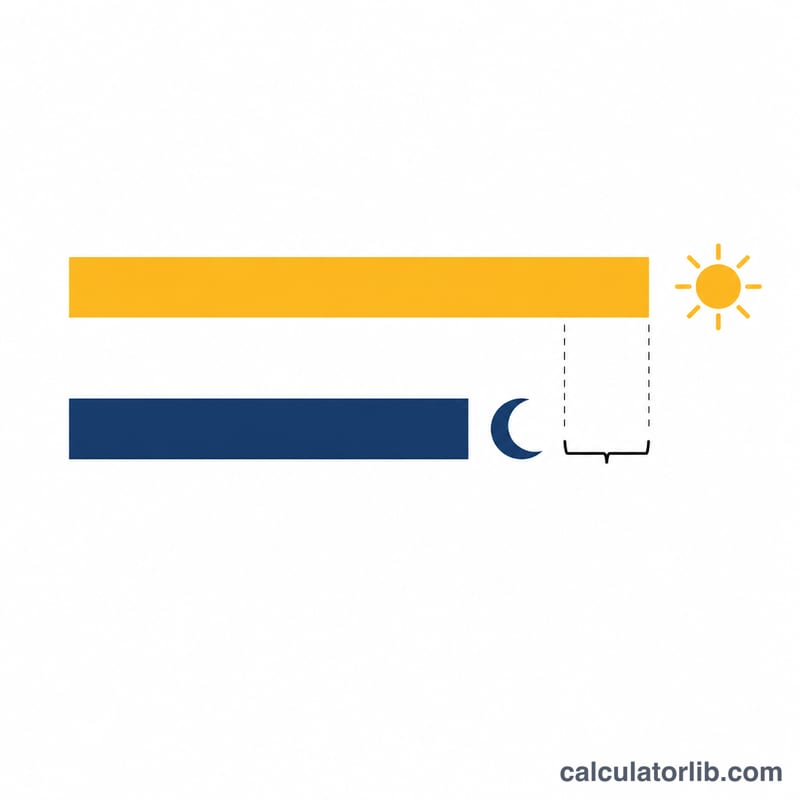
The converter doesn't rely on a simple subtraction. The Hijri calendar is a purely lunar calendar of 12 months that are 29 or 30 days long, giving a year of about 354 days — roughly 11 days shorter than the Gregorian solar year. Because of this, no fixed offset works for all dates.
Internally the tool parses your Gregorian date into a calendar date object, then maps it onto the standardised tabular Islamic calendar (the Umm al-Qura–style chronology built into the date library). It extracts four fields from the result: the Hijri year, the month number (1–12), the day of the month, and the localised month name.
Worked Example
Suppose you enter 2024-03-11 as the Gregorian Date. The converter maps it to the Hijri calendar and returns:
- Hijri Year: 1445
- Hijri Month: 9
- Hijri Day: 1
- Month Name: Ramadan
So 11 March 2024 corresponds to 1 Ramadan 1445 AH — the first day of the fasting month.
The 12 Hijri Months in Order
The Hijri (Islamic) year has 12 purely lunar months and no intercalary month, so it runs about 354 or 355 days — roughly 11 days shorter than a Gregorian year. The day counts below are those of the tabular (arithmetic) Islamic calendar, which alternates 30- and 29-day months; Dhu al-Hijjah takes a 30th day in a leap year. In calendars based on actual crescent sighting, any month may in practice be 29 or 30 days regardless of the tabular pattern.
| # | Month (transliterated) | Tabular length (days) | Commonly associated observance |
|---|---|---|---|
| 1 | Muharram (المحرم) | 30 | Islamic New Year begins on 1 Muharram; 10 Muharram is Ashura. One of the four sacred months. |
| 2 | Safar (صفر) | 29 | No major canonical observance. |
| 3 | Rabi' al-Awwal (ربيع الأول) | 30 | Traditionally linked to the birth of the Prophet Muhammad (Mawlid), marked by many though not all communities. |
| 4 | Rabi' al-Thani (ربيع الآخر) | 29 | No major canonical observance. |
| 5 | Jumada al-Ula (جمادى الأولى) | 30 | No major canonical observance. |
| 6 | Jumada al-Akhirah (جمادى الآخرة) | 29 | No major canonical observance. |
| 7 | Rajab (رجب) | 30 | A sacred month; 27 Rajab is widely observed as Isra' and Mi'raj. |
| 8 | Sha'ban (شعبان) | 29 | Month preceding Ramadan; 15 Sha'ban (Laylat al-Bara'ah) observed in many regions. |
| 9 | Ramadan (رمضان) | 30 | Month of obligatory fasting; Laylat al-Qadr sought in the last ten nights. |
| 10 | Shawwal (شوال) | 29 | 1 Shawwal is Eid al-Fitr; six voluntary fasting days often kept afterwards. |
| 11 | Dhu al-Qi'dah (ذو القعدة) | 30 | A sacred month; start of the Hajj travel season. |
| 12 | Dhu al-Hijjah (ذو الحجة) | 29 (30 in a leap year) | Hajj pilgrimage (8–13); Day of Arafah on 9; Eid al-Adha on 10. A sacred month. |
Totals: \(30+29+30+29+30+29+30+29+30+29+30+29 = 354\) days in a common year, and 355 days in a leap year. The four sacred months (Muharram, Rajab, Dhu al-Qi'dah, Dhu al-Hijjah) are named as such in the Qur'an. Local spellings vary — Rabi' al-Thani is also written Rabi' al-Akhir, and Jumada al-Ula/al-Akhirah are sometimes rendered Jumada I and Jumada II.
Interpreting Your Hijri Date Result
The date this converter returns is a calculated calendar date, not an announcement. Read it as follows.
- It is an arithmetic result. The conversion applies a fixed rule set (a tabular or algorithmic Islamic calendar) to your Gregorian input. No one looked at the sky for it. A moon-sighting-confirmed date is declared by a human authority after the crescent is observed or an observation report is accepted.
- A difference of ±1 day from your national calendar is normal. Saudi Arabia's Umm al-Qura calendar, printed calendars in Malaysia, Indonesia, Turkey, Pakistan, Morocco and elsewhere, and local hilal committees in Europe and North America each apply their own criteria. On any given day two of these can legitimately disagree by one day, and occasionally by two around the start of a month. Your result matching one of them and not another is expected behaviour, not an error.
- The Hijri day begins at sunset. In Islamic reckoning the new day starts at maghrib on the preceding Gregorian evening. So if you enter a Gregorian date and you are asking about a moment after sunset, the correct Hijri day is generally the next one after the converted result. This matters most for evening events: the night before Eid, the first night of Ramadan (Tarawih), and the night of Ashura.
- What "AH" means for the number. AH stands for Anno Hegirae, and year 1 AH begins with the Hijra in 622 CE. Because the lunar year is about 354.37 days against the Gregorian 365.2425 days, Hijri dates fall roughly 11 days earlier in the Gregorian year each year: $$365.2425 - 354.367 \approx 10.88 \text{ days per year}$$ Over about 33 Gregorian years a given Hijri date completes a full cycle through the seasons, which is why Ramadan moves across summer and winter over a lifetime. A rough sanity check on the year number is $$\text{AH} \approx \left(\text{CE} - 622\right) \times \frac{33}{32}$$ which for a 2026 CE date gives about 1447–1448 AH.
- Two Hijri years can touch one Gregorian year. Since a lunar year is shorter, one Gregorian year usually contains parts of two Hijri years, and roughly every 33 years a single Gregorian year contains two Islamic New Years. A year label in your result that seems to "jump early" is this effect.
- For religious timing, confirm locally. Use this result for administrative, historical, document-dating and planning purposes. For the start of Ramadan, Eid al-Fitr, Eid al-Adha, the Day of Arafah, Ashura or the date of an obligatory fast, take the announcement of your local mosque, national moon-sighting committee or religious authority as the operative one.
The converter is also useful in reverse-checking historical documents: dates in Ottoman, Mughal or classical Arabic sources are given in AH, and converting them gives an approximate Gregorian equivalent that may be off by a day for the same reasons above.
Key Terms Explained
| Term | Meaning |
|---|---|
| Hijri / Islamic calendar | A purely lunar calendar of 12 months and about 354 days per year, used for religious observance worldwide and as a civil calendar in Saudi Arabia and some neighbouring states. It is not tied to the seasons. |
| AH (Anno Hegirae) | Latin for "in the year of the Hijra" — the era marker for Hijri years, written after the number (e.g. 1447 AH). Year 1 AH begins in 622 CE. |
| Hijra | The migration of the Prophet Muhammad and his followers from Mecca to Medina in 622 CE. The calendar's epoch, 1 Muharram 1 AH, is conventionally placed at 16 July 622 CE in the Julian calendar under the tabular reckoning. |
| Lunar year vs. solar year | A lunar year is 12 lunar months, averaging about 354.37 days. A solar (tropical) year is about 365.2425 days. The roughly 11-day gap is why Hijri dates shift earlier through the Gregorian year and why Ramadan migrates through the seasons. |
| Lunar month (synodic month) | The average interval between new moons, about 29.53 days — the reason months alternate between 29 and 30 days. |
| Tabular (arithmetic) Islamic calendar | A rule-based calendar that fixes month lengths at 30 and 29 days alternately and inserts leap days on a fixed schedule. It requires no observation, is fully reversible, and is what computer conversions typically implement. |
| Umm al-Qura calendar | The official calendar of Saudi Arabia, computed from astronomical criteria for the moon's position over Mecca rather than from a fixed arithmetic table. It is widely referenced internationally but is a Saudi national calendar, and other countries do not always follow it. |
| Hilal | The young crescent moon whose sighting after sunset marks the start of a new Hijri month in traditional practice. Accepted either by naked-eye observation or, in some jurisdictions, by calculation-assisted criteria. |
| Intercalation / leap year | The insertion of a single extra day at the end of Dhu al-Hijjah, making a 355-day year. In the tabular calendar there are 11 leap years in every 30-year cycle; the most common scheme places them in years 2, 5, 7, 10, 13, 16, 18, 21, 24, 26 and 29 of the cycle, though several variant schemes exist. Note that the Islamic calendar has no intercalary month — unlike the Hebrew or traditional Chinese calendars, it is never re-synchronised with the solar year. |
| 30-year cycle | The tabular calendar's repeating unit: \(19 \times 354 + 11 \times 355 = 10{,}631\) days over 30 years, giving a mean month of about 29.5306 days — very close to the true synodic month. |
| CE / Gregorian calendar | CE ("Common Era") numbers years from the same epoch as AD. The Gregorian calendar is the solar calendar introduced in 1582 and now used civilly in most of the world; it is the calendar you enter dates in on this page. |
| Maghrib | Sunset prayer time, and the moment at which the Hijri day changes — the new Hijri date starts on the evening of the preceding Gregorian day. |
Frequently Asked Questions
Why might my result differ by a day from a local calendar? The tool uses a calculated (tabular) Islamic calendar. Many countries determine the start of each month by physical moon sighting, which can shift dates by a day in either direction.
What does "AH" mean? AH stands for "Anno Hegirae," counting years from the Prophet Muhammad's migration (Hijra) from Mecca to Medina in 622 CE.
Can I convert any date? You can convert any valid Gregorian date you enter; just provide it in the standard year-month-day format so it parses correctly.