

What the Annual Salary Calculator Does
The Annual Salary Calculator turns your hourly pay into a clear picture of what you earn over a week, a month, and a full year. It is useful whether you are quoted an hourly rate, comparing a new job offer, budgeting for the year ahead, or checking whether part-time hours add up to the income you need. Just enter three numbers and the calculator does the maths instantly.
The Inputs You Provide
- Hourly Wage — the amount you are paid per hour, in your own currency.
- Hours Worked Per Week — your typical weekly hours (for example, 40 for full-time).
- Weeks Worked Per Year — how many weeks you actually work. Use 52 for the whole year, or fewer if you take unpaid time off or work seasonally.
The Formula
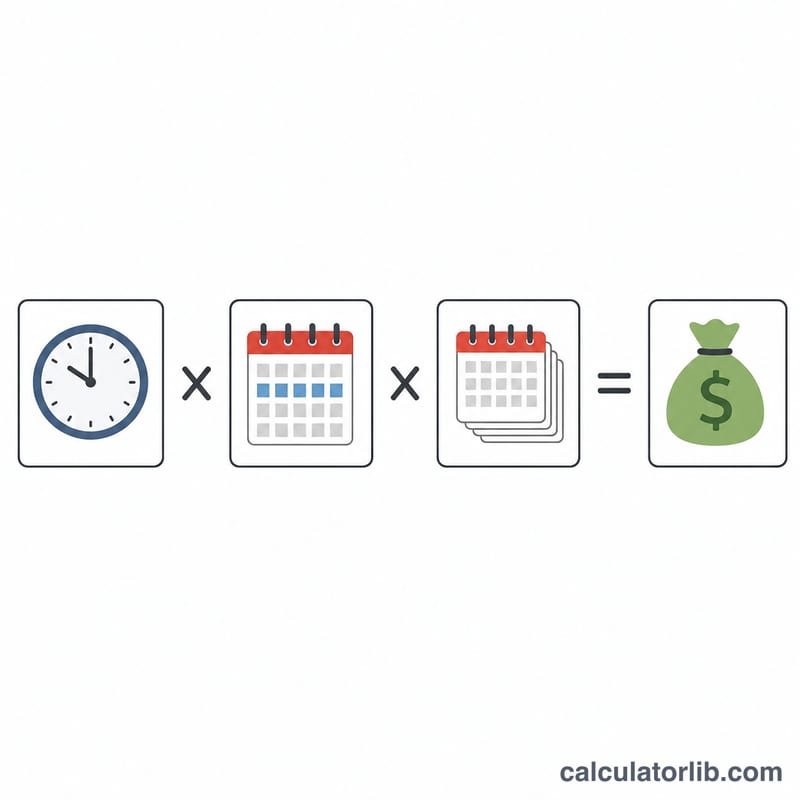
The core calculation is straightforward:
$$\text{Annual Salary} = \text{Hourly Wage} \times \text{Hours per Week} \times \text{Weeks per Year}$$Behind the scenes the tool also derives two extra figures. Your weekly salary is \(\text{Hourly Wage} \times \text{Hours per Week}\). Your monthly salary is calculated as \(\text{Weekly Salary} \times 52 \div 12\) — it always spreads a full 52-week year across 12 months, regardless of the weeks-per-year value you enter, giving a smooth average month.
Worked Example
Suppose you earn $25 per hour, work 40 hours per week, and work 50 weeks per year (taking two weeks of unpaid leave):
- Weekly salary: \(25 \times 40 = \mathbf{\$1{,}000}\)
- Monthly salary: \(1{,}000 \times 52 \div 12 = \mathbf{\$4{,}333.33}\)
- Annual salary: \(1{,}000 \times 50 = \mathbf{\$50{,}000}\)
Notice the monthly figure assumes a standard 52-week pattern, while the annual figure reflects the 50 weeks you actually worked.
Frequently Asked Questions
How many weeks should I enter? Enter 52 for a full year of paid work. If you have unpaid holidays or seasonal gaps, subtract those weeks for a more realistic annual figure.
Why doesn't the monthly figure match annual ÷ 12? The monthly value is based on a full 52-week year (\(\text{weekly pay} \times 52 \div 12\)), so it stays consistent even when your weeks-per-year differs. The annual figure uses your actual weeks worked.
Does this account for tax? No. The result is gross pay before income tax, deductions, or benefits. Your take-home pay will be lower.