

What the Salary to Hourly Calculator Does
This calculator converts an annual salary into an equivalent hourly wage — along with daily, weekly, bi-weekly, monthly and quarterly figures. It's useful whether you're comparing a salaried job offer to an hourly role, estimating freelance rates, or simply working out what your time is really worth. The math is universal and works with any currency, since it relies only on the numbers you enter.
The Inputs You Provide
- Annual Salary – your total gross pay for the year (before tax).
- Hours Per Week – how many hours you typically work each week (e.g. 40).
- Weeks Worked Per Year – the number of weeks you actually work. Use 52 for a full year, or fewer if you take unpaid weeks off.
The Formula Explained
The core calculation is straightforward:
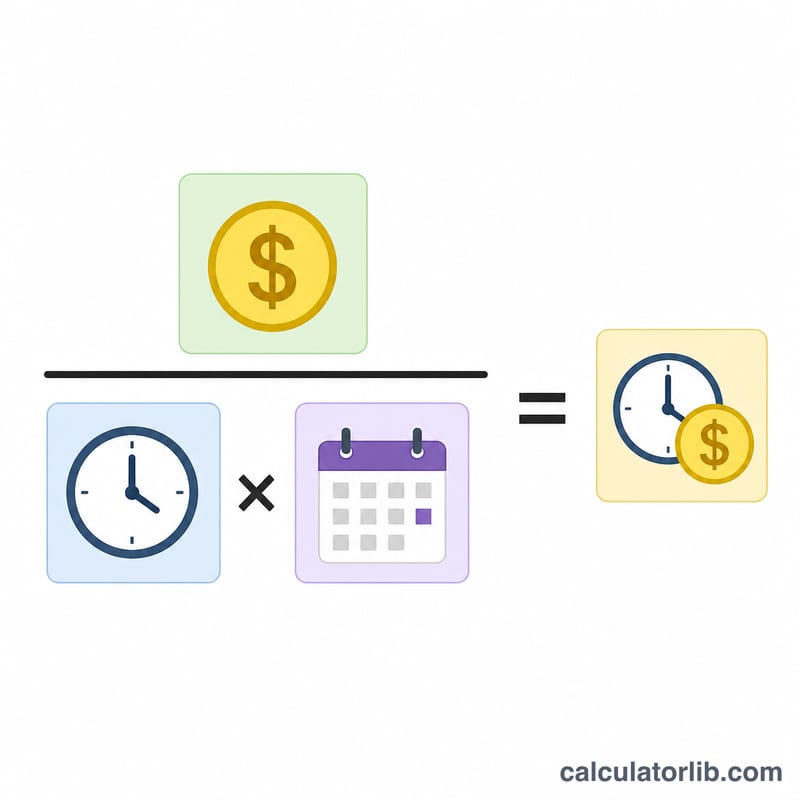
- Hourly Rate = Annual Salary ÷ (Hours Per Week × Weeks Worked Per Year)
- Weekly Rate = Hourly Rate × Hours Per Week
- Bi-weekly Rate = Weekly Rate × 2
- Daily Rate = Hourly Rate × (Hours Per Week ÷ 5) — assuming a 5-day week
- Monthly Rate = Annual Salary ÷ 12
- Quarterly Rate = Annual Salary ÷ 4
Note that monthly and quarterly figures are based purely on the salary divided into equal periods, while hourly, daily and weekly figures depend on your actual working hours.
Worked Example
Suppose your annual salary is 60,000, you work 40 hours per week, and you work 52 weeks per year.
- Total annual hours = 40 × 52 = 2,080
- Hourly Rate = 60,000 ÷ 2,080 = 28.85
- Weekly Rate = 28.85 × 40 = 1,153.85
- Bi-weekly Rate = 2,307.69
- Daily Rate = 28.85 × (40 ÷ 5) = 230.77
- Monthly Rate = 60,000 ÷ 12 = 5,000
- Quarterly Rate = 60,000 ÷ 4 = 15,000

Frequently Asked Questions
Should I use 52 weeks or fewer? If you're paid for the full year including holidays, use 52. If you want to reflect only the weeks you physically work (excluding unpaid leave), enter a smaller number — this raises your effective hourly rate.
Is this before or after tax? The result is based on gross salary, so the hourly figure is your pre-tax rate. Your take-home hourly pay will be lower after deductions.
Why is the daily rate divided by 5? The calculator assumes a standard 5-day working week, so it splits your weekly hours across five days to estimate a fair daily figure.