
What the Stock Return Calculator Does
This Stock Return Calculator measures how much money you actually made (or lost) on a stock investment, accounting for both price changes and dividends. It works in any currency but uses the dollar sign by default. By combining your capital gain with the dividends you received, it gives you a complete picture of total return, percentage return, and — crucially — your annualized return, which lets you compare investments held for different lengths of time on a level playing field.
The Input Fields Explained
- Initial Stock Price ($) — the price you paid per share when you bought.
- Final Stock Price ($) — the price per share when you sold or are valuing today.
- Number of Shares — how many shares you own.
- Total Dividends Received ($) — the total cash dividends paid across all your shares over the holding period.
- Holding Period (Years) — how long you held the position, used to annualize the return.
The Formula Behind It
The calculator runs these steps:
- Initial Investment = Initial Price \(\times\) Shares
- Final Value = Final Price \(\times\) Shares
- Capital Gain = Final Value \(-\) Initial Investment
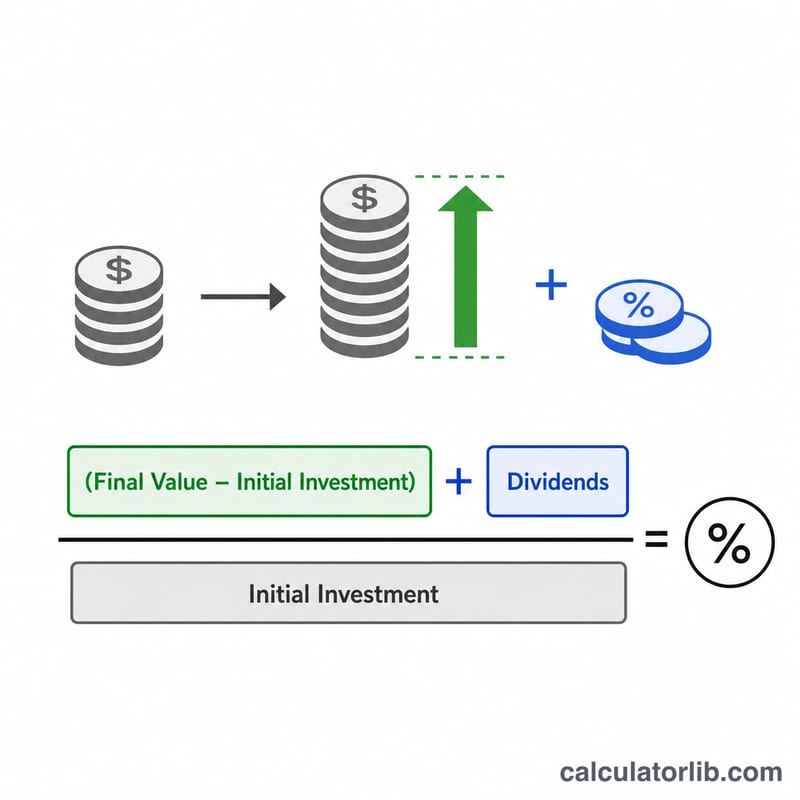
- Total Return = Capital Gain + Total Dividends
- Percentage Return = (Total Return \(\div\) Initial Investment) \(\times\) 100
- Annualized Return = ((1 + Percentage Return \(\div\) 100)^(1 \(\div\) Holding Period) \(-\) 1) \(\times\) 100
Note the dividends are added in dollar terms, so the percentage return includes both price appreciation and income.
Worked Example
Suppose you bought 100 shares at $50, sold them at $75, collected $300 in dividends, and held for 3 years.
- Initial Investment = \(\$50 \times 100 = \$5{,}000\)
- Final Value = \(\$75 \times 100 = \$7{,}500\)
- Capital Gain = \(\$7{,}500 - \$5{,}000 = \$2{,}500\)
- Total Return = \(\$2{,}500 + \$300 = \$2{,}800\)
- Percentage Return = \((\$2{,}800 \div \$5{,}000) \times 100 = 56\%\)
- Annualized Return = \(((1.56)^{1/3} - 1) \times 100 \approx 15.97\%\) per year
Frequently Asked Questions
Why is the annualized return lower than the total percentage return? Because annualizing spreads the total gain across each year using compounding. A 56% total return over 3 years works out to roughly 16% compounded annually.
Should I include reinvested dividends? Enter the total cash dividends you received. If you reinvested them and want exact accuracy, this simple model treats them as a lump sum added to your return rather than buying extra shares.
Does this account for taxes or trading fees? No. The result is a gross return. Subtract brokerage commissions and any capital-gains or dividend taxes to estimate your net, take-home return.