
What the Sine Calculator Does
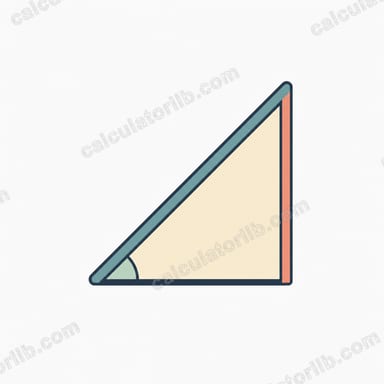
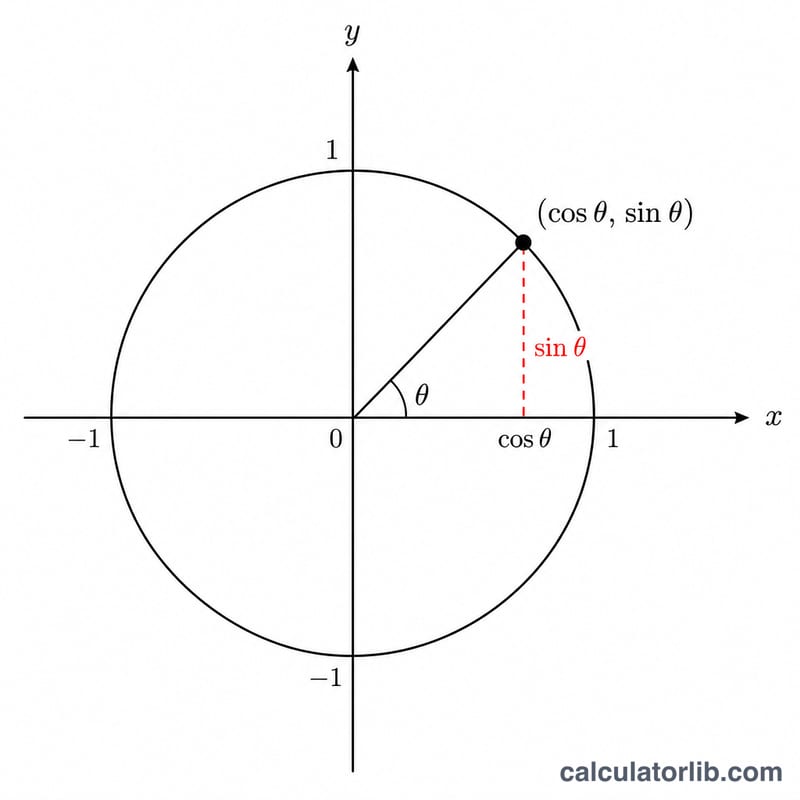
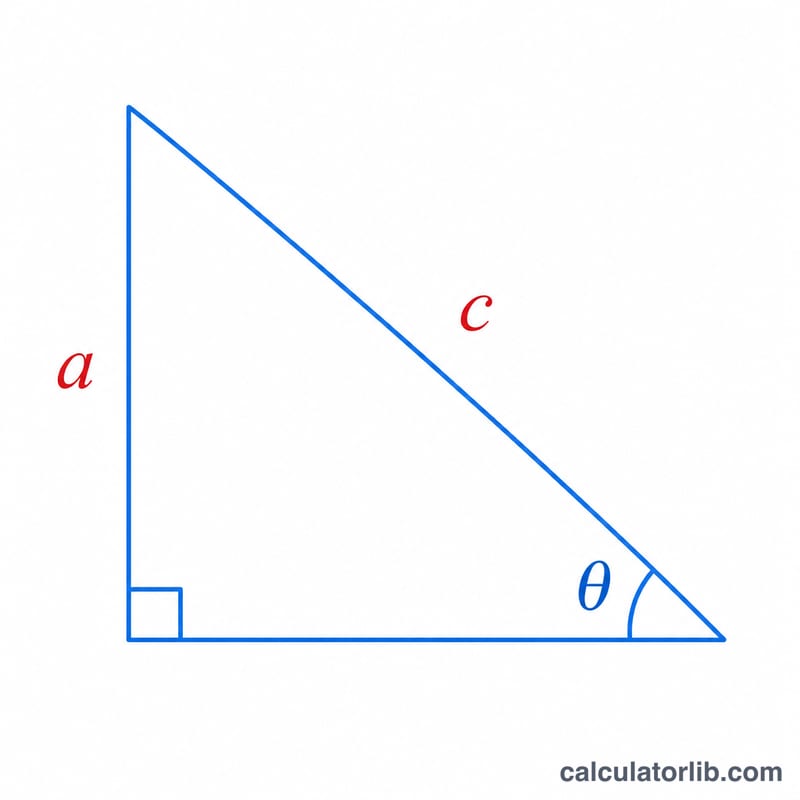
This Sine Calculator computes the trigonometric sine of any angle you enter. Sine is one of the three core trigonometric functions and represents, in a right triangle, the ratio of the side opposite an angle to the hypotenuse. On the unit circle, \(\sin(\theta)\) is simply the y-coordinate of the point at angle \(\theta\). This tool removes the manual work and returns a precise decimal value instantly.
The Input Fields
The calculator keeps things deliberately simple with two inputs:
- Angle — the numeric value of the angle you want the sine of (for example 30, 90, or 1.5708).
- Unit — a choice between Degrees and Radians. This tells the calculator how to interpret your angle.
Selecting the correct unit matters, because 90 degrees and 90 radians give completely different results.
The Formula and How It Works
The underlying formula is:
$$\sin(\theta)$$Internally, the sine function always works in radians. So the calculator first converts your input if needed. If you chose degrees, it multiplies your angle by \(\pi/180\) to get radians \((\theta_{\text{rad}} = \theta_{\text{deg}} \times \pi \div 180)\). If you chose radians, the value is used directly. It then computes \(\sin(\theta_{\text{rad}})\). For convenience the tool also reports the angle in both degrees and radians alongside the final sine value.
Worked Example
Suppose you enter Angle = 30 and Unit = Degrees:
- Convert to radians: \(30 \times \pi \div 180 \approx 0.5236\) radians.
- Compute the sine: \(\sin(0.5236) = 0.5\).
The result is 0.5, the well-known value for \(\sin(30°)\). If instead you entered Angle = 0.5236 with Unit set to Radians, you would get the same 0.5, since the value is already in radians.
Frequently Asked Questions
Why does sin(90) give 1 in degrees but a different number in radians? In degrees, 90° is a quarter turn and its sine is exactly 1. In radians, 90 is a very large angle (about 14.3 full turns), so \(\sin(90\ \text{rad}) \approx 0.894\). Always match the unit to your intended angle.
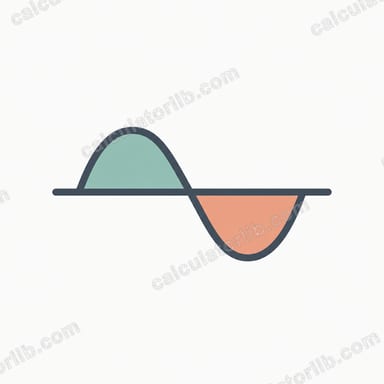
What range of outputs can I expect? Sine always returns a value between −1 and 1, inclusive, no matter how large or small the angle.
Can I enter negative angles? Yes. Sine is an odd function, so \(\sin(-\theta) = -\sin(\theta)\). For example, \(\sin(-30°) = -0.5\).