
What the Inverse Sine Calculator Does
This tool reverses the sine function: you give it a sine value and it returns the angle that produced it. Where the regular sine function takes an angle and gives a ratio between −1 and 1, the inverse sine (written arcsin or sin⁻¹) does the opposite — it takes that ratio and tells you the angle. It's a universal math tool with no country-specific rules, useful in trigonometry, physics, engineering and geometry.
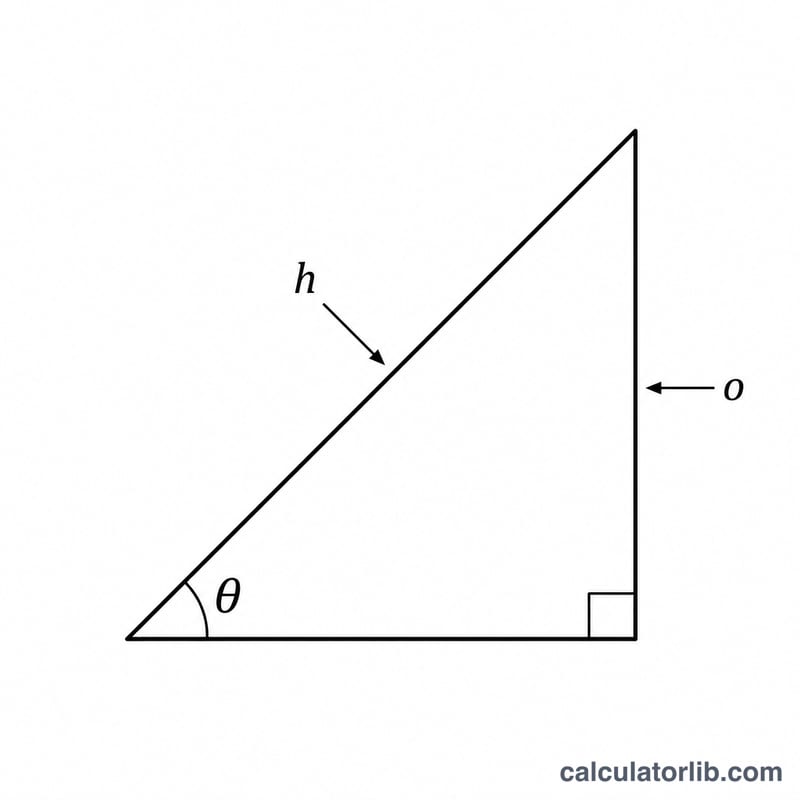
The Inputs You Enter
- Sine Value (between −1 and 1): The ratio whose angle you want to find. If you type a number outside this range, the calculator safely clamps it to the nearest valid limit (−1 or 1), because sine never exceeds those bounds.
- Result Unit: Choose Degrees or Radians for the answer. Internally the angle is always computed in radians and converted to degrees when you select that option.
The Formula
The core calculation is simply:
$$\theta = \arcsin\!\left(\text{Sine Value}\right)$$
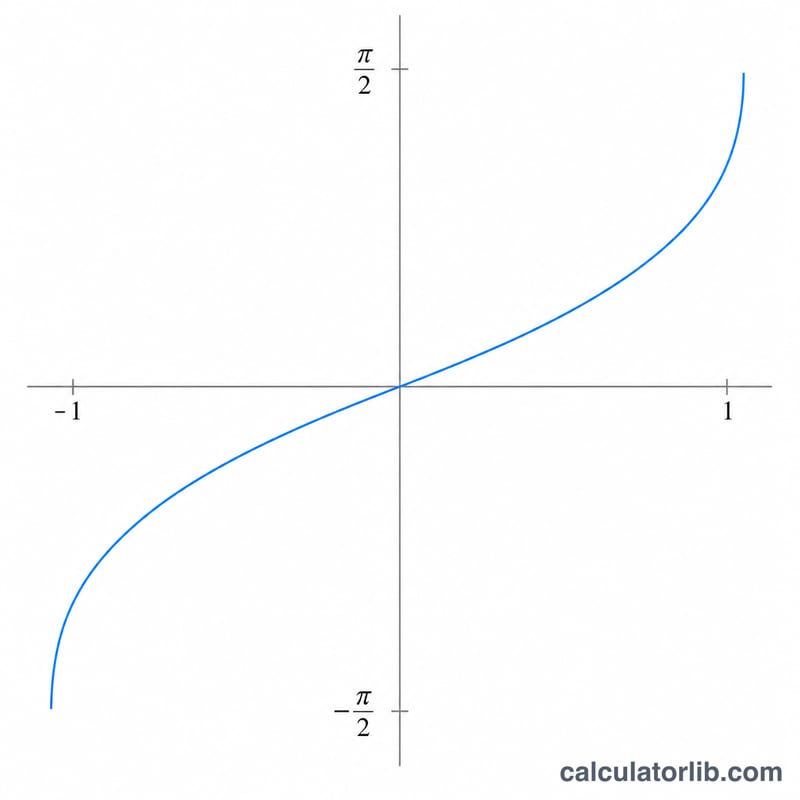
The result is the principal value, meaning the angle always falls in the range −90° to +90° (or \(-\pi/2\) to \(+\pi/2\) radians). When you pick degrees, the calculator converts the radian result using $$\theta^\circ = \theta \times \frac{180}{\pi}.$$
Worked Example
Suppose you enter a sine value of 0.5 and select Degrees:
- \(\arcsin(0.5) = 0.5236\) radians
- Converted to degrees: $$0.5236 \times \frac{180}{\pi} = 30^\circ$$
So the angle whose sine is 0.5 is 30 degrees. If you had chosen radians instead, the answer would display as 0.5236.
Frequently Asked Questions
Why must the input be between −1 and 1? Sine of any real angle never goes above 1 or below −1, so no real angle has a sine outside that range. Values you enter beyond the limits are automatically clamped.
Why is the result only between −90° and 90°? Many angles share the same sine value, so arcsin returns the single principal value in this range. For other solutions, use identities like \(180^\circ - \theta\).
Which unit should I choose? Degrees are common in everyday geometry and navigation; radians are standard in calculus and most programming languages. Pick whichever your problem requires.