
What is the sine integral Si(x)?
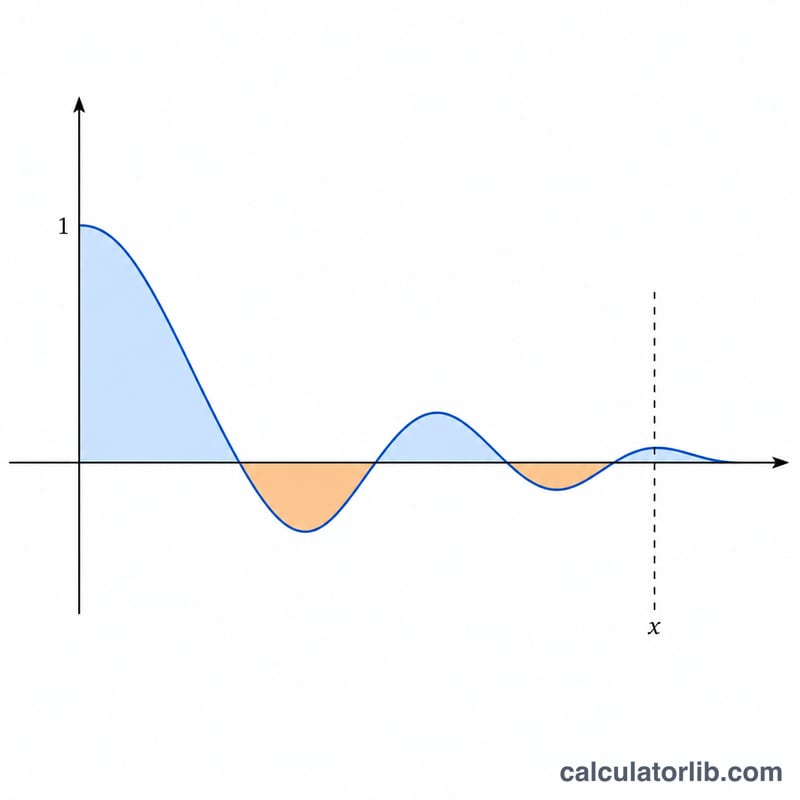
The sine integral, written \(\operatorname{Si}(x)\), is a special function defined as the definite integral of sin(t)/t from 0 to x. Although sin(t)/t looks undefined at t = 0, its limit there is exactly 1, so the integrand is continuous and \(\operatorname{Si}(0) = 0\). This is a pure mathematics tool and gives identical results everywhere; it is not tied to any country or region.
How to use this calculator
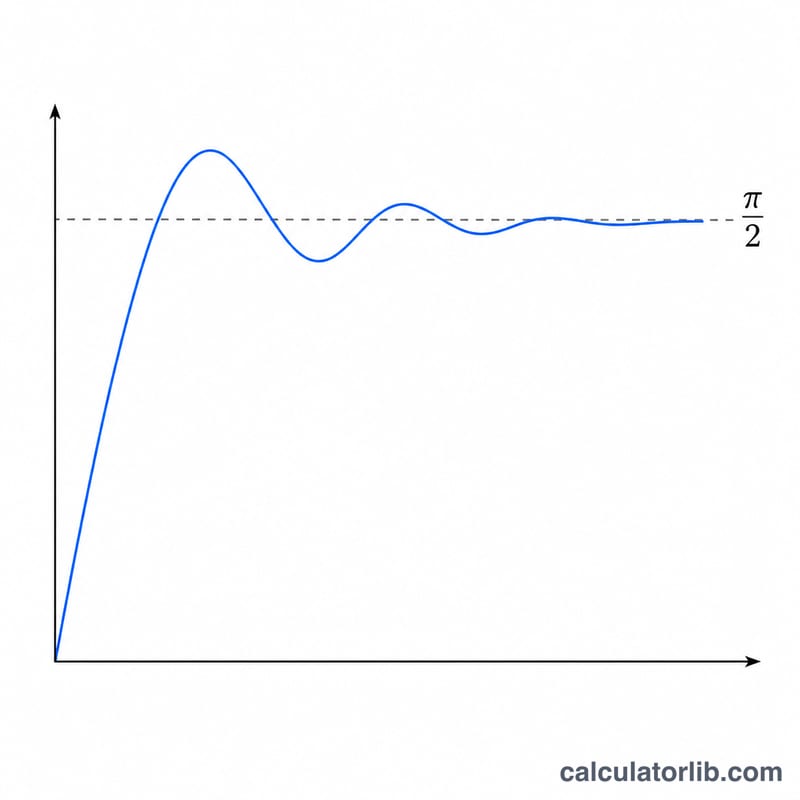
Enter any real number for x — positive, negative, or zero — and the calculator returns Si(x). Because Si is an odd function, \(\operatorname{Si}(-x) = -\operatorname{Si}(x)\), so negative inputs simply mirror the positive result. As x grows large, Si(x) oscillates while converging toward \(\pi/2 \approx 1.5707963268\).
The formula explained
We evaluate Si(x) with its Maclaurin power series:
$$\operatorname{Si}(x) = x - \frac{x^{3}}{3\cdot 3!} + \frac{x^{5}}{5\cdot 5!} - \frac{x^{7}}{7\cdot 7!} + \dots$$Each term is generated recursively from the previous one by multiplying by \(-x^{2}/((2n)(2n+1))\) and dividing the odd power by \((2n+1)\). This avoids computing large factorials directly and keeps the calculation stable for small-to-moderate |x|.
Worked example
For x = 1 the series gives $$1 - \frac{1}{18} + \frac{1}{600} - \frac{1}{35280} + \frac{1}{3265920} - \dots \approx 1 - 0.0555556 + 0.0016667 - 0.0000283 + 0.0000003 \approx 0.9460831.$$ The accepted reference value is \(\operatorname{Si}(1) = 0.9460830703671830\).
FAQ
What is Si(0)? Exactly 0, since the integral from 0 to 0 is zero.
What is the maximum value? Si(x) has its first and largest local maximum near \(x = \pi\) (\(\operatorname{Si}(\pi) \approx 1.8519\)), then oscillates toward the limit \(\pi/2\).
Does it work for negative x? Yes — Si is odd, so \(\operatorname{Si}(-2) = -\operatorname{Si}(2) \approx -1.6054\).