

What is the Hyperbolic Cosine Integral Chi(x)?
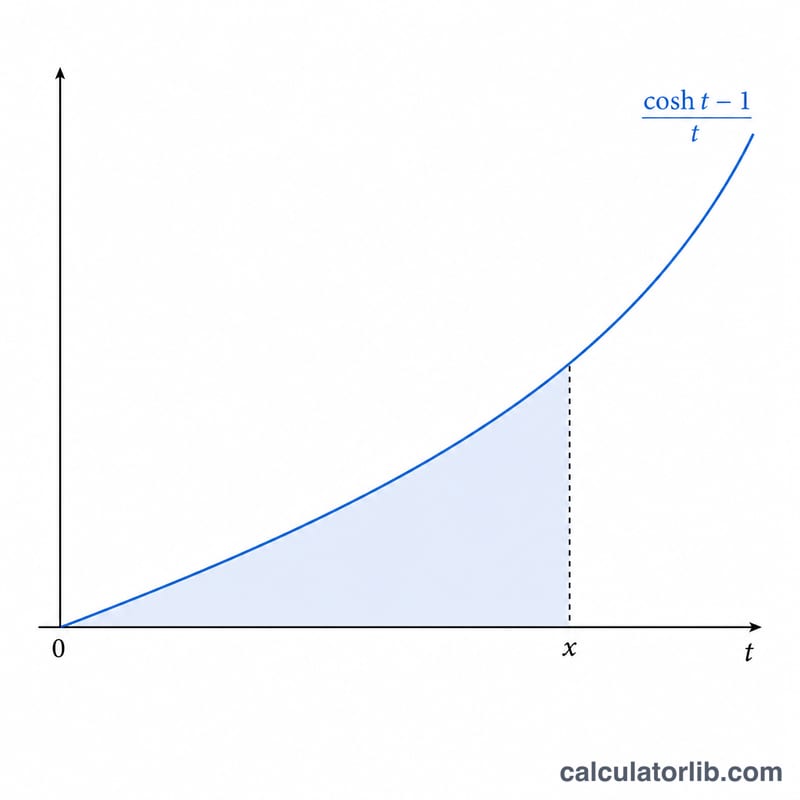
The hyperbolic cosine integral, written \(\mathrm{Chi}(x)\), is a special function defined by the integral $$\mathrm{Chi}(x) = \gamma + \ln(x) + \int_0^x \frac{\cosh t - 1}{t}\,dt,$$ where \(\gamma\) is the Euler-Mascheroni constant (approximately \(0.5772156649\)). It is the hyperbolic analogue of the ordinary cosine integral \(\mathrm{Ci}(x)\) and appears in physics, signal analysis, and the theory of exponential integrals. This calculator evaluates \(\mathrm{Chi}(x)\) for any real argument \(x\) greater than 0.
How to Use the Calculator
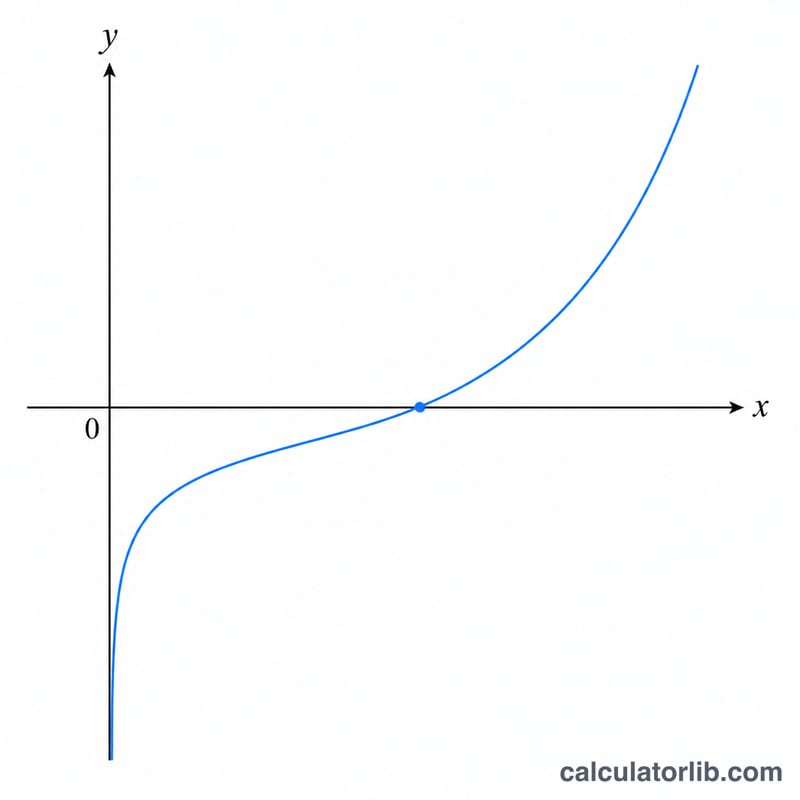
Enter a positive real number for \(x\) and submit. The result is the dimensionless value \(\mathrm{Chi}(x)\). Because \(\mathrm{Chi}(x)\) contains \(\ln(x)\), the function tends to negative infinity as \(x\) approaches 0 from above and is undefined for real \(x\) less than or equal to 0, so the tool only accepts \(x > 0\). \(\mathrm{Chi}(x)\) is negative for small arguments and crosses zero near \(x = 0.523822\), becoming positive and growing rapidly thereafter.
The Formula Explained
For practical computation we use the everywhere-convergent power series $$\mathrm{Chi}(x) = \gamma + \ln(x) + \frac{x^2}{4} + \frac{x^4}{96} + \frac{x^6}{4320} + \cdots,$$ that is the sum over \(k\) of $$\sum_{k=1}^{\infty} \frac{x^{\,2k}}{(2k)\,(2k)!}.$$ Terms are accumulated until they fall below machine precision relative to the partial sum. For very large \(x\) (\(x > 20\)) the series terms can overflow double precision, so the calculator switches to the asymptotic expansion $$\mathrm{Chi}(x) \sim \frac{e^x}{2x}\left(1 + \frac{1}{x} + \frac{2}{x^2} + \cdots\right).$$
Worked Example
For \(x = 1\), \(\ln(1) = 0\) and the series gives $$0.25 + 0.0104167 + 0.0002315 + \cdots = 0.2606514.$$ Adding \(\gamma\): $$\mathrm{Chi}(1) = 0.5772157 + 0.2606514 = 0.8378670,$$ matching the reference value \(\mathrm{Chi}(1) = 0.8378670410\).
FAQ
Why must x be positive? The \(\ln(x)\) term makes \(\mathrm{Chi}(x)\) undefined for real \(x \le 0\); for negative \(x\) the principal value is complex, \(\mathrm{Chi}(x) = \mathrm{Chi}(|x|) + i\pi\).
How is Chi related to other functions? For \(x > 0\), \(\mathrm{Chi}(x) = \frac{\mathrm{Ei}(x) + E_1(x)}{2}\), and \(\mathrm{Chi}(x) + \mathrm{Shi}(x) = \mathrm{Ei}(x)\), where \(\mathrm{Shi}\) is the hyperbolic sine integral.
How accurate is the result? Results are computed in double precision and are accurate to roughly 15 significant figures for typical inputs.