What is the Time Percentage Calculator?
This tool tells you what percentage one duration of time is of another. For example, if you worked 1 hour 30 minutes of an 8-hour shift, what share of the day did that take? Both the "part" and the "whole" are entered in hours, minutes and seconds, converted to a common unit (seconds), and compared.
How to use it
Enter the smaller duration under Part Duration and the total or reference duration under Whole Duration. You can leave any field at zero. Click calculate and the result shows the part as a percentage of the whole, along with both durations expressed in seconds so you can verify the math.
The formula explained
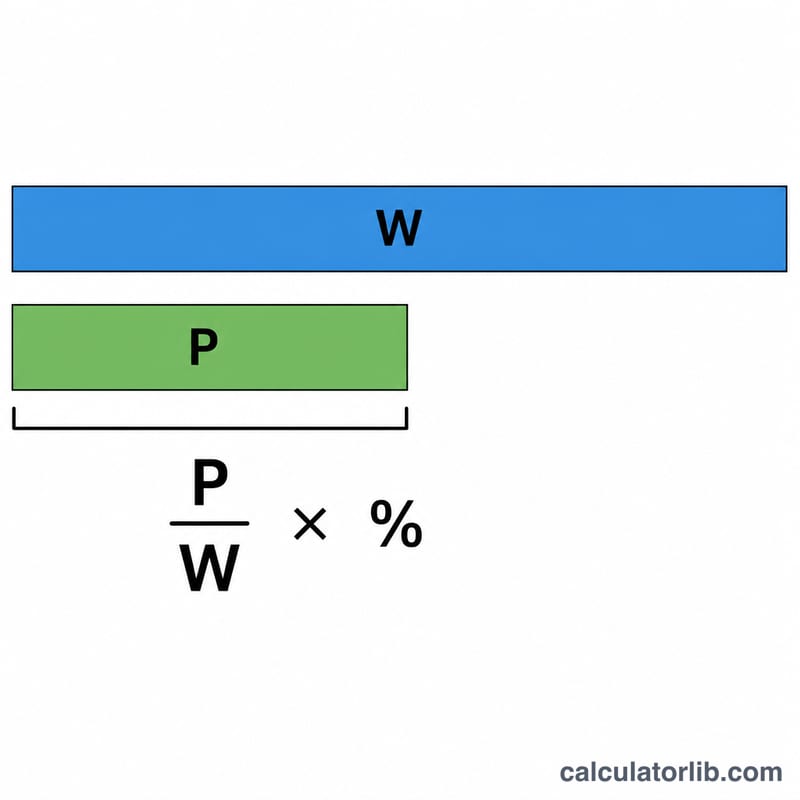
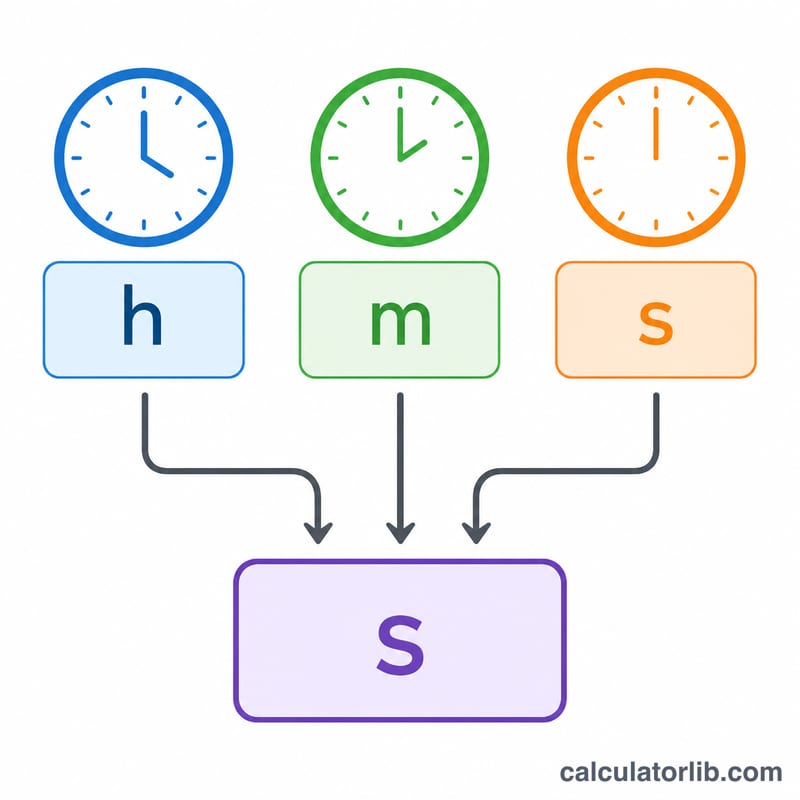
Each duration is first converted to seconds using \( t = h \times 3600 + m \times 60 + s \). The percentage is then simply the part divided by the whole, multiplied by 100:
$$\text{Percent} = \frac{\text{Part}_{\text{sec}}}{\text{Whole}_{\text{sec}}} \times 100\%$$
Because both values use the same unit, the conversion factors cancel out — so the result is correct regardless of how the time is split across hours, minutes and seconds.
Worked example
Part = 1 hour 30 minutes = 5,400 seconds. Whole = 8 hours = 28,800 seconds. $$\text{Percent} = \frac{5{,}400}{28{,}800} \times 100 = 18.75\%$$ So a 90-minute task is 18.75% of an 8-hour workday.
Common Time Percentage Scenarios Compared
Every calculation follows the same two steps: convert both durations to seconds, then divide. In symbols,
$$\text{Percentage} = \frac{\text{Part}_{\text{sec}}}{\text{Whole}_{\text{sec}}} \times 100\%$$The table below shows typical comparisons, with both durations already expressed in seconds so the division is easy to check. Percentages are rounded to two decimal places.
| Part duration | Whole duration | Part (seconds) | Whole (seconds) | Percentage |
|---|---|---|---|---|
| 30 minutes | 1 hour | 1,800 | 3,600 | 50% |
| 45 minutes | 8 hours | 2,700 | 28,800 | 9.38% |
| 1 hour 30 minutes | 8 hours | 5,400 | 28,800 | 18.75% |
| 2 hours | 24 hours (1 day) | 7,200 | 86,400 | 8.33% |
| 8 hours | 40 hours (work week) | 28,800 | 144,000 | 20% |
| 90 minutes | 60 minutes | 5,400 | 3,600 | 150% |
Worked example for the second row — 45 minutes of an 8-hour day:
$$\text{Part}_{\text{sec}} = 0 \times 3600 + 45 \times 60 + 0 = 2{,}700$$$$\text{Whole}_{\text{sec}} = 8 \times 3600 + 0 \times 60 + 0 = 28{,}800$$$$\text{Percentage} = \frac{2{,}700}{28{,}800} \times 100\% = 0.09375 \times 100\% = 9.375\% \approx 9.38\%$$Two things are worth noting. First, a result above 100% is not an error: it simply means the part is longer than the reference duration, as in the 90-minutes-of-60-minutes row, where the overrun is 50% of the reference. Second, the "whole" is whatever you choose it to be — 2 hours is 8.33% of a full 24-hour day but 25% of an 8-hour shift, so the same part duration yields very different percentages depending on the baseline. The 8-hour shift and 40-hour week used here are common scheduling conventions in many countries, not universal legal standards; statutory working hours differ by jurisdiction, so substitute your own contracted hours when the number matters.
Time Unit Conversion Reference
Because the percentage is computed on a common unit, converting durations to seconds first removes any ambiguity about mixed hours, minutes and seconds. These factors are exact by definition in the SI-based civil time system (leap seconds aside, a calendar day is taken as exactly 86,400 s here).
| Unit | Seconds | Minutes | Hours |
|---|---|---|---|
| 1 second | 1 | 0.016667 | 0.000278 |
| 1 minute | 60 | 1 | 0.016667 |
| 1 hour | 3,600 | 60 | 1 |
| 1 day | 86,400 | 1,440 | 24 |
| 1 week | 604,800 | 10,080 | 168 |
Common workplace durations
| Duration | Seconds | Minutes | Hours |
|---|---|---|---|
| 15-minute break | 900 | 15 | 0.25 |
| 30-minute lunch | 1,800 | 30 | 0.5 |
| 45-minute meeting | 2,700 | 45 | 0.75 |
| 8-hour shift | 28,800 | 480 | 8 |
| 40-hour week (5 × 8 h) | 144,000 | 2,400 | 40 |
Minutes to decimal hours
Timesheets and billing systems usually want decimal hours rather than minutes. Divide minutes by 60:
$$\text{Decimal hours} = \frac{\text{Minutes}}{60}$$| Minutes | Decimal hours |
|---|---|
| 6 | 0.1 |
| 15 | 0.25 |
| 20 | 0.333… |
| 30 | 0.5 |
| 45 | 0.75 |
| 50 | 0.833… |
| 60 | 1.0 |
To convert a mixed duration in one step, use \(\text{Seconds} = h \times 3600 + m \times 60 + s\). For 2 hours 15 minutes 30 seconds this gives \(2 \times 3600 + 15 \times 60 + 30 = 7200 + 900 + 30 = 8{,}130\) seconds, or \(8130 \div 3600 = 2.2583\) hours. Note that the 8-hour shift and 40-hour week listed above are widespread scheduling conventions rather than a global rule — contracted full-time hours vary by country, employer and collective agreement, so use your own reference week when computing a share of working time.
FAQ
Can the part be larger than the whole? Yes — the result will simply exceed 100%, meaning the part is longer than the reference duration.
What if the whole duration is zero? Division by zero is undefined, so the calculator returns 0% when the whole is empty. Enter a non-zero whole duration for a meaningful answer.
Does the unit split matter? No. 90 minutes and 1 hour 30 minutes give identical results because everything is converted to seconds first.