What is the Minutes to Hours Calculator?
This tool converts a duration given in minutes into hours. Because there are exactly 60 minutes in one hour, the conversion is a simple division. The calculator shows both the decimal hours (for example 1.5 hours) and a friendly hours-and-minutes breakdown (for example 1 h 30 min), which is handy for timesheets, cooking, workouts, billing, and scheduling.
How to use it
Type the number of minutes you want to convert into the input box and submit. The result panel displays the equivalent number of hours as a decimal, your original minute count, and the same duration written as whole hours plus leftover minutes.
The formula explained
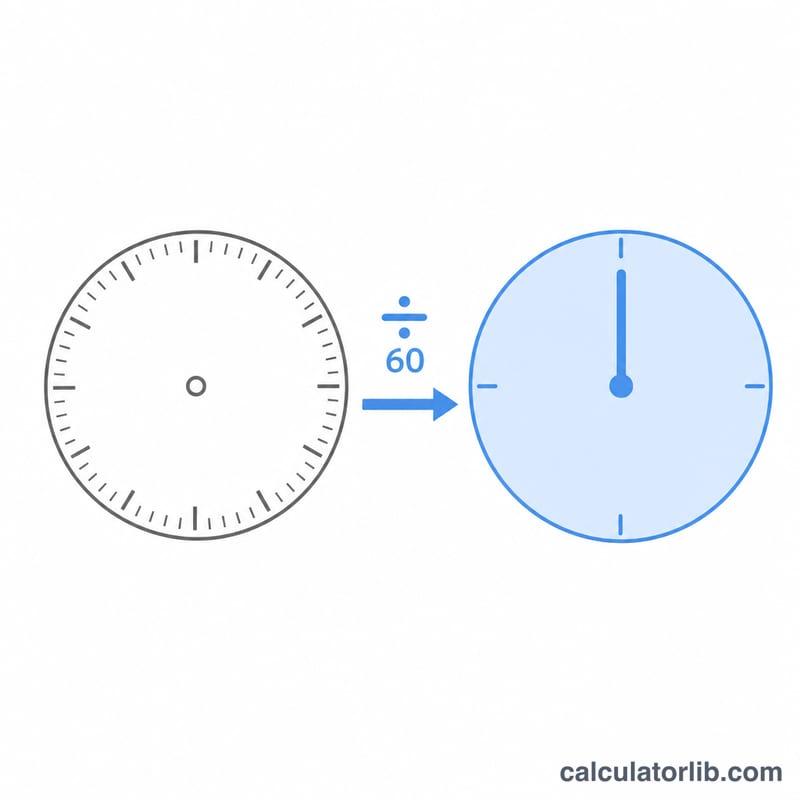
The relationship between minutes and hours is fixed: 1 hour = 60 minutes. To convert minutes to hours you divide by 60:
$$\text{Hours} = \dfrac{\text{Minutes}}{60}$$
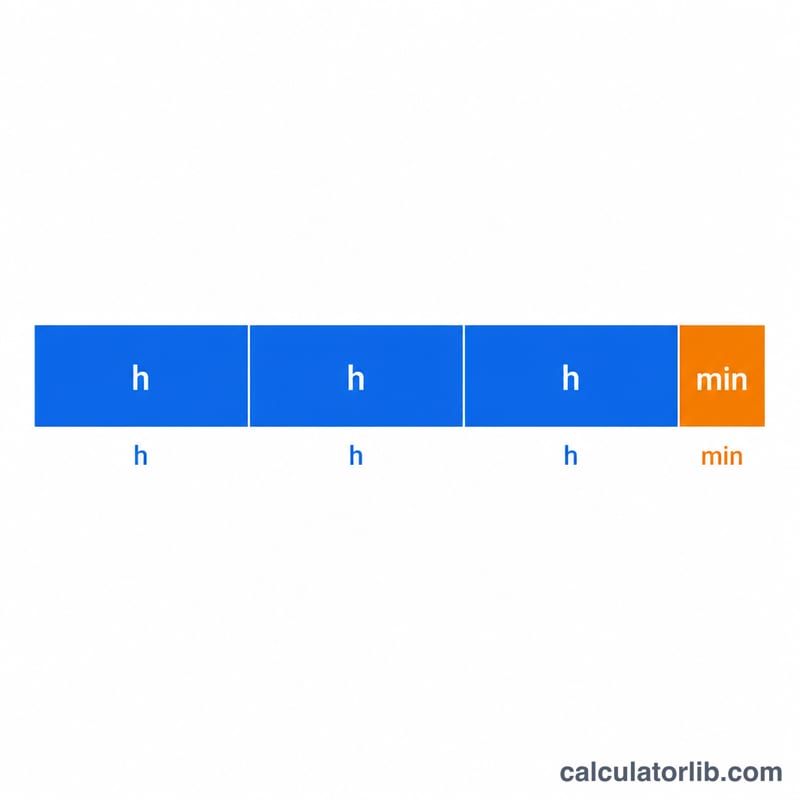
To split the decimal result into hours and minutes, take the whole-number part as the hours and multiply the fractional part by 60 to get the remaining minutes.
Worked example
Suppose you worked for 135 minutes. Divide by 60: \(135 \div 60 = 2.25\) hours. The whole-hour part is 2, and the remaining 0.25 hour equals \(0.25 \times 60 = 15\) minutes. So 135 minutes is 2.25 hours, or 2 h 15 min.
How to Convert Minutes to Hours by Hand
One hour is defined as 60 minutes, so every minutes-to-hours conversion is a single division by 60. The only real work is deciding how to present the answer: as decimal hours (for timesheets, billing and spreadsheets) or as whole hours plus leftover minutes (for schedules and clock times).
- Write down the total minutes. Combine everything into one number first — if a task ran 90 minutes in the morning and 45 in the afternoon, work with 135 minutes, not two separate conversions.
- Divide by 60 to get decimal hours. $$\text{Hours} = \frac{\text{Minutes}}{60}$$ For 135 minutes: \(135 \div 60 = 2.25\) hours. So 135 minutes = 2.25 hours.
- Take the integer part as whole hours. In 2.25, the integer part is 2, so the duration contains 2 complete hours.
- Convert the fractional part back to minutes. Multiply the decimal remainder by 60: \(0.25 \times 60 = 15\) minutes. Equivalently, use the remainder (modulo) method: \(135 - (2 \times 60) = 15\) minutes. Either way, 135 minutes = 2 hours 15 minutes.
- Round the decimal hours to the precision you actually need. Two decimal places (0.01 h = 36 seconds) is the common default for payroll and client billing; some employers instead round each entry to the nearest quarter-hour (0.25 h) or nearest tenth (0.1 h = 6 minutes). Rounding rules are set by your employer, contract or local labour law — in the United States, for example, the Department of Labor has long accepted nearest-quarter-hour rounding under the FLSA provided it does not systematically shortchange the employee — so check the rule that applies to you rather than assuming a universal one.
A mental-math shortcut: ÷6, then ÷10
Dividing by 60 in one step is awkward in your head, but dividing by 6 and then shifting the decimal point one place left is easy, because \(60 = 6 \times 10\):
Take 414 minutes. First \(414 \div 6 = 69\), then move the decimal one place: 6.9 hours. Check: \(414 \div 60 = 6.9\). ✓ The same trick runs in reverse for hours to minutes — multiply by 6, then by 10.
Why the remainder method beats re-multiplying a rounded decimal
If you round the decimal hours first and then multiply the fraction back by 60, you import that rounding error into the minutes. Take 100 minutes: \(100 \div 60 = 1.6\overline{6}\) hours. Round to 1.67 h, then \(0.67 \times 60 = 40.2\) minutes — which is wrong, because the true leftover is \(100 - 60 = 40\) minutes exactly. The remainder (mod 60) method works only with whole numbers, so it never drifts. Practical rule: use mod 60 for the hours-and-minutes breakdown, and round only the decimal figure you report — and when you are summing many entries, add the raw minutes first and convert the total once, rather than rounding each row and adding the rounded values.
FAQ
How many hours is 90 minutes? \(90 \div 60 = 1.5\) hours, which is 1 h 30 min.
How do I convert hours back to minutes? Multiply the hours by 60. For example, \(3 \text{ hours} \times 60 = 180\) minutes.
How many minutes are in an hour? There are exactly 60 minutes in one hour, which is why the conversion factor is 60.