
What Is the Hours From Now Calculator?
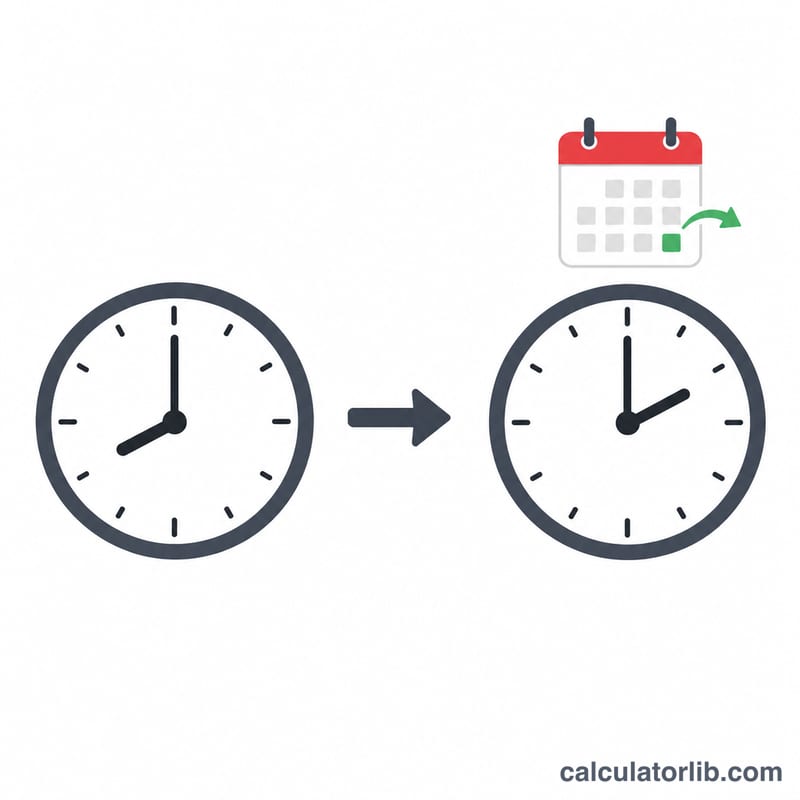
This tool tells you exactly what time it will be a chosen number of hours from a given start time. Whether you're scheduling a meeting "in 5 hours," timing a recipe, planning a flight layover, or counting medication doses, it removes the mental arithmetic and the 12-hour/24-hour confusion. It also tells you whether the result falls on the same day or rolls over into the next day.
How to Use It
Enter your start hour (0–23) and start minute (0–59). By default these prefill with the current time. Then enter how many hours from now you want to add — fractions like 1.5 or 0.25 are allowed. The calculator returns the resulting clock time in both 12-hour and 24-hour formats and shows how many days were carried over.
The Formula Explained
Time is converted entirely into minutes since midnight: \(\text{Start Hour} \times 60 + \text{Start Minute}\). We add \(N \times 60\) minutes, then take the result modulo 1440 (the number of minutes in a day) to wrap back onto a single clock face.
$$T = \left(\,60\cdot\text{Start Hour} + \text{Start Minute} + 60\cdot\text{Hours}\,\right) \bmod 1440$$The number of whole days that rolled over is \(\left\lfloor \tfrac{\text{totalMinutes}}{1440} \right\rfloor\).
$$\left\{ \begin{aligned} \text{Result Hour} &= \left\lfloor \tfrac{T}{60} \right\rfloor \\ \text{Result Minute} &= T \bmod 60 \end{aligned} \right.$$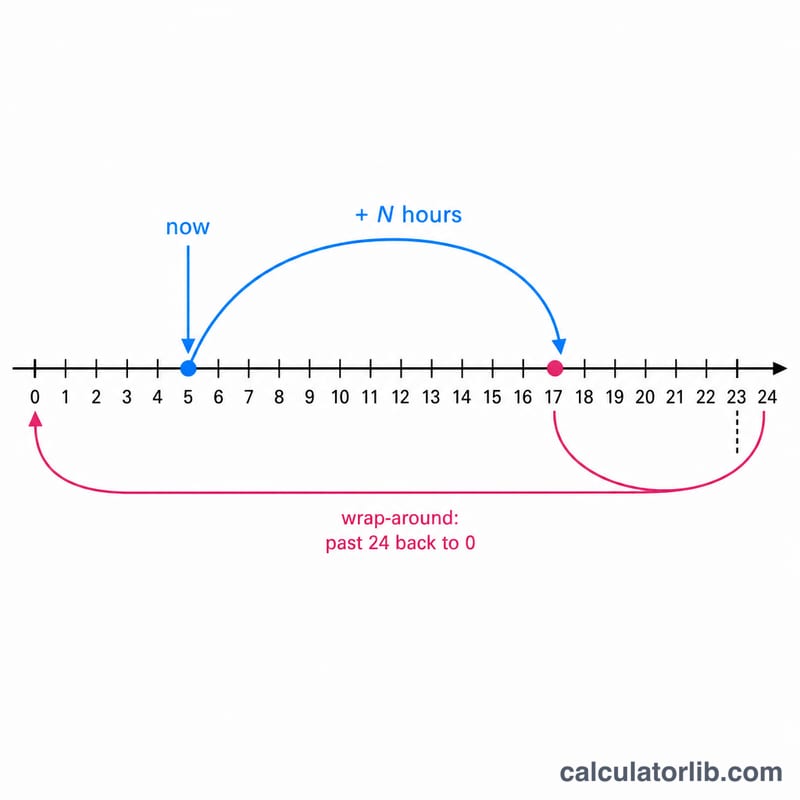
Worked Example
Start time 22:30 (10:30 PM) plus 5 hours. Start minutes = \(22\times60 + 30 = 1350\). Add \(5\times60 = 300\) → total 1650 minutes. dayCarry = \(\left\lfloor 1650 / 1440 \right\rfloor = 1\). Minute of day = \(1650 - 1440 = 210\), which is 03:30. So the result is 3:30 AM the next day.
FAQ
Can I use decimal hours? Yes — enter 2.5 for two and a half hours, or 0.25 for 15 minutes.
Does it handle crossing midnight? Yes. The "days carried" row shows how many days the result moves forward.
Is it 24-hour or 12-hour? Enter the start time in 24-hour format; the result is shown in both formats for convenience.