
What Is the Army ETS Date Calculator?
ETS stands for Expiration of Term of Service — the date your current military enlistment contract ends. This calculator estimates your ETS date from your enlistment date and contract length, then tells you how many days you have served, how many remain, and what percentage of your contract is complete. It applies to US military service contracts.
How to Use It
Enter your enlistment date (year, month, day), your contract length in years (4-year and 6-year contracts are common; half-year increments are supported), and an "as-of" date to measure against (default is today). The calculator returns your projected ETS date and your progress through the contract.
The Formula
ETS date = enlistment date + contract years. Days remaining = ETS − as-of date. Time in service = as-of date − enlistment date. Percent complete = (days served ÷ total contract days) × 100. Dates are computed at midnight, and whole years are added on the calendar so leap days are respected.
$$\text{Days Remaining} = \text{ETS Date} - \text{As-of Date}$$
$$\text{Years Served} = \frac{\text{As-of} - \text{Enlist}}{365.25}, \qquad \text{Complete} = \frac{\text{As-of} - \text{Enlist}}{\text{ETS} - \text{Enlist}} \times 100\%$$
Worked Example
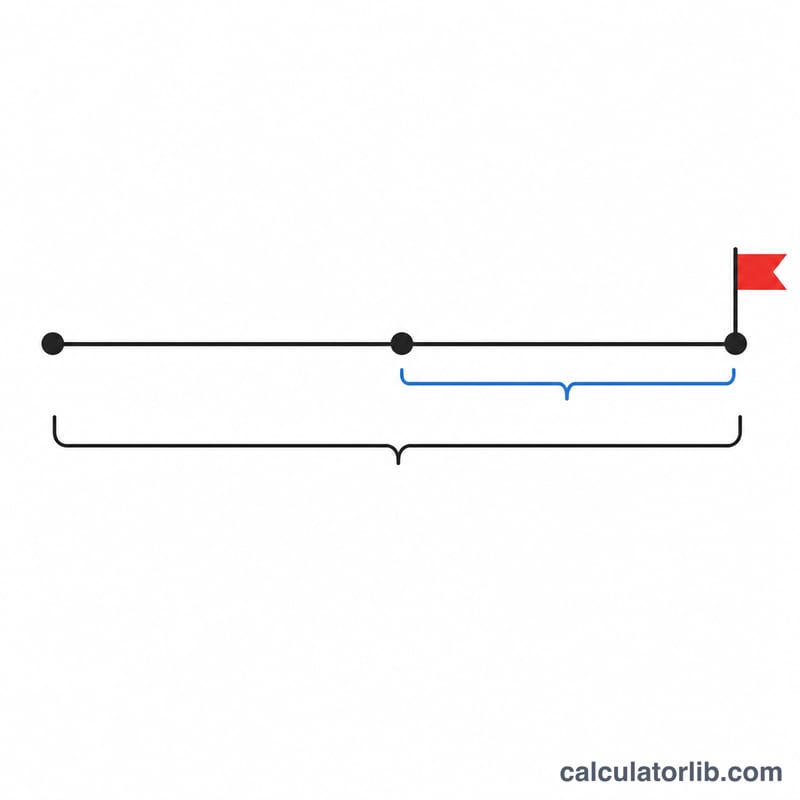
Enlist June 15, 2022 on a 4-year contract → ETS June 15, 2026. As of June 15, 2024 you have served 731 days (the span includes the leap day Feb 29, 2024), with 730 days remaining out of 1,461 total, so you are about 50.03% through your contract.
$$\frac{731}{1{,}461} \times 100\% \approx 50.03\%$$
Definitions & Glossary
Understanding your ETS estimate requires familiarity with the service terminology that appears on Army personnel records. The terms below are the ones you will most often encounter when checking dates with your unit or reviewing your own paperwork.
- ETS (Expiration Term of Service) — The date a soldier's current enlistment contract is scheduled to end. It is the primary date this calculator estimates, derived from your enlistment date plus your contract length.
- EAS (Expiration of Active Service) — A closely related term (used more heavily in the Marine Corps and Navy) marking the end of the active-duty obligation. In Army usage it is often treated interchangeably with ETS, though Reserve/Guard obligations can extend the total service commitment beyond it.
- BASD / PEBD (Basic Active Service Date / Pay Entry Basic Date) — The date used to compute time in service for pay and longevity. PEBD accounts for any prior service and may differ from your actual enlistment date if you had a break in service or prior time.
- ERB (Enlisted Record Brief) — The one-page summary of an enlisted soldier's career data, including PEBD, ETS, awards, and assignments. The ETS shown here is the official one of record. (Now often the Soldier Record Brief, SRB.)
- LES (Leave and Earnings Statement) — The monthly statement of pay, allowances, deductions, and leave balance. It lists ETS and current leave balance, both of which affect when you actually stop being paid.
- S-1 — The personnel/administrative section of a battalion-level unit. The S-1 is the authoritative office for verifying and correcting ETS and related dates.
- Time in Service — The total elapsed duty time, typically measured from PEBD to an as-of date. Used for longevity pay raises, promotion points, and retirement eligibility.
- Contract / Enlistment Term — The committed length of active service agreed to in the enlistment contract (DD Form 4), commonly 2, 3, 4, 5, or 6 years. Added to the enlistment date, it produces the ETS date.
ETS Date Scenarios at a Glance
The table below assumes an enlistment date of 1 January 2023 and an as-of date of 1 January 2025 (exactly two years served) so the columns are directly comparable across contract lengths. Total contract days count whole calendar years including any leap days; figures will vary slightly with your real dates.
| Contract | Enlistment date | Computed ETS date | Total contract days | Days served (as of 1 Jan 2025) | Days remaining | Percent complete |
|---|---|---|---|---|---|---|
| 2 years | 2023-01-01 | 2025-01-01 | 731 | 731 | 0 | 100% |
| 3 years | 2023-01-01 | 2026-01-01 | 1096 | 731 | 365 | 66.7% |
| 4 years | 2023-01-01 | 2027-01-01 | 1461 | 731 | 730 | 50.0% |
| 5 years | 2023-01-01 | 2028-01-01 | 1826 | 731 | 1095 | 40.0% |
| 6 years | 2023-01-01 | 2029-01-01 | 2192 | 731 | 1461 | 33.3% |
Percent complete is computed as days served divided by total contract days. For example, the 4-year contract is \(731 \div 1461 \approx 50.0\%\) complete at the two-year mark.
Interpreting Your Result
The ETS date and days-remaining figure produced here are an estimate based purely on the enlistment date and contract length you entered. Treat them as a planning aid, not as an official record.
- Your official ETS lives on the ERB/SRB and LES. If the date here differs from those documents, the documents win. Differences usually come from a PEBD that reflects prior service, administrative adjustments, or contract modifications not captured by a simple add-the-years calculation.
- ETS is not the same as your separation/last-day date. ETS is the contractual end of obligated service. Your actual departure from the unit is typically earlier because of terminal leave — accrued leave you take immediately before separating. A soldier with 30 days of leave may physically out-process a month before the ETS date.
- Several actions move the real date. Reenlistment, extensions, deployment stop-loss, early-separation/early-out programs, and changes in contract length all shift the ETS. None of these are reflected automatically by an estimate built from your original enlistment terms.
- Leap years and exact day counts matter. Adding whole years lands on the same calendar date, but the raw day count between today and ETS will include any intervening 29 February.
Before making any decision that depends on your departure date — housing, employment, school enrollment, or PCS planning — verify your ETS with your unit S-1 and cross-check it against your most recent LES and ERB/SRB. This article provides general information about how the dates are calculated and is not official personnel guidance.
FAQ
Is this my exact official ETS date? No. It is an estimate. Extensions, early separations, leave, and administrative actions can change your real ETS. Always confirm with your unit S-1 or your ERB/Leave and Earnings Statement.
Why don't days served and days remaining match exactly at the halfway point? Calendar years vary in length (leap years add a day), so a "halfway" point measured in calendar dates can differ by one day from a pure 50/50 split.
Can I use partial-year contracts? Yes. Fractional years are converted to months (e.g., \(4.5\) years = 4 years + 6 months).