What Is the Expiration Date Calculator?
This calculator determines a product's expiration (or "best before") date by adding a known shelf life to its manufacture date. Manufacturers, food handlers, pharmacists, cosmetics sellers, and home cooks routinely use a fixed shelf-life period — for example 365 days, 730 days, or 90 days — and need to translate it into a precise calendar date. Instead of counting on a calendar, simply enter the production date and the shelf life in days and read the result.
How to Use It
Pick the manufacture or production date, then type the shelf life in days. Press calculate to see the exact expiration date, the shelf life that was applied, and how many days remain from today until the product expires. A negative "days remaining" means the item has already expired.
The Formula Explained
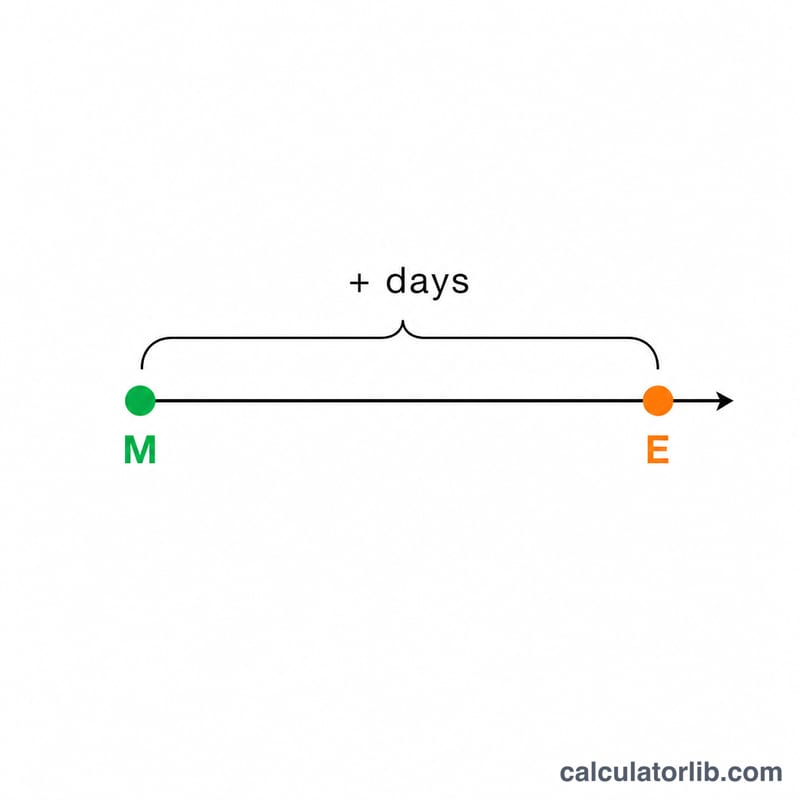
The math is simple date arithmetic: $$\text{Expiration Date} = \text{Manufacture Date} + \text{Shelf Life (days)}$$ The calculator converts the manufacture date to a calendar value, advances it by the number of shelf-life days (correctly accounting for month lengths and leap years), and returns the resulting date. It then compares that date with today to compute the days remaining.
Worked Example
Suppose a canned food is produced on 2024-01-01 with a shelf life of 365 days. Adding 365 days to January 1, 2024 — a leap year with 366 days — lands on 2024-12-31. So the expiration date is December 31, 2024.
$$\text{2024-01-01} + 365 \text{ days} = \text{2024-12-31}$$Typical Shelf Life by Product Type
The table below lists shelf-life periods that are commonly published or used as industry rules of thumb, converted into days so they can be entered directly into the calculator. Every figure is indicative: actual shelf life depends on the recipe, packaging, preservatives and storage temperature chosen by the manufacturer. Always defer to the date printed on the pack — this table is for planning and estimation only.
| Product type | Typical shelf life | Shelf life in days | Usual labelling convention |
|---|---|---|---|
| Canned goods (low-acid: vegetables, beans, fish) | 2–5 years | 730–1825 | "Best before" / "best if used by" quality date; cans often remain safe longer if the seam and can are intact |
| UHT (ultra-heat-treated) milk, unopened | 6–9 months | 180–270 | "Best before" from production; refrigerate and use within a few days once opened |
| Dried pasta (durum semolina, no egg) | ~2 years | 730 | "Best before" quality date |
| Packaged sliced bread (ambient) | 5–7 days | 5–7 | "Best before" date, sometimes shown as a day-of-week bag tag |
| Fresh shell eggs (EU rule) | 28 days from lay; often sold with a "best before" up to ~35 days | 28–35 | EU marketing standards set the best-before date at 28 days after laying; this is an EU/UK convention, not a worldwide rule (in the US, eggs carry a sell-by/EXP date set under different rules) |
| Cosmetics, unopened (typical) | 2–3 years | 730–1095 | Printed expiry or "best before end" date; in the EU a date is mandatory only when durability is under 30 months, otherwise a PAO symbol is used |
| Cosmetics, after opening (PAO symbol) | 6M / 12M / 24M | 180 / 365 / 730 | Open-jar symbol with a number of months; counted from the day of first opening, not from manufacture |
| OTC (over-the-counter) medicines | 1–5 years from manufacture | 365–1825 | "EXP" date set by stability testing; where only a month and year are printed, the convention is the last day of that month |
To use any row, enter the manufacture (or opening) date in manufactureDate and the day figure in shelfLifeDays. For PAO values, treat the opening date as the start date.
Converting Months and Years to Days
Shelf life is usually declared in weeks, months or years, while this calculator adds a number of days. The table converts the most common expressions using the standard commercial approximation of 30 days per month and 365 days per year.
| Stated shelf life | Days to enter | Notes |
|---|---|---|
| 1 week | 7 | Exact |
| 2 weeks | 14 | Exact |
| 1 month | ≈ 30 | True calendar months are 28, 29 (leap February), 30 or 31 days |
| 3 months | ≈ 90 | Real span is 89–92 days depending on start date |
| 6 months | ≈ 180 | Real span is 181–184 days |
| 9 months | ≈ 270 | Real span is 273–276 days |
| 1 year | 365 | 366 if the span includes 29 February |
| 18 months | ≈ 545 | Real span is about 546–549 days |
| 2 years | 730 | 731 if one 29 February falls in the span |
| 3 years | 1095 | 1096 with one leap day |
| 5 years | 1825 | 1826 with one leap day |
Why the approximation drifts. Twelve 30-day months give
$$12 \times 30 = 360 \ \text{days} \neq 365 \ \text{days}$$so "12 months" entered as 360 days lands about five days early, and a 30-day month rule applied over three years is roughly a fortnight short. The error grows with the length of the period, and leap days add another day roughly every four years.
Practical rule. If the pack states a shelf life in calendar months (for example "best before 24 months from production"), the legally correct date is obtained by adding months on the calendar — 15 March plus 24 months is 15 March two years later, whatever the day counts in between. Use the day-based method here for planning, batch scheduling and quick estimates, and add whole months when you need the exact contractual or regulatory date. Where the two disagree, the printed date on the pack always wins.
Key Terms Explained
- Manufacture (production) date — the day the product was made, packed or filled. It is the start point of the shelf-life count and the value you enter in manufactureDate. On packs it may appear as "MFD", "PROD" or be encoded inside the batch code.
- Shelf life — the length of time, determined by the manufacturer through stability or storage trials, during which the product keeps its intended quality and safety under the stated storage conditions. Entered here as a number of days in shelfLifeDays.
- Expiration date — the end point of the shelf life: manufacture date plus shelf life. Depending on the product and the country it is printed as "EXP", "use by", "best before" or "best before end".
- Best before (quality date) — indicates the date until which the product retains its expected quality (texture, flavour, aroma) when stored correctly. Food is generally still safe after this date but may have declined in quality. It is used for shelf-stable and low-risk foods.
- Use by (safety date) — under EU and UK food-information rules this is the mandatory date for highly perishable foods; after it the food is deemed unsafe and must not be sold or eaten, even if it looks and smells fine. This "use by = safety" distinction is an EU/UK legal convention; other countries use different wording and rules.
- Sell by — a stock-rotation date aimed at the retailer, not the consumer. It tells the shop when to pull the item from the shelf while leaving reasonable home-storage time. It is a trade convention rather than a safety limit, and in some markets it is not regulated at all.
- PAO (Period After Opening) — the open-jar symbol on cosmetics showing a number followed by "M" (6M, 12M, 24M). The countdown starts the day the container is first opened, not at manufacture, because opening exposes the product to air and skin flora. Entered here as 180, 365 or 730 days from the opening date.
- Lot / batch code — an alphanumeric identifier for the production run, used for traceability and recalls. Many manufacturers encode the production date inside it, so the batch code is often the only way to recover a manufacture date when none is printed.
- Days remaining — the number of days from today to the expiration date. A positive value is the remaining usable window; zero means it expires today; a negative value means the product is already past its date by that many days.
- Open vs unopened shelf life — the printed date normally assumes the pack is intact and unopened. Once opened, a much shorter secondary limit applies (for example "consume within 3 days of opening" or a PAO figure), and it overrides the original date whenever it falls earlier.
Definitions above are general information for planning purposes. For food-safety and medicine decisions, follow the printed date, the manufacturer's storage instructions and your local regulations rather than a calculated estimate; this is not professional food-safety, medical or regulatory advice.
FAQ
Is the manufacture date counted as day zero? Yes. We add the full shelf-life period to the manufacture date, so a 1-day shelf life means it expires the next day.
Does it handle leap years? Yes. The date math respects leap years and varying month lengths automatically.
What if the shelf life is given in months or years? Convert to days first (a year \(\approx 365\) days, a month \(\approx 30\) days) and enter that total here.