
What Is the Implantation Date Calculator?
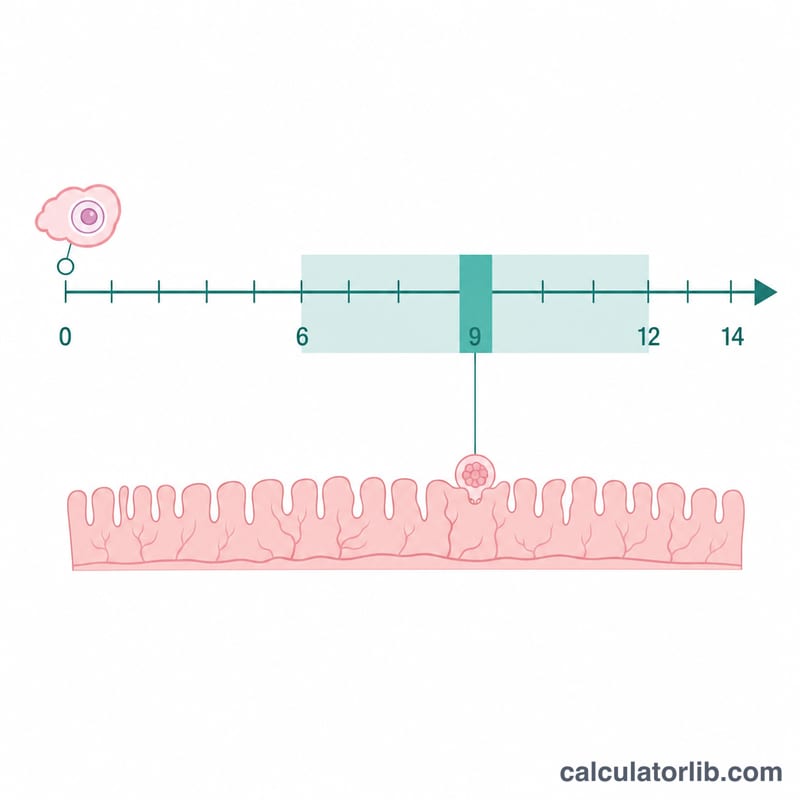
After conception, a fertilized egg travels to the uterus and embeds itself into the uterine lining — a process called implantation. This calculator estimates when implantation most likely occurs based on your ovulation date. Implantation usually happens 6 to 12 days after ovulation, with day 9 being the most common. The calculator marks the most likely date as well as the earliest and latest typical days in the window.
How to Use It
Enter your ovulation date (the day the egg was released, which is also when conception typically occurs). Then choose the days-post-ovulation (DPO) value you want to highlight — the default is 9, the average implantation day. The tool returns your most likely implantation date plus the full 6–12 DPO window so you understand the realistic range.
The Formula Explained
The calculation is a simple date addition:
$$\text{Implantation Date} = \text{Ovulation Date} + \text{DPO}\ \text{days}$$
where DPO defaults to 9 and is bounded between 6 and 12. The earliest possible date is ovulation + 6 days, and the latest typical date is ovulation + 12 days.
Worked Example
Suppose you ovulated on January 10, 2024. Using the average of 9 DPO, your most likely implantation date is January 19, 2024. The full window runs from January 16 (6 DPO) to January 22 (12 DPO).
FAQ
Is implantation the same as a positive pregnancy test? No. A test usually turns positive a few days after implantation, once hCG rises enough to detect.
Can I feel implantation? Some people report light spotting (implantation bleeding) or mild cramping, but many feel nothing at all.
How accurate is this estimate? It is an estimate based on population averages. Actual implantation timing varies between individuals and cycles. This tool is for educational purposes and is not medical advice.