
What is the Progesterone to Estrogen Ratio?
The progesterone to estrogen ratio (often written Pg/E2 or P/E) compares your serum progesterone level to your estradiol level. Because progesterone and estradiol act in partnership, many practitioners look at their relationship rather than each hormone in isolation. A balanced ratio is associated with a regular cycle, while a relatively low ratio is sometimes described as "estrogen dominance." This tool is for educational purposes only and is not a substitute for professional medical interpretation.
How to Use the Calculator
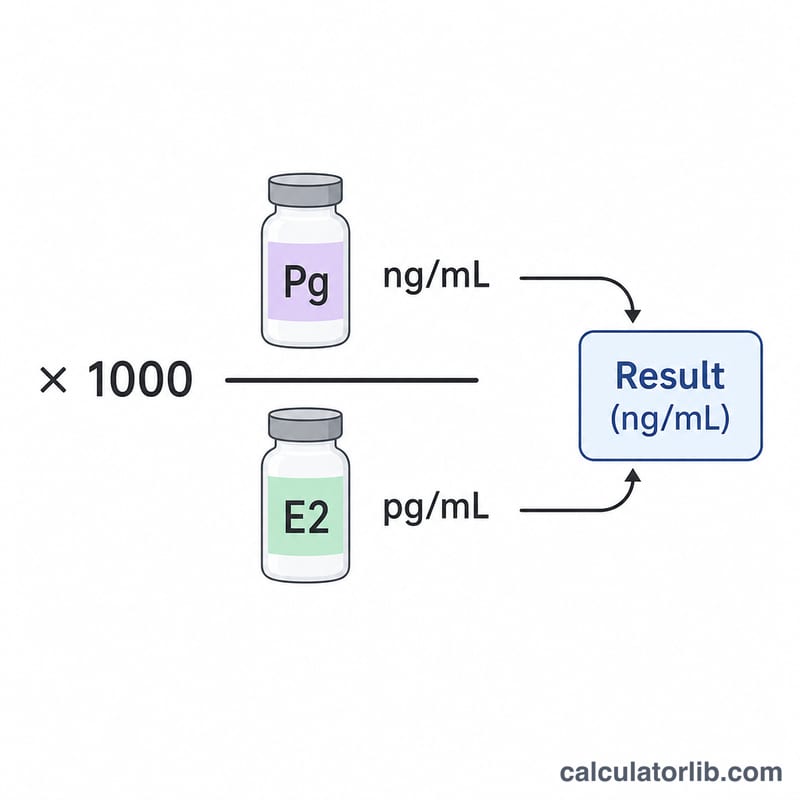
Enter your progesterone result in nanograms per milliliter (ng/mL) and your estradiol (estrogen) result in picograms per milliliter (pg/mL) — these are the most common reporting units on a US blood panel. The calculator converts progesterone to pg/mL by multiplying by 1000, then divides by estradiol so both hormones share the same unit. The output is a single dimensionless ratio.
The Formula Explained
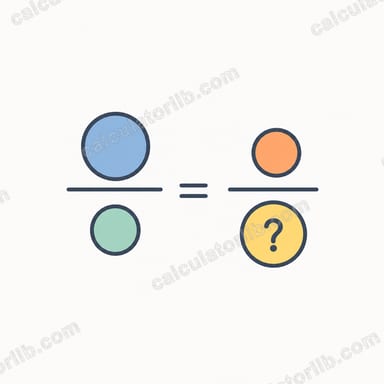
$$\text{Ratio} = \frac{\text{Progesterone ng/mL} \times 1000}{\text{Estradiol pg/mL}}$$ The \(\times 1000\) step exists only to put progesterone into the same pg/mL unit as estradiol so the division is apples-to-apples. If you already have both values in identical units, the conversion factor would be 1.
Worked Example
Suppose progesterone is 10 ng/mL and estradiol is 100 pg/mL. First convert progesterone: $$10 \times 1000 = 10{,}000 \text{ pg/mL}.$$ Then divide: $$10{,}000 \div 100 = 100.$$ The Pg/E2 ratio is 100.
FAQ
What units should I use? Progesterone in ng/mL and estradiol in pg/mL, as reported on most lab panels.
What is a "good" ratio? There is no single universal target — desirable values depend on cycle phase, age, and clinical context. Discuss your numbers with your healthcare provider.
Why multiply progesterone by 1000? \(1 \text{ ng/mL}\) equals \(1000 \text{ pg/mL}\); the conversion ensures both hormones are compared in the same unit.