
What this ratio calculator does
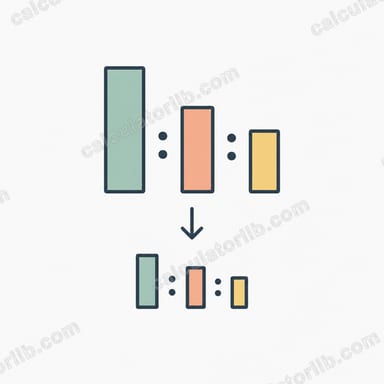
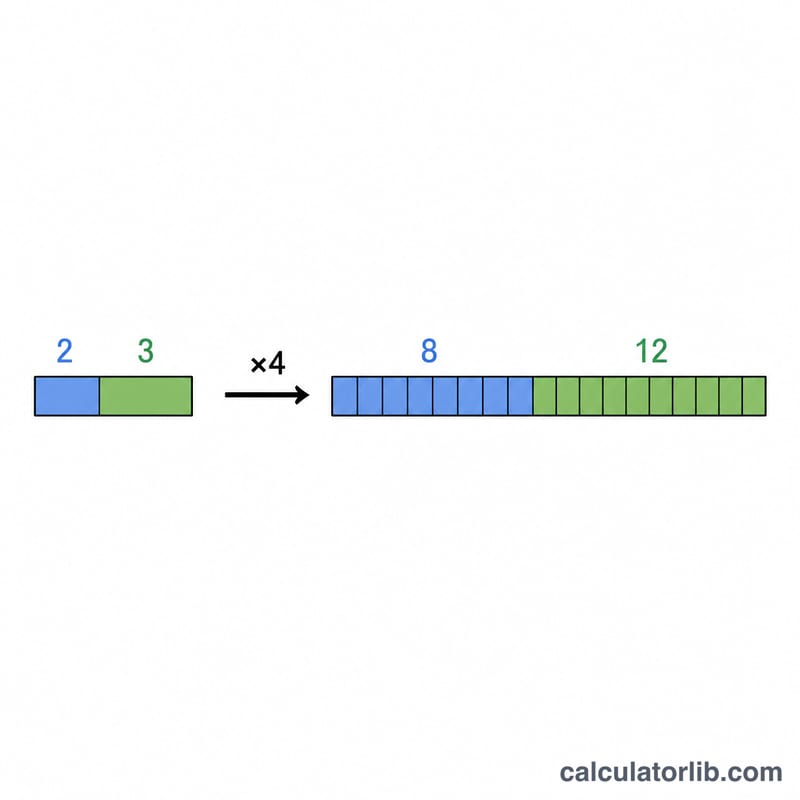
A ratio compares quantities, written like 1:2 or 1:2:3. This tool works in four modes. Solve A:B = C:D finds a missing term in a two-part proportion. Solve A:B:C = D:E:F finds a missing term in a three-part proportion. Scale A:B and Scale A:B:C multiply or divide every term by a factor. In every mode the result is also simplified to lowest terms, and equivalence can be checked. This is pure mathematics, so it applies identically everywhere.
How to use it
Pick a mode from the "Solve:" dropdown. For the proportion modes, type the values you know and leave exactly one box blank to solve for it. If you fill all four (or all six) boxes, the calculator instead checks whether the two ratios are equivalent. For the scale modes, enter the ratio terms, choose Multiply or Divide, and enter the factor.
The formula explained
Two ratios are equal exactly when their cross products match: \(\text{A}:\text{B} = \text{C}:\text{D}\) means \(\text{A}\times\text{D} = \text{B}\times\text{C}\). Rearranging gives each missing term, for example \(\text{D} = (\text{B}\times\text{C})/\text{A}\). For three-term proportions, every corresponding pair shares one scale factor \(k\), found from a known pair (\(k = \text{D}/\text{A}\)), then applied to the missing term. Simplifying divides all terms by their greatest common divisor (GCD); decimals are first scaled to whole numbers.
$$\frac{\text{A}}{\text{B}} = \frac{\text{C}}{\text{D}} \quad\Longrightarrow\quad \text{A}\cdot\text{D} = \text{B}\cdot\text{C}$$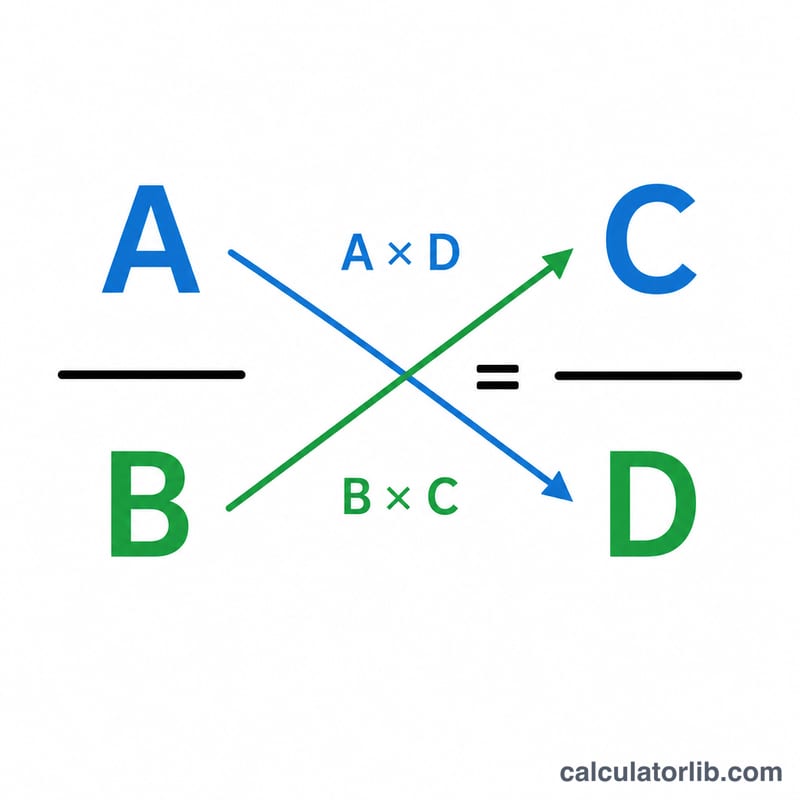
Worked example
Solve 1:2 = 4:? Enter A=1, B=2, C=4 and leave D blank. The calculator computes
$$\text{D} = (\text{B}\times\text{C})/\text{A} = (2\times 4)/1 = 8$$giving the completed proportion 1:2 = 4:8, which simplifies to 1:2 = 1:2. The cross products are \(1\times 8 = 8\) and \(2\times 4 = 8\), confirming equivalence.
FAQ
Can I express a ratio as a fraction? Yes — a two-term ratio A:B equals the fraction A/B. For example \(3:4 = 3/4 = 0.75 = 75\%\).
Can I use decimals or negatives? Yes. Decimal terms are scaled to integers before simplifying (0.5:1.5 becomes 1:3), and negative numbers are allowed.
What is a practical use? Concrete mixes such as cement:sand:gravel 1:2:3 can be scaled to a full batch, and recipes can be multiplied by the same factor for more servings.