
What is the Significant Figures Counter?
The Significant Figures Counter tells you exactly how many significant figures (often shortened to "sig figs") a number contains and lists which individual digits are significant. Significant figures express the precision of a measurement - they are the digits that carry real, reliable information. This tool works for whole numbers, decimals, numbers written in scientific notation (like \(3.5 \times 10^3\)), and e-notation (like 3.5e3).
How to use it
Type any number into the input box and submit. You can include a decimal point, a leading minus or plus sign (it is ignored for counting), and scientific or e-notation. To force a trailing zero to be counted as the last significant figure without a decimal point, wrap that zero in square brackets to mark an overline, for example 788[0]0. The tool returns the total count and the ordered list of significant digits.
$$\text{Sig Figs} = \operatorname{count}\Big(\text{Number}\Big)$$The rules explained
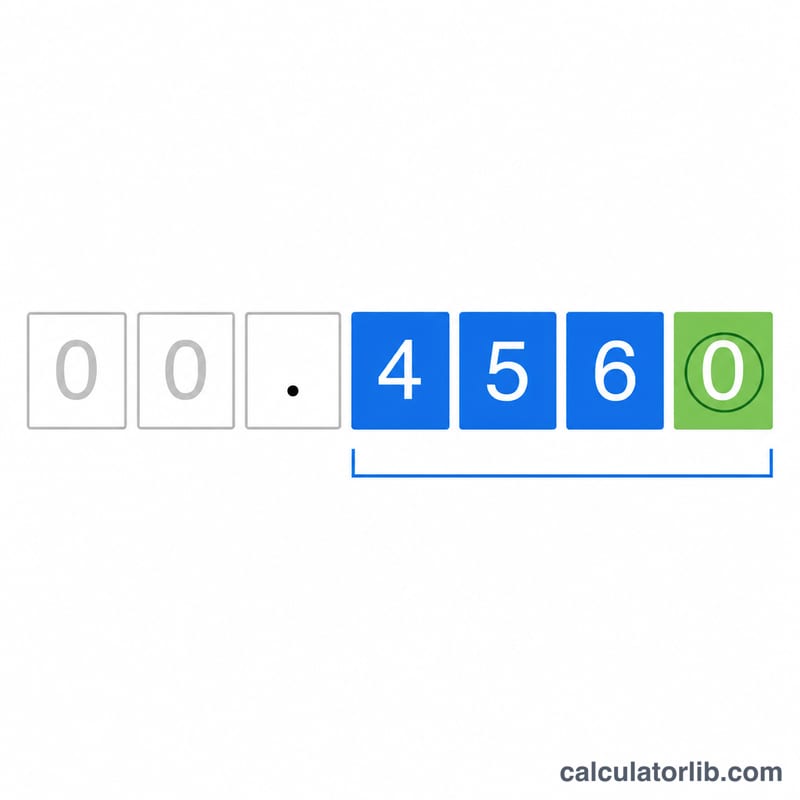
R1 Every non-zero digit (1-9) is always significant. R2 Any zero between two significant digits is significant (e.g. 5200.38 has 6 sig figs). R3 Leading zeros are never significant (0.007 has only 1). R4 Trailing zeros are significant only when a decimal point is present (380.0 has 4, but 78800 has only 3). R5 An overlined trailing zero is treated as the last significant figure even without a decimal point. In any notation only the mantissa is examined - the power of ten never adds sig figs.
Worked example
Take 35.0056. The digits are 3, 5, 0, 0, 5, 6 and a decimal point is present. The first non-zero digit is 3 and the last is 6, so every digit between them - including the two interior zeros - is significant. The result is 6 significant figures: 3, 5, 0, 0, 5, 6.
$$\text{Sig Figs} = \operatorname{count}\Big(\text{significant digits of }\;35.0056\Big) = 6$$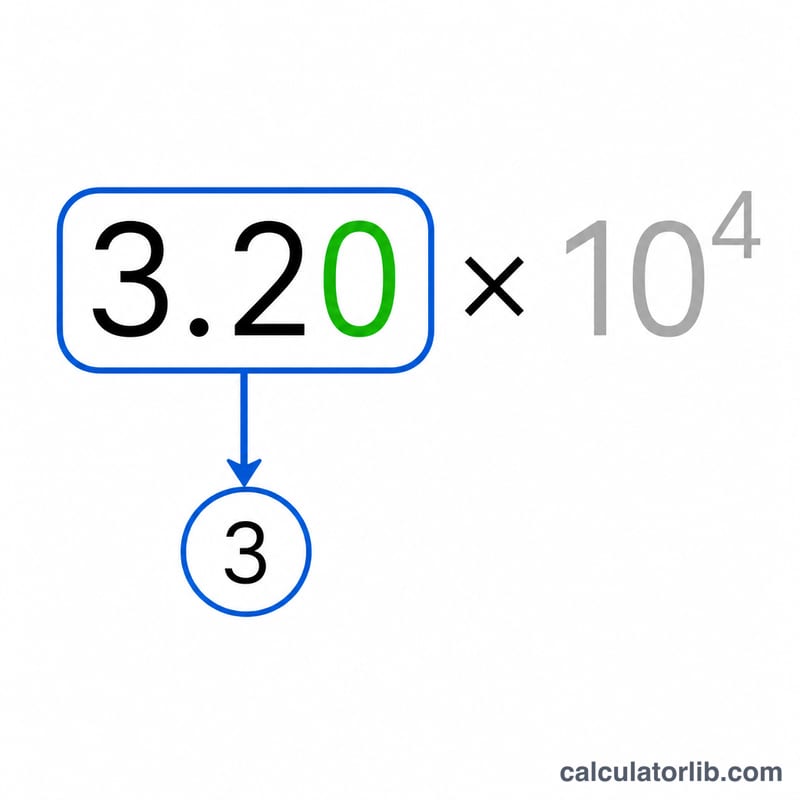
FAQ
Why does 78800 only have 3 sig figs but 78800. has 5? Without a decimal point, trailing zeros are ambiguous and treated as placeholders. Adding a trailing decimal point declares them measured and therefore significant.
Does the exponent in 3.5e3 count? No. Only the mantissa (\(3.5\)) is examined, giving 2 sig figs. The power of ten is just scale.
What about leading zeros like 0.007? Leading zeros only position the decimal point; they are never significant, so 0.007 has just 1 sig fig.