
What is standard form?
Standard form, also called scientific notation, expresses any number as a coefficient a multiplied by a power of ten, written \(a \times 10^{b}\). The coefficient satisfies \(1 \le |a| < 10\) (unless the number is exactly 0), and the exponent b is a whole number that can be positive, negative, or zero. This compact format makes very large numbers (like 345,600,000) and very small numbers (like 0.000380) easy to read, write, and compare.
How to use this calculator
Type any real number into the Number box - it can include a decimal point and a minus sign. Use the +/- button to flip the sign quickly. Press calculate and you will get three results: the coefficient (a), the power of 10 (b), and the full standard form string. The calculator works directly on the digits you type, so it preserves the exact significant figures without floating-point rounding errors.
The formula explained
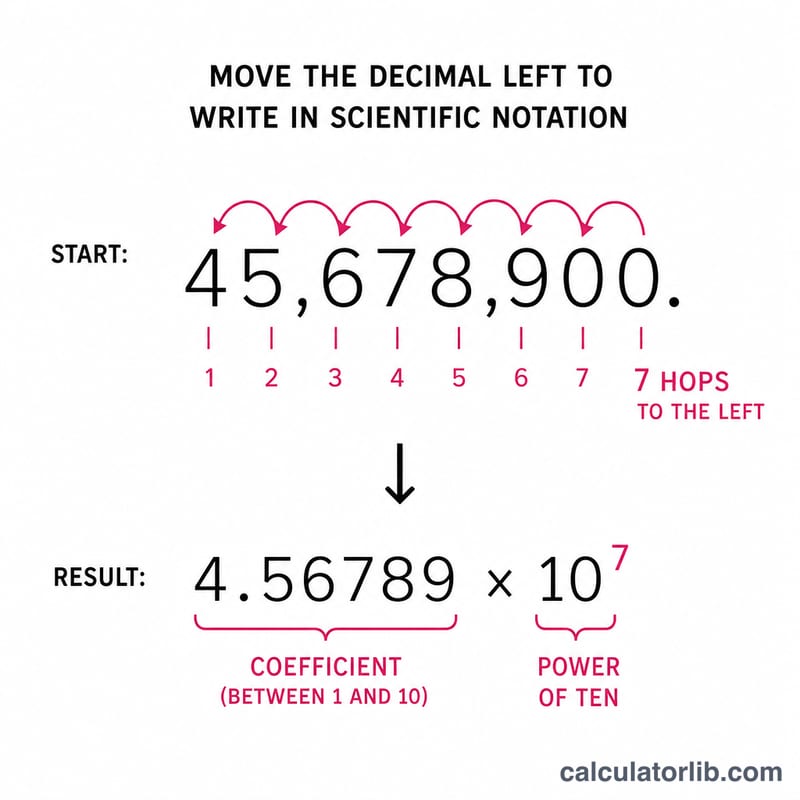
To convert N to standard form, find the exponent with \(b = \lfloor \log_{10}|N| \rfloor\), then the coefficient is \(a = N / 10^{b}\). Equivalently, shift the decimal point until exactly one non-zero digit sits to its left: moving left gives a positive exponent, moving right gives a negative exponent. Trailing zeros that came from the integer magnitude are dropped, while trailing zeros after a decimal point are kept because they are significant figures.
$$\text{Number} = a \times 10^{\,b}\,,\quad 1 \le |a| < 10$$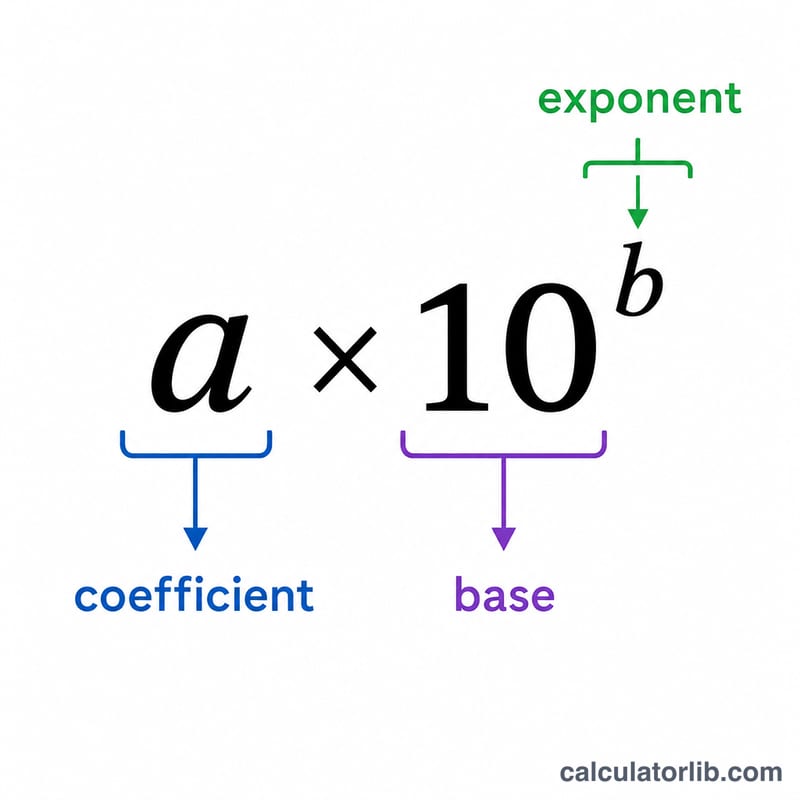
Worked example
Convert 345,600,000. The magnitude has 9 digits, so the decimal point moves 8 places left: \(b = 8\). The significant digits are 3.456, and the trailing zeros were part of the integer magnitude, so they drop. The answer is \(3.456 \times 10^{8}\). For a small number such as 0.000380, the decimal point moves 4 places right giving \(b = -4\); the trailing zero is after the decimal point so it stays, yielding \(3.80 \times 10^{-4}\).
FAQ
Is standard form the same as scientific notation? Yes - in the \(a \times 10^{b}\) convention with \(1 \le |a| < 10\) they are identical.
What is the standard form of 0? Zero is a special case: it is simply written as 0, with coefficient 0 and exponent 0.
How are negative numbers handled? The minus sign stays on the coefficient only; the coefficient still has magnitude between 1 and 10, for example -671,000,000 becomes \(-6.71 \times 10^{8}\).