
What This Calculator Does
The Dividing Scientific Notation Calculator divides one number in scientific notation by another. Scientific notation writes a number as a coefficient multiplied by a power of ten, such as \(6 \times 10^{8}\). This tool takes two such numbers, computes their quotient, and returns the answer in normalized scientific notation (coefficient between 1 and 10) as well as plain decimal form.
How To Use It
Enter the coefficient and exponent of the numerator (a and m) and of the denominator (b and n). Press calculate. The tool divides the coefficients, subtracts the exponents, then normalizes the result so the coefficient sits between 1 and 10.
The Formula Explained
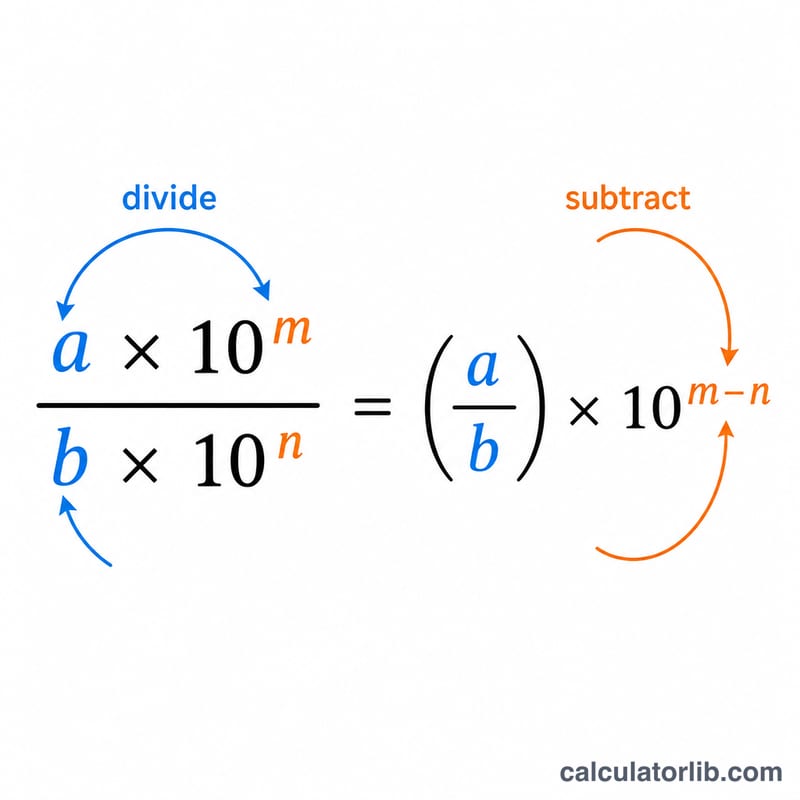
Division of powers of ten relies on a single exponent rule: when you divide like bases, you subtract the exponents. So:
$$\frac{\text{a} \times 10^{\text{m}}}{\text{b} \times 10^{\text{n}}} = \left(\frac{\text{a}}{\text{b}}\right) \times 10^{\,\text{m} - \text{n}}$$
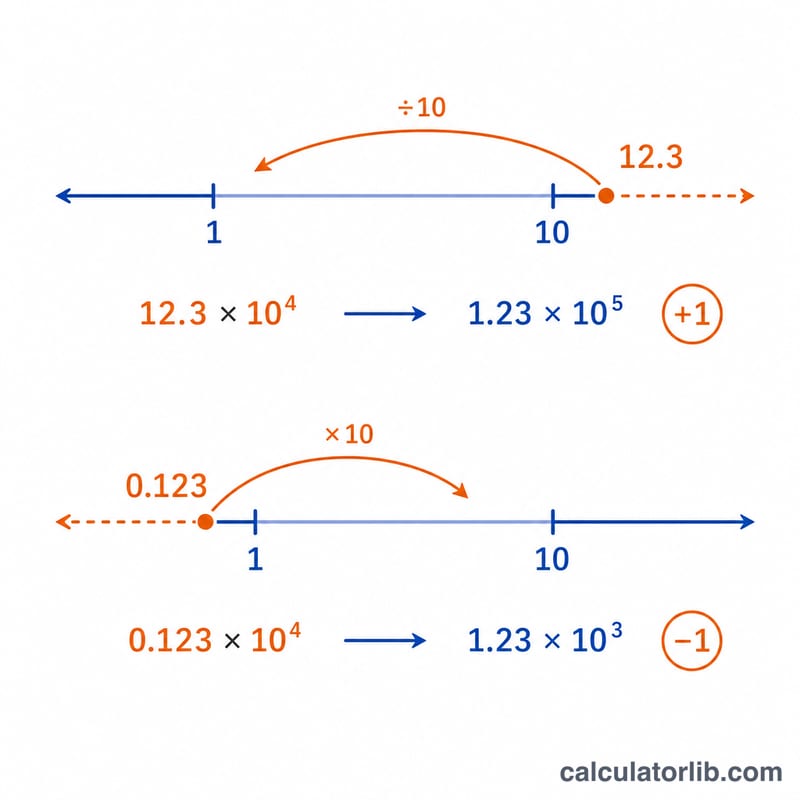
If the resulting coefficient a / b is not between 1 and 10, you shift the decimal point and adjust the exponent accordingly to reach standard form.
Worked Example
Divide \(6 \times 10^{8}\) by \(3 \times 10^{2}\). First divide the coefficients: \(6 / 3 = 2\). Then subtract the exponents: \(8 - 2 = 6\). The result is \(2 \times 10^{6}\), which equals 2,000,000. The coefficient 2 is already between 1 and 10, so no normalization is needed.
FAQ
What if the coefficient comes out greater than 10? The calculator normalizes it automatically. For example \(8 / 2 = 4\) stays as is, but \(9 / 2 = 4.5\) also stays; a value like 15 would become \(1.5 \times 10^{1}\), with the exponent increased by one.
Can the exponents be negative? Yes. Subtracting a negative exponent increases the result, exactly as the rule \(\text{m} - \text{n}\) dictates.
What happens if b is zero? Division by zero is undefined, so the calculator guards against it and returns zero rather than crashing.