
What It Does
The Multiplying Scientific Notation Calculator multiplies two numbers written in scientific notation, such as \((3 \times 10^4) \times (2 \times 10^3)\). It multiplies the coefficients, adds the exponents, and then normalizes the answer so the coefficient sits between 1 and 10 — the proper standard form used in science and engineering.
How to Use It
Enter the first number as a coefficient a and an exponent m, then the second number as coefficient b and exponent n. Press calculate. The tool shows the result in scientific notation, the plain decimal value, and the un-normalized intermediate result so you can follow each step.
The Formula Explained
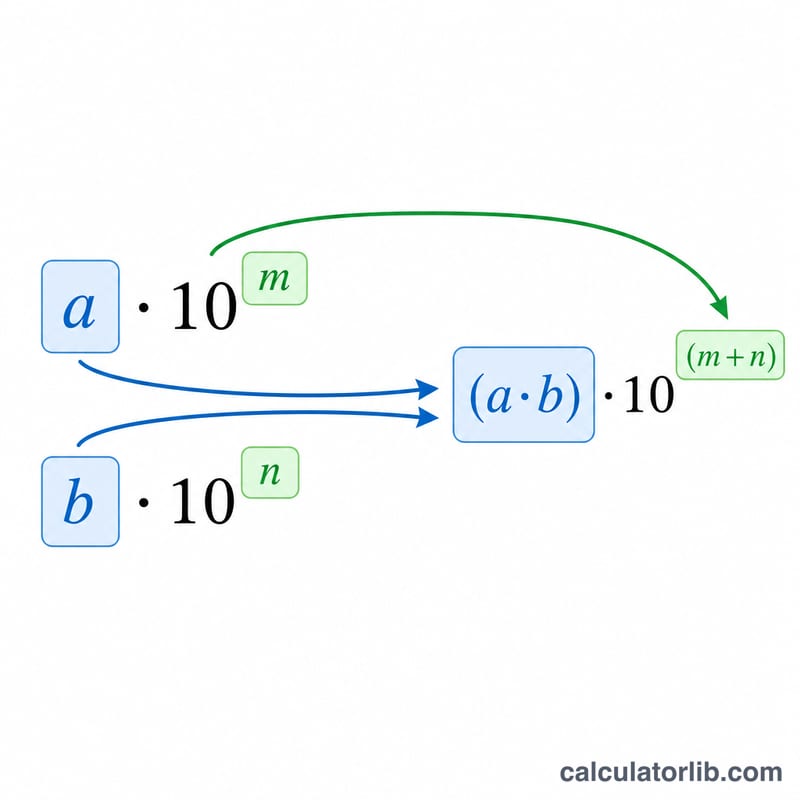
Multiplication of powers of ten follows the exponent rule:
$$\left(\text{a} \times 10^{\text{m}}\right) \times \left(\text{b} \times 10^{\text{n}}\right) = \left(\text{a} \cdot \text{b}\right) \times 10^{\text{m} + \text{n}}$$
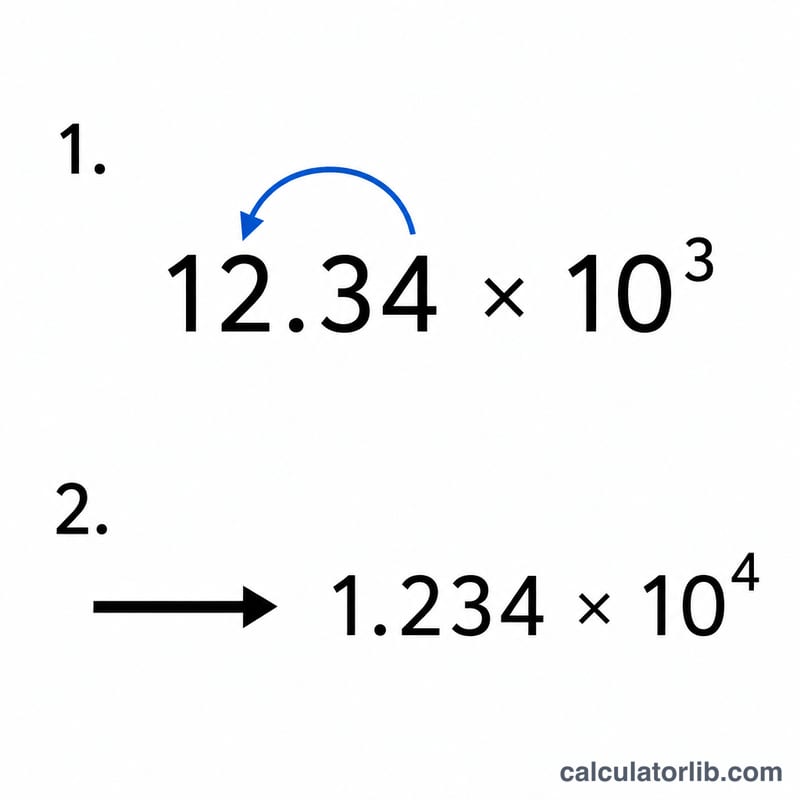
First multiply the coefficients a and b. Then add the exponents m and n, because multiplying powers with the same base adds their exponents. Finally, if the resulting coefficient is 10 or larger (or smaller than 1), shift the decimal and adjust the exponent until the coefficient is between 1 and 10.
Worked Example
Multiply \((4 \times 10^5)\) by \((3 \times 10^2)\). Multiply coefficients: \(4 \times 3 = 12\). Add exponents: \(5 + 2 = 7\). This gives \(12 \times 10^7\). Since 12 is not between 1 and 10, normalize: \(12 = 1.2 \times 10^1\), so the answer becomes \(1.2 \times 10^8\), which equals 120,000,000.
FAQ
Why add the exponents instead of multiplying them? Because \(10^{\text{m}} \times 10^{\text{n}} = 10^{\text{m}+\text{n}}\) — the product of equal bases adds the exponents.
Can I use negative exponents? Yes. Negative exponents represent small numbers (e.g. \(10^{-3} = 0.001\)), and the same rules apply.
What is normalization? Putting the result into standard scientific notation where the coefficient is at least 1 but less than 10, so answers are unambiguous and easy to compare.