
What Is Scientific Notation?
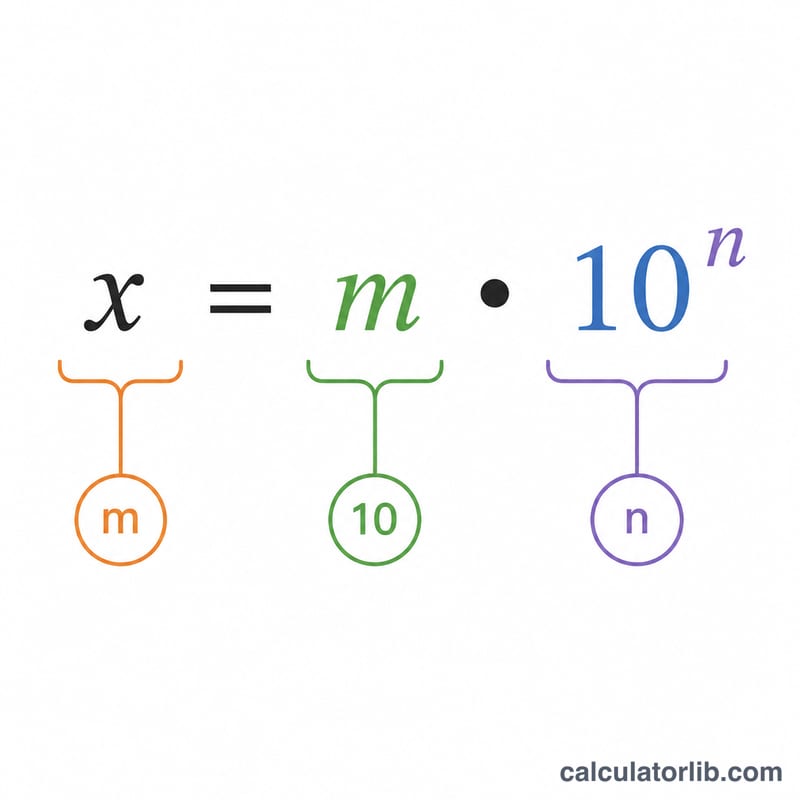
Scientific notation is a compact way to write very large or very small numbers as a product of a single-digit mantissa and a power of ten. Instead of writing 0.00000642, you write \(6.42 \times 10^{-6}\). This calculator converts any decimal or already-scientific number into the standard form $$x = m \times 10^{n}$$ where the mantissa \(m\) satisfies \(1 \le |m| < 10\) and \(n\) is an integer exponent.
How to Use This Calculator
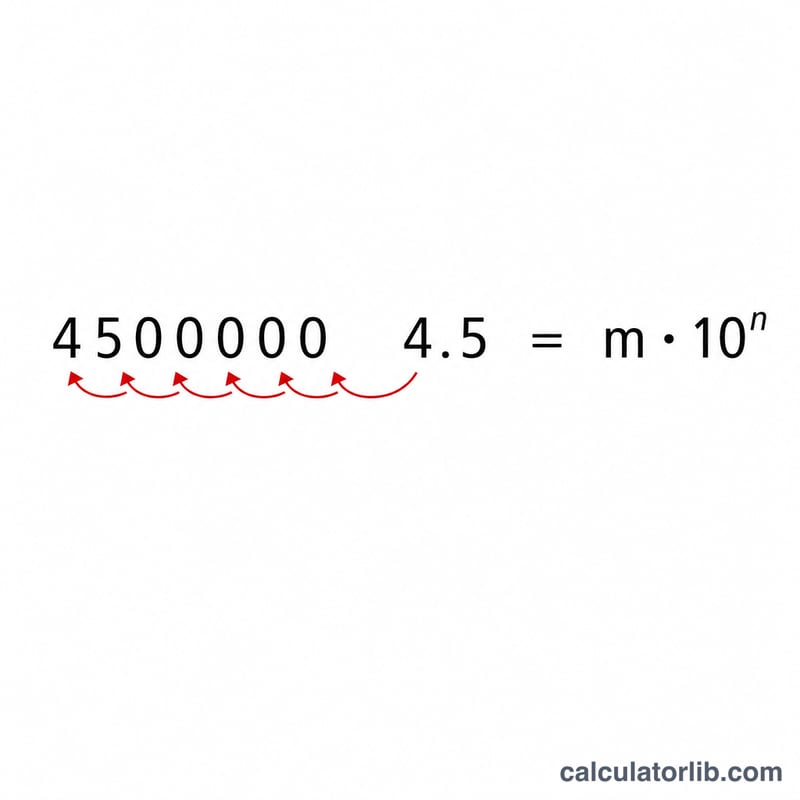
Type any number into the field — it accepts ordinary decimals like 1234.56 or 0.00042, and also values already in scientific form such as 4.2e-4. Press calculate and the tool returns the mantissa, the exponent, and the full notation. Negative numbers and numbers between 0 and 1 are handled automatically.
The Formula Explained
For a nonzero number, the exponent is found with $$n = \left\lfloor \log_{10}|x| \right\rfloor$$ the largest integer power of ten that does not exceed the magnitude of \(x\). The mantissa is then $$m = \frac{x}{10^{n}}$$ which is guaranteed to fall in the range \(1 \le |m| < 10\). The sign of the original number is carried into the mantissa.
Worked Example
Convert 1234.56. The magnitude is 1234.56, and \(\log_{10}(1234.56) \approx 3.09\), so \(n = \lfloor 3.09 \rfloor = 3\). The mantissa is \(1234.56 / 10^{3} = 1.23456\). Therefore $$1234.56 = 1.23456 \times 10^{3}$$
FAQ
What is the mantissa? It is the significant-digits part of the number, always written so its absolute value is at least 1 but less than 10.
How do small numbers work? Numbers smaller than 1 get negative exponents. For example \(0.00042 = 4.2 \times 10^{-4}\).
What does zero return? Zero cannot be written in standard scientific notation, so the calculator returns a mantissa of 0 and an exponent of 0.