
What is a quadratic inequality?
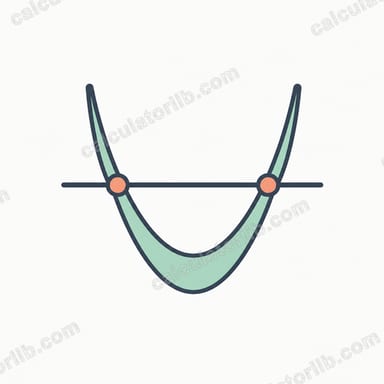
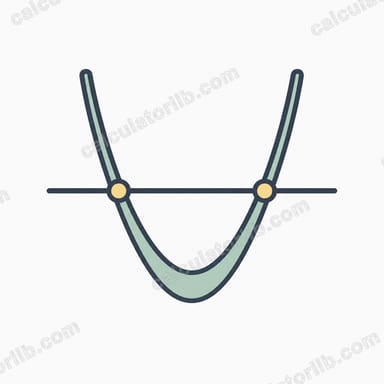
A quadratic inequality compares a quadratic expression to zero, for example \(\text{a}x^2 + \text{b}x + \text{c} > 0\). Its solution is the set of all real x-values that make the statement true. Because the graph of a quadratic is a parabola, the solution always takes one of a few shapes: two outward rays, a single bounded interval, all real numbers, a single point, or no solution at all. This is pure mathematics and works the same everywhere.
How to use this calculator
Pick the inequality sign you want applied to \(\text{a}x^2 + \text{b}x + \text{c}\), then enter the coefficients \(\text{a}\), \(\text{b}\) and \(\text{c}\). The coefficient \(\text{a}\) must be non-zero, otherwise the expression is linear and you should use a linear inequality solver instead. Choose how many significant digits to display, then read off the solution set, the discriminant, the two roots and the parabola vertex used for sketching.
The method explained
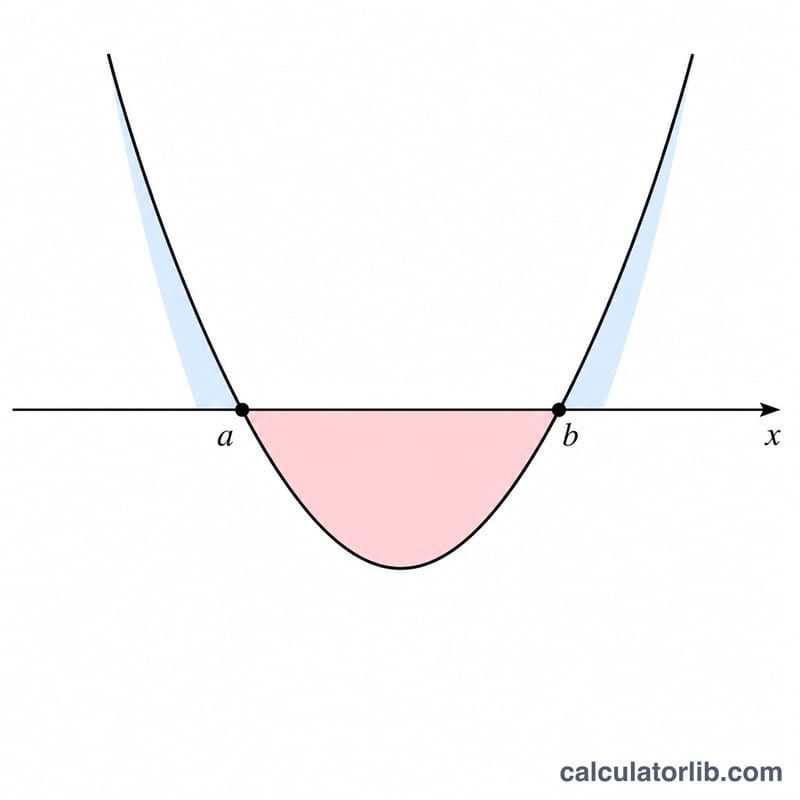
First compute the discriminant $$D = \text{b}^2 - 4\,\text{a}\,\text{c}.$$ If \(D > 0\) there are two distinct roots lo and hi; if \(D = 0\) there is one double root; if \(D < 0\) there are no real roots. Next note that the parabola opens upward when \(\text{a} > 0\) (negative strictly between the roots, positive outside) and downward when \(\text{a} < 0\) (the signs reverse). Matching the chosen sign to these regions gives the solution: outside the roots for the "greater" family, between the roots for the "less" family, with the endpoints included only for the non-strict signs (\(\ge\), \(\le\)).
Worked example
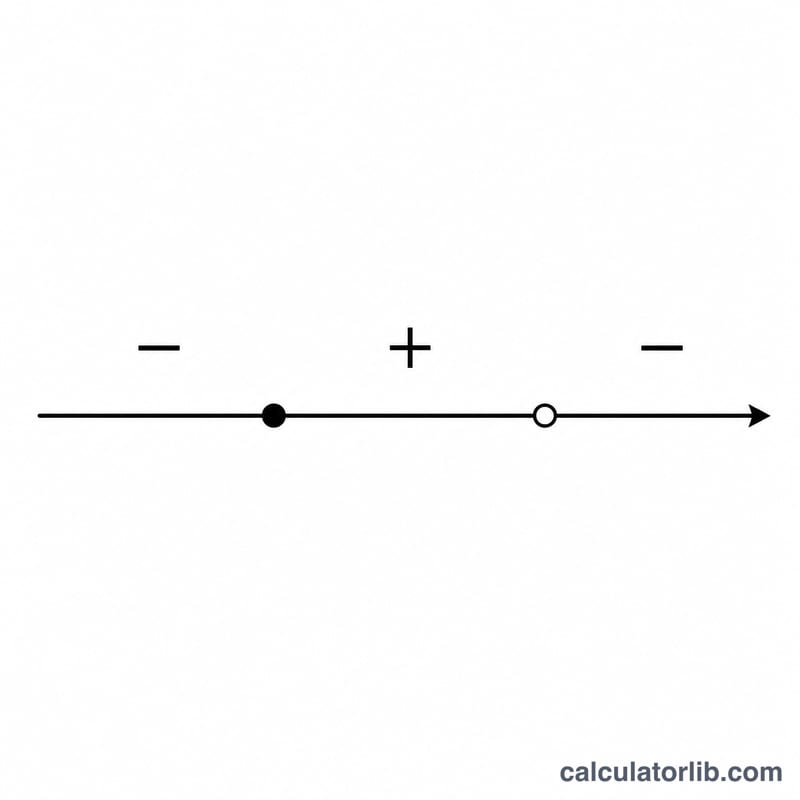
Solve \(x^2 + x - 2 > 0\). Here \(\text{a} = 1\), \(\text{b} = 1\), \(\text{c} = -2\). $$D = 1 - 4(1)(-2) = 9,$$ so \(\sqrt{D} = 3\). The roots are $$\frac{-1 - 3}{2} = -2 \quad\text{and}\quad \frac{-1 + 3}{2} = 1,$$ so \(\text{lo} = -2\), \(\text{hi} = 1\). Because \(\text{a} > 0\) and the sign is "\(>\)", the expression is positive outside the roots, giving \(x < -2\) or \(x > 1\). The vertex is at \(x = -0.5\), \(y = -2.25\).
FAQ
What happens when \(D < 0\)? The parabola never touches the x-axis. For an upward parabola the expression is always positive, so "\(>\)" and "\(\ge\)" give all real numbers while "\(<\)" and "\(\le\)" give no solution; for a downward parabola the reverse holds.
Why does the double-root case give a single point? When \(D = 0\) the parabola touches the axis at one point \(r = -\frac{\text{b}}{2\,\text{a}}\). Only the non-strict sign that matches the touching side (for example "\(\le\)" with \(\text{a} > 0\)) is satisfied there, yielding \(x = r\).
Can \(\text{a}\) be zero? No. With \(\text{a} = 0\) the expression is linear, the formula for the roots divides by zero, and the calculator asks you to use a linear inequality solver instead.