
What This Calculator Does
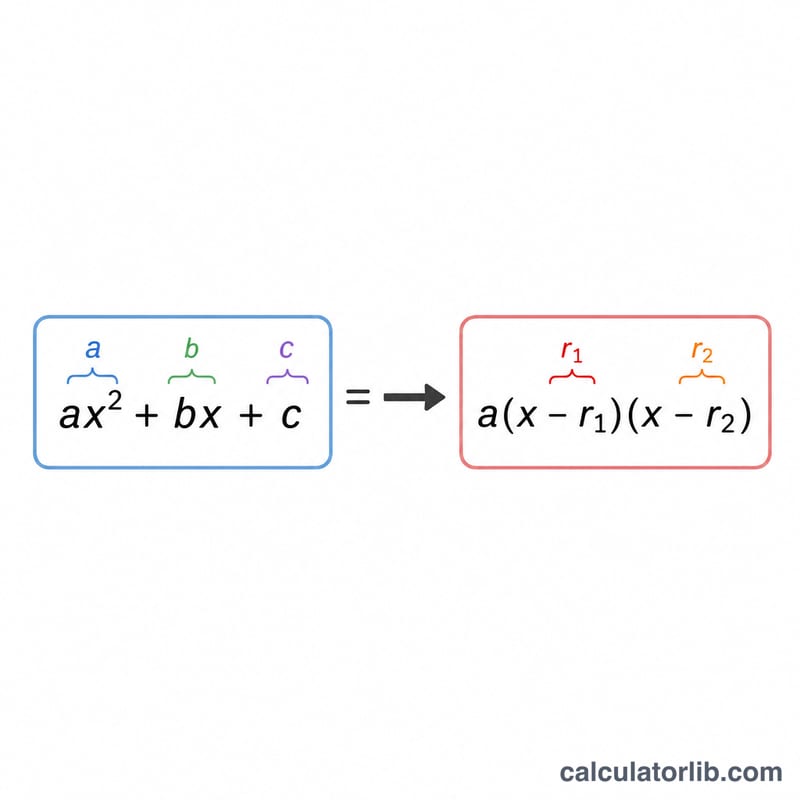
This Quadratic Factoring Calculator takes any quadratic expression of the form \(\text{a}x^{2} + \text{b}x + \text{c}\) and rewrites it as a product of binomials: \(\text{a}(x - r_{1})(x - r_{2})\). It works for any real coefficients — not just "nice" integers — by computing the roots with the quadratic formula and using them to build the factored form. It also reports the discriminant so you can tell at a glance whether the quadratic factors over the real numbers.
How to Use It
Enter the three coefficients: \(\text{a}\) (the number in front of \(x^{2}\)), \(\text{b}\) (the number in front of \(x\)), and \(\text{c}\) (the constant term). Press calculate. The tool returns the factored binomial form, both roots, and the discriminant \(\text{b}^{2} - 4\,\text{a}\,\text{c}\). If the discriminant is negative the quadratic has no real factorization, and the calculator reports the complex conjugate roots instead.
The Formula Explained
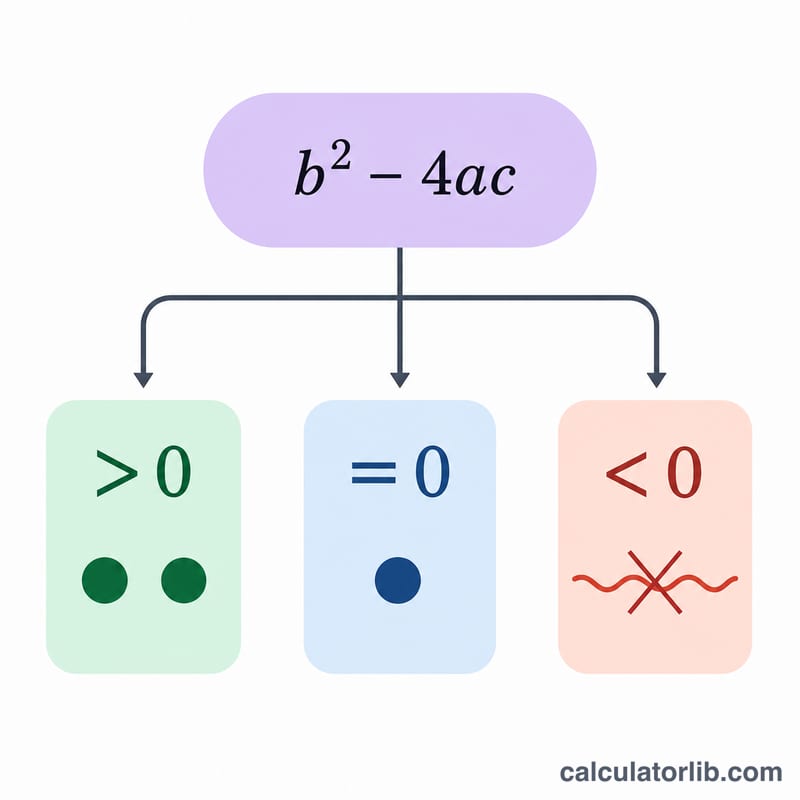
The roots come from the quadratic formula $$r = \frac{-\text{b} \pm \sqrt{\text{b}^{2} - 4\,\text{a}\,\text{c}}}{2\,\text{a}}.$$ The quantity under the square root, \(\text{b}^{2} - 4\,\text{a}\,\text{c}\), is the discriminant. When it is positive there are two distinct real roots; when it is zero there is one repeated root (a perfect square); when it is negative the roots are complex. Given the roots \(r_{1}\) and \(r_{2}\), the original quadratic equals \(\text{a}(x - r_{1})(x - r_{2})\), because expanding that product reproduces the coefficients.
Worked Example
Factor \(x^{2} - 5x + 6\). Here \(\text{a} = 1\), \(\text{b} = -5\), \(\text{c} = 6\). The discriminant is $$(-5)^{2} - 4(1)(6) = 25 - 24 = 1.$$ The roots are $$\frac{5 \pm 1}{2} = 3 \text{ and } 2.$$ So \(x^{2} - 5x + 6 = (x - 3)(x - 2)\). You can verify by multiplying: \(x^{2} - 2x - 3x + 6 = x^{2} - 5x + 6\). ✓
FAQ
What if a = 0? Then the expression is linear, not quadratic, and cannot be factored into two binomials — the calculator flags this case.
What does a negative discriminant mean? The quadratic has no real roots, so it cannot be factored using real numbers; the roots are a complex conjugate pair \(p \pm qi\).
Can the roots be fractions or decimals? Yes. Even when the factors are not whole numbers, the displayed binomial form \(\text{a}(x - r_{1})(x - r_{2})\) is exact for the given coefficients.