
What is the water vapor pressure calculator?
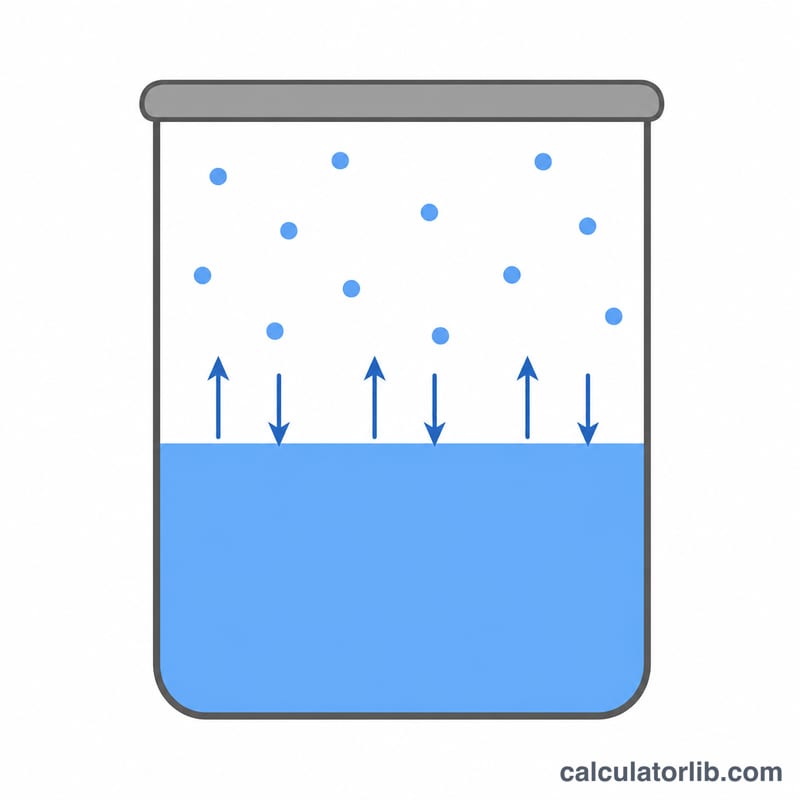
This tool computes the saturation vapor pressure of water — the pressure at which water vapor is in equilibrium with liquid water at a given temperature. It uses the widely used Tetens approximation, which is accurate over the everyday range of meteorological and engineering temperatures. Results are reported in kilopascals (kPa), hectopascals (hPa, equal to millibars), and millimeters of mercury (mmHg).
How to use it
Enter the water (or air) temperature in degrees Celsius and read off the saturation vapor pressure. Saturation vapor pressure is the maximum partial pressure water vapor can exert before it condenses; multiplying it by relative humidity (as a fraction) gives the actual vapor pressure of moist air.
The formula explained
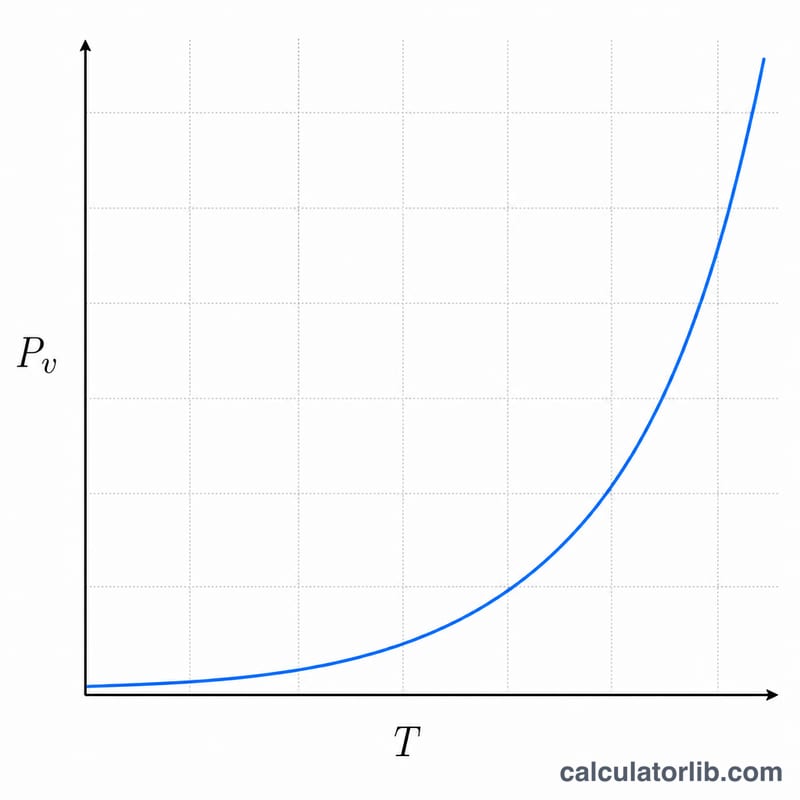
The Tetens equation is $$P_v = 0.6108 \cdot \exp\!\left(\frac{17.27 \cdot T}{T + 237.3}\right)$$ where \(P_v\) is in kPa and \(T\) is the temperature in °C. The exponential term grows rapidly with temperature, which is why warm air can hold far more moisture than cold air. The constant 0.6108 kPa is the vapor pressure at 0 °C.
Worked example
At \(T = 25\) °C: the exponent is $$\frac{17.27 \times 25}{25 + 237.3} = \frac{431.75}{262.3} = 1.6460$$ Then \(\exp(1.6460) = 5.1862\), and $$P_v = 0.6108 \times 5.1862 = 3.168 \text{ kPa}$$ That equals about 31.68 hPa (mbar) or roughly 23.76 mmHg.
FAQ
Is this for liquid water or ice? The Tetens form used here is for saturation over liquid water and is most accurate above 0 °C.
What is the difference between hPa and mbar? They are identical: 1 hPa = 1 mbar.
How do I get actual vapor pressure from this? Multiply the saturation value by the relative humidity expressed as a decimal (e.g. 60% → 0.60).