
What Is the Dilution Factor?
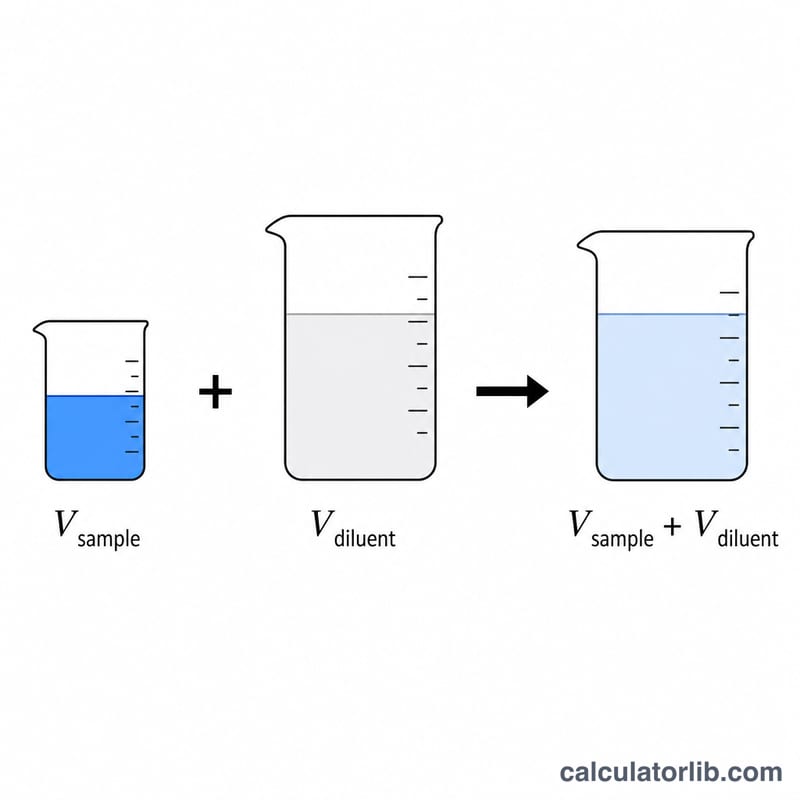
The dilution factor (DF) describes how many times a sample has been diluted. When you take a fixed volume of sample and add diluent (solvent, buffer, water, etc.), the dilution factor is the ratio of the final total volume to the original sample volume. A DF of 10 means the sample is diluted tenfold and is often written as 1:10.
How to Use This Calculator
Enter the volume of sample (the aliquot you pipetted) and the volume of diluent you added. Both volumes must be in the same units (mL, µL, L). The calculator returns the dilution factor along with the total combined volume. Because the result is a ratio, the actual units cancel out — only consistency matters.
The Formula Explained
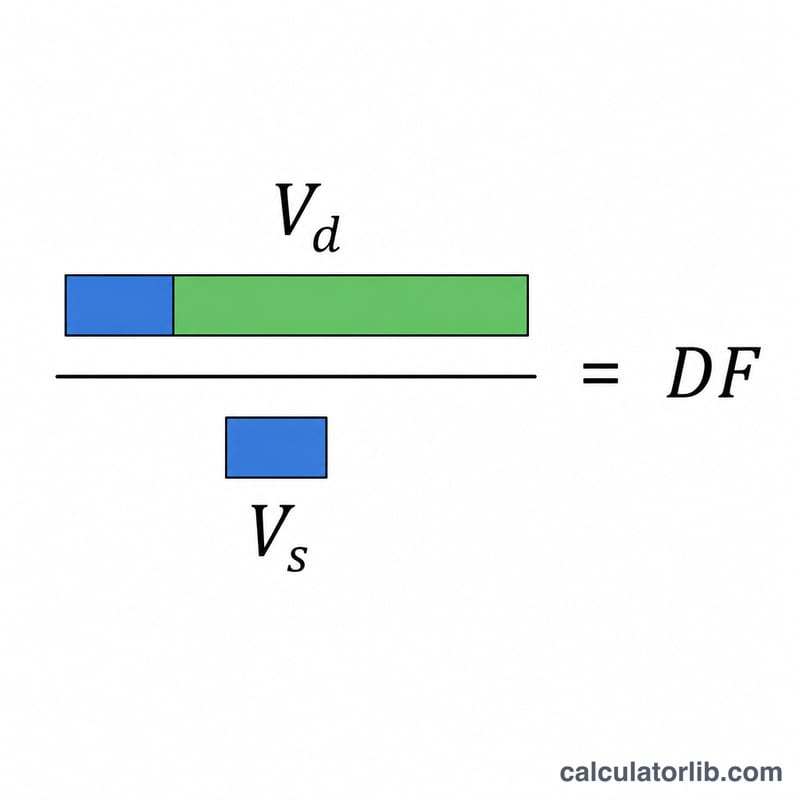
The dilution factor is calculated as:
$$\text{DF} = \frac{\text{V}_{sample} + \text{V}_{diluent}}{\text{V}_{sample}}$$
The numerator is the total volume after mixing, and the denominator is the volume of original sample. To find the diluted concentration, divide the original concentration by the dilution factor.
Worked Example
Suppose you add 1 mL of bacterial culture to 9 mL of broth. The total volume is \(1 + 9 = 10\) mL. The dilution factor is \(10 / 1 = 10\), written as a 1:10 dilution. If the original concentration was \(10^8\) cells/mL, the diluted sample is now \(10^7\) cells/mL.
FAQ
Is the dilution factor the same as the dilution ratio? Closely related. A dilution factor of 10 corresponds to a 1:10 dilution (1 part sample to 9 parts diluent, 10 total parts).
Do the units matter? No, as long as both volumes use the same unit. The dilution factor is dimensionless.
How do I find the final concentration? Divide the starting concentration by the dilution factor: \(\text{C}_{final} = \text{C}_{initial} / \text{DF}\).