
What is the Nature of Roots Calculator?
This calculator analyses any quadratic equation of the form \(ax^{2} + bx + c = 0\) and tells you what kind of solutions (roots) it has. It does this by computing the discriminant, $$D = b^{2} - 4ac,$$ which acts as a single number that decides whether the roots are real or complex without you having to solve the whole equation.
How to use it
Enter the three coefficients: a (the coefficient of \(x^{2}\)), b (the coefficient of \(x\)), and c (the constant term). The calculator returns the discriminant value, a plain-language description of the nature of the roots, and the actual root values — real or complex conjugates.
The formula explained
The discriminant is the part under the square root in the quadratic formula. Because you cannot take the real square root of a negative number, its sign tells you everything:
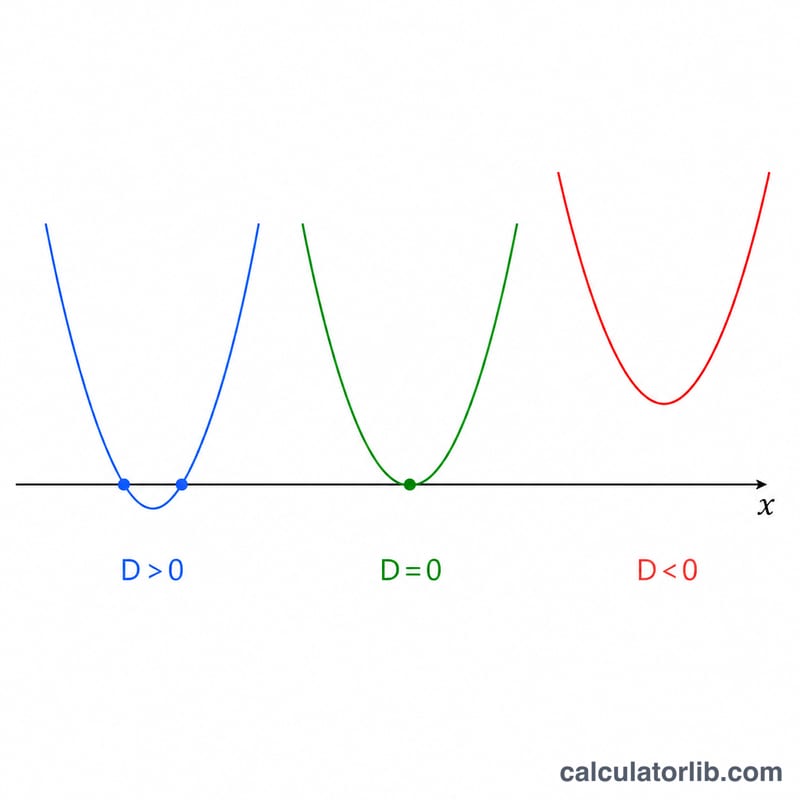
\(D > 0\): two distinct real roots. \(D = 0\): one real root repeated twice (the parabola just touches the x-axis). \(D < 0\): no real roots — instead two complex conjugate roots of the form \(p \pm qi\).
Worked example
For \(x^{2} - 5x + 6 = 0\) we have \(a = 1\), \(b = -5\), \(c = 6\). Then $$D = (-5)^{2} - 4(1)(6) = 25 - 24 = 1.$$ Since \(D > 0\), there are two distinct real roots: $$x = \frac{5 \pm 1}{2},$$ giving \(x = 3\) and \(x = 2\).
FAQ
What if \(a = 0\)? Then the equation is linear, not quadratic, and the discriminant does not apply — the calculator flags this case.
Can the discriminant be a fraction or decimal? Yes. Any real coefficients are allowed, so \(D\) can be any real number.
What are complex conjugate roots? When \(D < 0\) the two roots share the same real part and have opposite imaginary parts, written as \(p + qi\) and \(p - qi\).