
What is potential alcohol?
Potential alcohol (PA) is the maximum alcohol by volume (% ABV) a wine, mead, or fruit wine could reach if all of the fermentable sugar in the must were converted to alcohol — that is, fermented down to a final gravity of roughly 1.000. It is calculated from the starting sugar concentration, measured either as specific gravity with a hydrometer or as Brix with a refractometer.
How to use this calculator
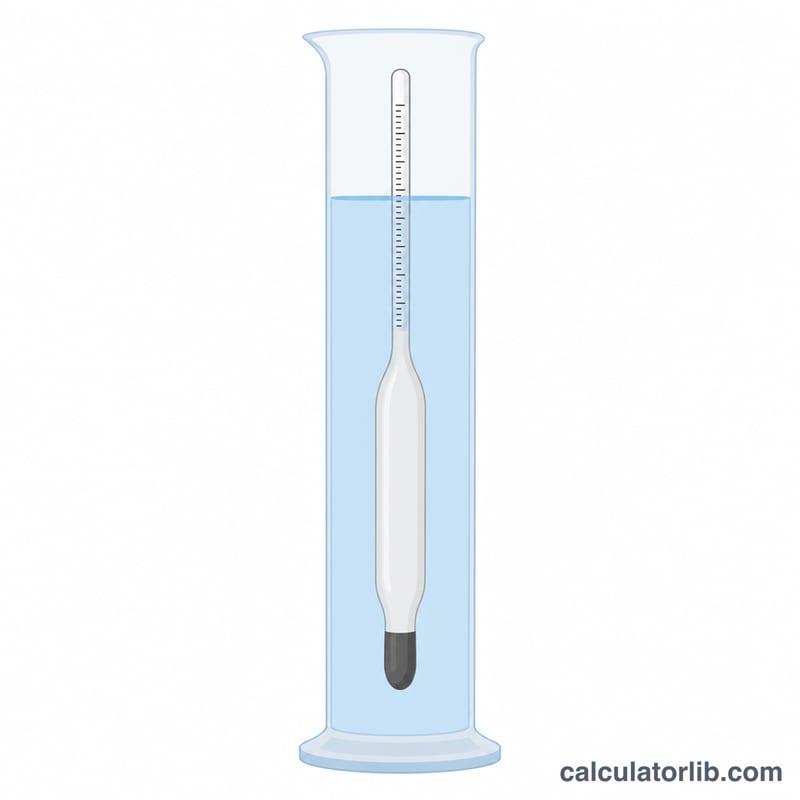
Choose your measurement type. If you used a hydrometer, select Specific Gravity and enter your original gravity reading (for example 1.090). If you used a refractometer, select Brix and enter the degrees Brix (for example 22). The calculator converts Brix to specific gravity automatically, then estimates the potential ABV.
The formula explained
The widely used winemaking estimate is
$$\text{potential ABV} = \left( \text{OG} - 1 \right) \times 131.25$$where OG is the original specific gravity. The factor 131.25 comes from the relationship between sugar density and the alcohol it produces. For Brix readings, the value is first converted to specific gravity using
$$\text{SG} = 1 + \dfrac{B}{258.6 - (B/258.2) \times 227.1}$$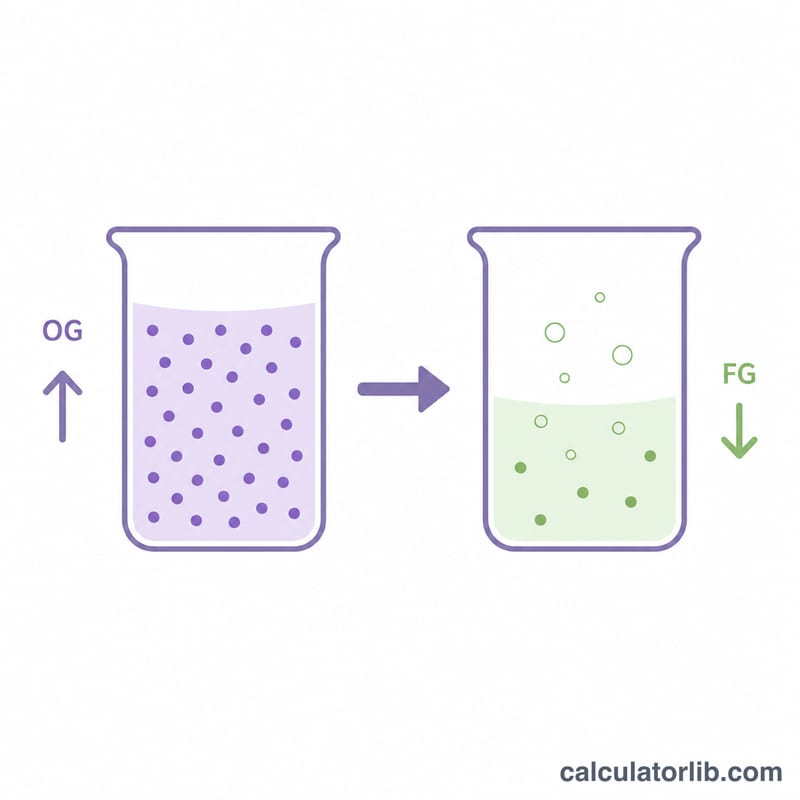
Worked example
Suppose your must reads 1.090 on the hydrometer. Then
$$\text{ABV} \approx \left( 1.090 - 1 \right) \times 131.25 = 0.090 \times 131.25 = 11.81\% \text{ ABV}$$If the wine actually finishes at 1.000 you would expect close to that figure; a sweeter finish (higher final gravity) yields less alcohol.
FAQ
Is this exact? No — it is a practical estimate. Real ABV depends on yeast efficiency, temperature, and the actual final gravity. For precision, take both an original and final gravity reading.
Does it assume the wine ferments dry? Yes. The result is the alcohol you would get if the final gravity reached 1.000. A residual-sweet wine will be lower.
Why convert Brix to SG? The 131.25 formula is defined in terms of specific gravity, so a Brix reading must be converted first for an accurate result.