
What Is Water Potential?
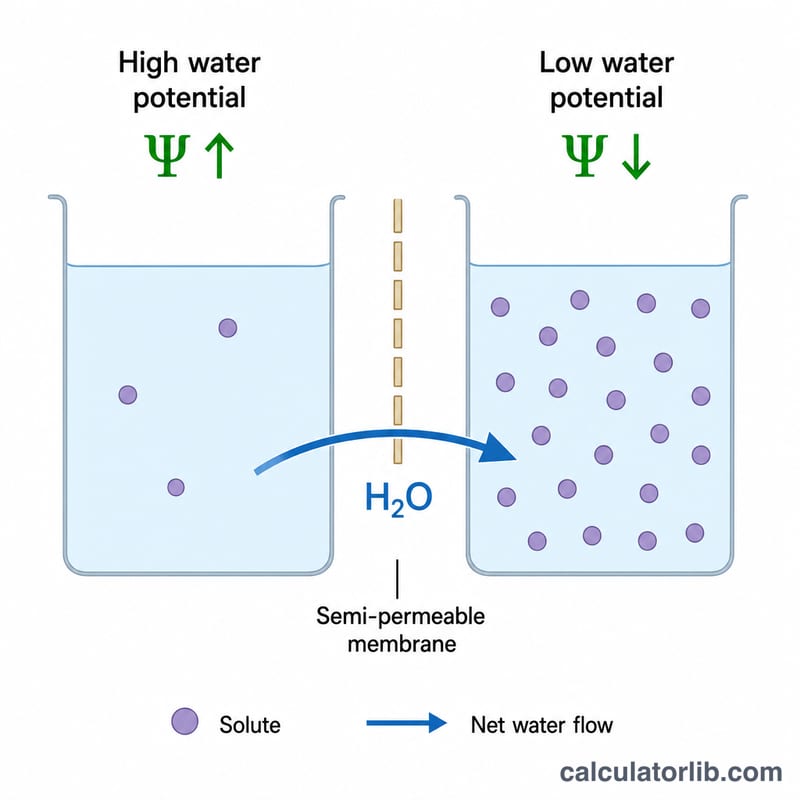
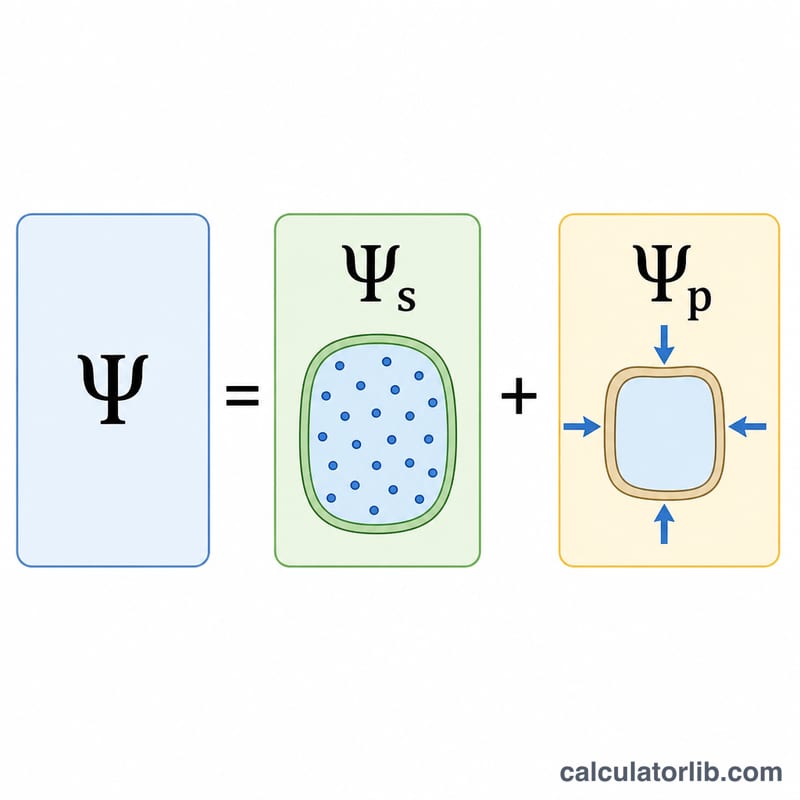
Water potential (\(\Psi\)) measures the potential energy of water per unit volume relative to pure water at standard conditions. It predicts the direction water will move: water always flows from a region of higher (less negative) water potential to one of lower (more negative) water potential. In plant biology it explains how water moves from soil into roots, up through xylem, and out of leaves. Water potential is measured in bars or megapascals (this calculator uses bars).
How to Use This Calculator
Enter the ionization constant (\(i\)) of the solute, the molar concentration \(C\) in mol/L, the temperature in degrees Celsius, and the pressure potential \(\Psi_p\) in bars. The tool converts temperature to kelvin, computes the solute potential with \(\Psi_s = -iCRT\), and adds the pressure potential to give the total water potential \(\Psi\).
The Formula Explained
The governing equations are $$\Psi = \Psi_s + \Psi_p$$ and $$\Psi_s = -iCRT$$ where \(i\) is the ionization (van 't Hoff) constant, \(C\) is molar concentration (mol/L), \(R\) is the pressure constant \(0.0831\ \text{L}\cdot\text{bar}/(\text{mol}\cdot\text{K})\), and \(T\) is temperature in kelvin (\(\degree\text{C} + 273\)). The solute potential is always zero or negative because dissolving solutes lowers water potential. Pressure potential is usually positive inside turgid plant cells and can be negative in xylem under tension.
Worked Example
Suppose a sucrose solution (\(i = 1\)) at \(0.15\) mol/L and \(22\ \degree\text{C}\) with no added pressure (\(\Psi_p = 0\)). Convert temperature: $$22 + 273 = 295\ \text{K}$$ Then $$\Psi_s = -(1)(0.15)(0.0831)(295) = -3.677\ \text{bar}$$ With \(\Psi_p = 0\), the total $$\Psi = -3.677 + 0 = -3.677\ \text{bar}$$
FAQ
What value of i should I use? Use \(i = 1\) for non-ionizing solutes like sucrose or glucose. For NaCl use \(i \approx 2\) (it dissociates into Na⁺ and Cl⁻), and for CaCl₂ use \(i \approx 3\).
Why is solute potential negative? Adding solutes reduces the free energy of water, so \(\Psi_s\) lowers water potential below zero. Pure water has \(\Psi = 0\).
Which value of R is used? This tool uses \(R = 0.0831\ \text{L}\cdot\text{bar}/(\text{mol}\cdot\text{K})\) so results come out in bars. Multiply bars by \(0.1\) to convert to megapascals (MPa).